Lost time injury (LTI): Finger injury during main engine exhaust valve overhaul
- Safety Flash
- Published on 7 November 2017
- Generated on 15 September 2026
- IMCA SF 28/17
- 3 minute read
An engineer suffered a crushed finger when there was an unplanned movement of a main engine exhaust valve during maintenance.
What happened?
An engineer suffered a crushed finger when there was an unplanned movement of a main engine exhaust valve during maintenance. The second engineer and a fitter were working together on the overhaul of a main engine exhaust valve. After completion, the valve was tested with compressed air. Once the air was shut off and the seat descended, the second engineer noticed some dirt on the face of the seat. He instructed the fitter to stand clear using hand signals, and attempted to clean the dirt with a rag. At that moment, the fitter opened the air and the seat face moved upwards, crushing the second engineer’s finger as he attempted to remove his hand.
The vessel had to deviate from its course to the nearest port to disembark the injured person for further treatment ashore, to substantial cost. The engineer suffered an LTI and loss of his fingertip.
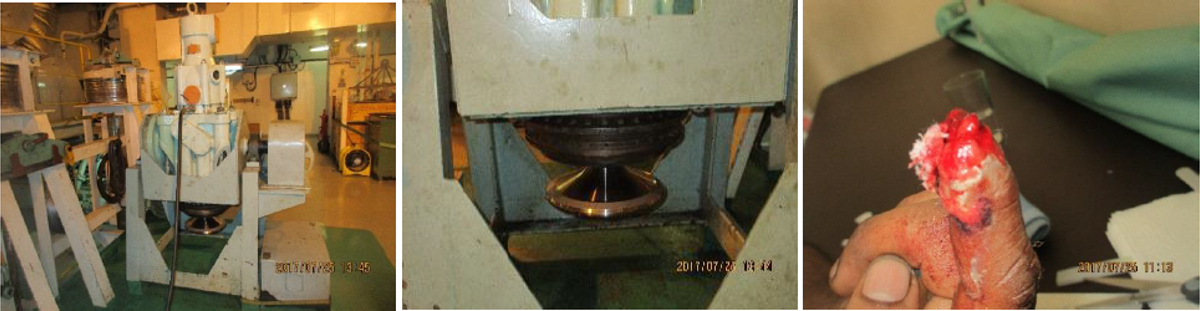
A risk assessment had been reviewed and a toolbox talk had been carried out prior to the overhaul. It was not clear that communication with hand signals had been discussed at this stage. In the preceding weeks, the same team had undertaken overhaul of three similar exhaust valves.
What went wrong? What were the causes?
Some of the immediate causes were found to be:
- Poor communication – although in plain sight of each other the noise of the engine room meant that verbal communication was not possible between the second engineer and the fitter. The fitter didn’t see or understand the hand signals from the second engineer, and the reopening of the valve was not communicated to the second engineer.
- Hand placed in dangerous position ‘in the line of fire’.
- Following the successful test of the overhauled valve, the compressed air was not disconnected prior to second engineer cleaning the face – crew were servicing equipment that was still in operation.
- Inadequate planning – there was a failure to disconnect the compressed air prior to cleaning the face.
- Hazardous environmental condition – noisy engine room.
The root causes were found to be:
- There was no adequate system of communication and confirmation during operations in noisy
environment was not identified during risk assessment neither discussed in the toolbox talk. - There was no isolation (lockout/tagout).
- Inadequate compliance – the risk in this routine, recurring task was seen as tolerable.
Actions
- Develop method of communications in noisy work environment and ensure this is included in risk assessment.
- Review/familiarisation of crew on company lockout/tagout procedures.
Members may wish to refer to the Related Safety Flashes below (all are similar to the above though not identical.; poor planning and risk assessment, inadequate communications and inadequate procedures, and hand positioning, have led in all these cases to serious hand injuries).
Related Safety Flashes
-
IMCA SF 08/17
12 April 2017
-
-
IMCA SF 19/16
12 July 2016
-
IMCA SF 08/16
13 April 2016
-
IMCA SF 13/11
25 November 2011
IMCA Safety Flashes summarise key safety matters and incidents, allowing lessons to be more easily learnt for the benefit of the entire offshore industry.
The effectiveness of the IMCA Safety Flash system depends on the industry sharing information and so avoiding repeat incidents. Incidents are classified according to IOGP's Life Saving Rules.
All information is anonymised or sanitised, as appropriate, and warnings for graphic content included where possible.
IMCA makes every effort to ensure both the accuracy and reliability of the information shared, but is not be liable for any guidance and/or recommendation and/or statement herein contained.
The information contained in this document does not fulfil or replace any individual's or Member's legal, regulatory or other duties or obligations in respect of their operations. Individuals and Members remain solely responsible for the safe, lawful and proper conduct of their operations.
Share your safety incidents with IMCA online. Sign-up to receive Safety Flashes straight to your email.