Common mode failure of DGNSS
- DP Event
- Published on 2 November 2017
- Generated on 14 November 2026
- DPE 04/17
- 2 minute read
Undesired event
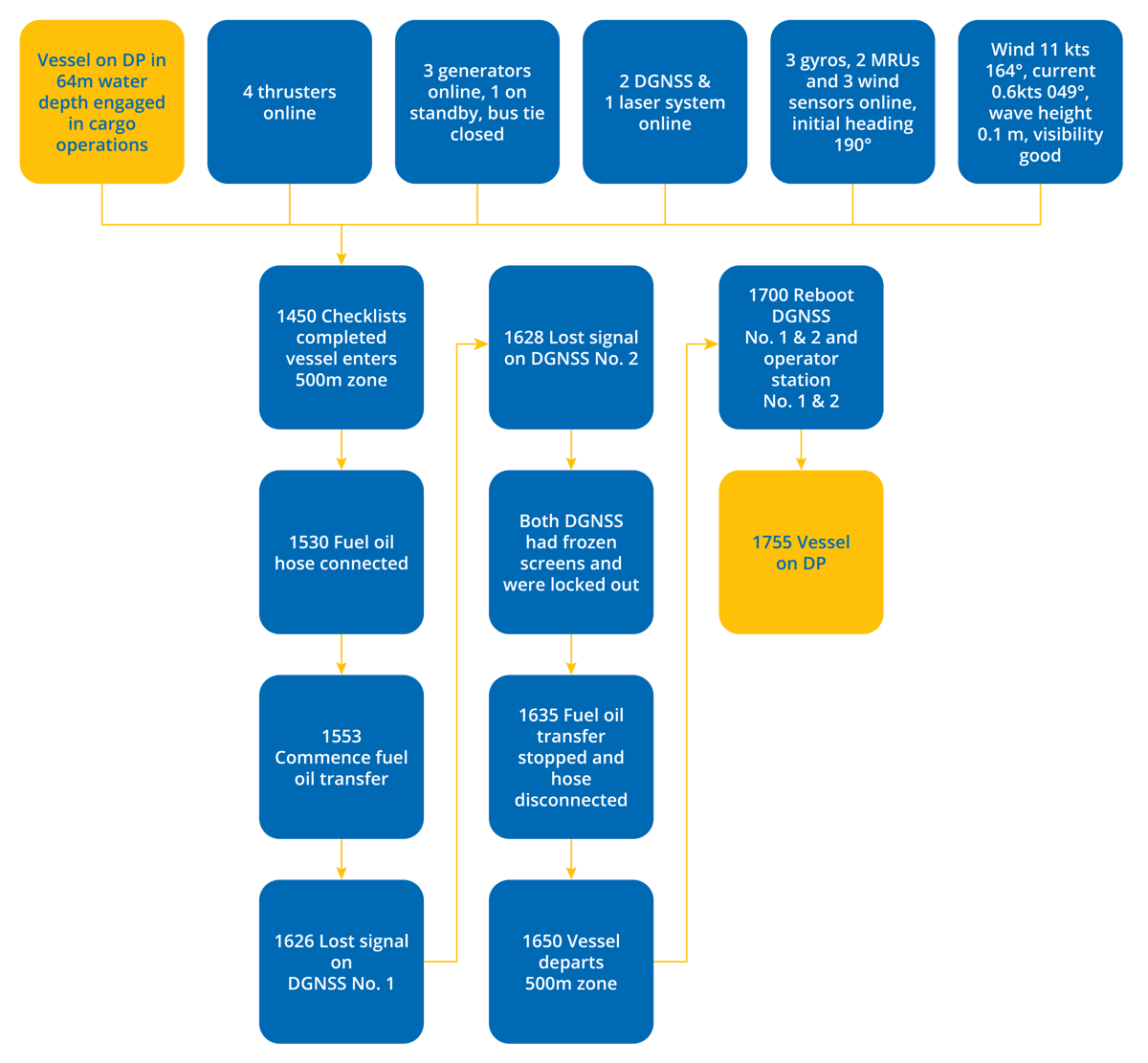
With both systems suffering issues at the same time, it pointed towards a common factor with the likely cause signal interference.
Comments
Both DGNSS systems had locked up, the touch screen was not responding and the NMEA signal was no longer being received, the DP system alarm displayed ‘Telegram timeout’.
The GNSS manufacturer concluded that with both systems suffering issues at the exact same time it pointed towards a common factor, the likely root cause was signal interference.
Recommendations included:
- Ensure the antenna, cables, and connectors are in a good condition, and no damage to them.
- Tune the MF module on each set to different MF stations.
- Check if both systems are utilising the same Precise Point Positioning service; if so, consider changing one of them.
- Copy the configuration files for reference.
- If a further crash occurs take pictures of the system screens as there may be additional windows error messages.
Considerations
- The DP system worked as designed, the vessel departed the 500m zone, for investigation, on DP using the laser system as reference.
- The root cause of the problem was not found however it was believed to be a common mode failure.
- Most DGNSS suppliers have a function available to check for shadow of satellites, users would be wise to make proper use of this tool.
- Improvement measure would be to use two different DGNSS suppliers and different differential position services.
Latest DP incidents
-
Watch what you are pressing
While transiting away from a wind farm, the Master of a DP equipment class 2 vessel observed that the vessel was operating in Backup Mode and queried this with the bridge team and attending electrician
DPE 03/26
19 October 2026
Incident
-
The domino effect
The event demonstrates the importance of maintaining the approved DP power configuration, addressing known defects before equipment is relied upon during DP operations, and ensuring DP personnel understand how changes to the generating arrangement can affect redundancy and failure propagation
DPE 03/26
19 October 2026
Incident
-
Lost in calibration
During activity associated with calibration of a vessel Vertical Reference Unit (VRU), the DP control system experienced degradation of its attitude reference arrangement. Shortly afterwards, the vessel generated an Off Position Warning followed by an Off Position Alarm
DPE 03/26
19 October 2026
Incident
-
The UPS and downs
While a vessel was transiting in DP mode, the DPO observed the loss of Gyros 2 and 3 together with alarms from a 230V backup power supply. The telephone system remained powered but was inoperable.
DPE 03/26
19 October 2026
Incident
-
DP drill scenario – Consequence Analysis Class DP2 & DP3
DP drill scenario – Consequence Analysis Class DP2 & DP3
DPE 03/26
19 October 2026
Drill Scenario
The case studies and observations above have been compiled from information received by IMCA. All vessel, client, and operational data has been removed from the narrative to ensure anonymity. Case studies are not intended as guidance on the safe conduct of operations, but rather to assist vessel managers, DP operators, and technical crew.
IMCA makes every effort to ensure both the accuracy and reliability of the information, but it is not liable for any guidance and/or recommendation and/or statement herein contained.
Any queries should be directed to DP team at IMCA. Share your DP incidents with IMCA online. Sign-up to receive DP event bulletins straight to your email.