Holding position, losing references
- DP Event
- Published on 1 September 2026
- Generated on 17 October 2026
- DPE 02/26
- 3 minute read
Observation
Overview
A DP equipment class 2 vessel was conducting an approach to a turret-moored, weather-vaning offshore installation (FPSO), in preparation for cargo operations.
Two DGNSS units were established as Absolute Position Reference Systems. Radius and CyScan were established as Relative Position Reference Systems, operating in mobile target mode, with the vessel in Follow Target/Track mode.
What happened?
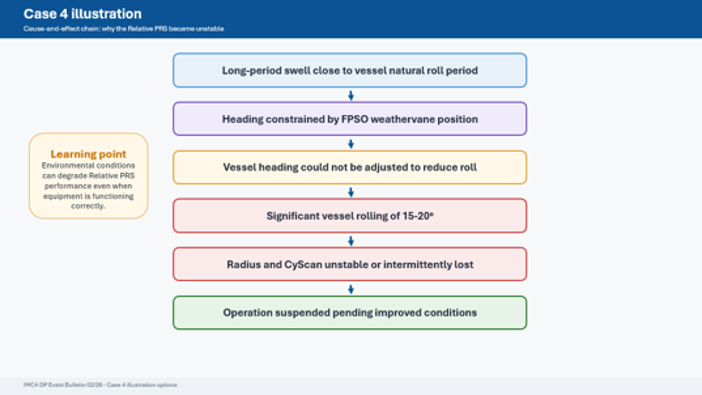
During the final approach, with both Relative PRS successfully established, the vessel experienced significant rolling of up to 15–20° due to a long-period swell close to the vessel’s natural roll period, resulting in a resonance effect.
As the vessel’s heading was fixed relative to the FPSO’s weathervane position, the relative heading to the swell could not be independently adjusted to reduce rolling. Both Relative PRS (Radius and CyScan) became unstable and were intermittently lost as a result of the excessive motion. The vessel moved away from the FPSO, where motions immediately reduced and the vessel became stable.
Absolute PRS remained available throughout the event. However, the operation required reliable Relative PRS for close proximity cargo operations, and therefore continuation of the approach was not considered acceptable following repeated loss of Radius and CyScan.
A second approach was attempted; however, the same excessive rolling and loss of the Relative PRS occurred during the final approach, as the FPSO’s weathervane position relative to the swell remained similarly unfavourable. The operation was suspended pending improvement of the sea conditions.
Findings
The vessel encountered a long-period swell with characteristics close to the vessel's natural rolling period. This resulted in significant roll motions during the final approach. Because the operation required the vessel to maintain a fixed heading relative to the weathervane installation, the vessel's heading could not be adjusted independently to reduce the effects of the swell.
As vessel motions increased, both relative position reference systems became unstable and were intermittently lost. Although the absolute position reference systems remained healthy throughout the event, degradation of the relative systems reduced confidence in continuing the operation. Repeating the approach produced similar results, confirming that the issue was linked to the prevailing environmental conditions and operational constraints rather than equipment malfunction.
Key findings
- Excessive rolling was caused by environmental conditions rather than equipment failure.
- The installation's weathervane behaviour constrained heading management options.
- Both relative position reference systems suffered intermittent degradation due to vessel motion.
- Absolute position reference systems remained stable throughout the event.
- A repeat approach validated the original observations and supported operational decision-making.
Conclusion
The event serves as a reminder that successful DP operations depend not only on equipment functionality but also on understanding the interaction between environmental conditions, vessel characteristics and operational constraints.
When vessel motion approaches levels that can adversely affect sensor performance, early recognition and conservative decision-making are essential. In this case, suspending operations until conditions improved prevented further escalation and ensured risks remained adequately controlled.
The key learning point is the interaction between:
- environmental conditions
- vessel response
- FPSO weathervane behaviour
- degradation of relative PRS performance rather than equipment failure.
Primary references
- IMCA M252 – Guidance on position reference systems and sensors for DP operations
- IMCA M103 – Guidelines for the design and operation of dynamically positioned vessels
- IMCA M220 – Recommended practice on operational activity planning
Useful supporting reference
- IMCA M159 – Guidance on thruster-assisted station keeping by FPSOs and similar turret-moored vessels
Latest DP incidents
-
Know your equipment, or at least where to find the answers
During an update in the Follow Target Mode, the crew noticed an anomaly with joystick control.
DPE 02/26
1 September 2026
Observation
-
New equipment, unexpected consequences
During the operation, a loss of DGNSS correction signals was experienced across multiple vessel DGNSS units.
DPE 02/26
1 September 2026
Incident
-
A chain of small failures leads to a major consequence
While conducting cargo operations on DP a vessel experienced a partial blackout caused by an unexpected shutdown of generator 3
DPE 02/26
1 September 2026
Incident
-
Holding position, losing references
While approaching a turret-moored, weather-vaning offshore installation (FPSO), in preparation for cargo operations, a DP equipment class 2 vessel experienced significant rolling of up to 15–20° due to a long-period swell close to the vessel’s natural roll period, resulting in a resonance effect
DPE 02/26
1 September 2026
Observation
-
DP drill scenario – Loss of seawater cooling pump redundancy
Exercise scenario – Loss of seawater cooling pump redundancy
DPE 02/26
1 September 2026
Drill Scenario
The case studies and observations above have been compiled from information received by IMCA. All vessel, client, and operational data has been removed from the narrative to ensure anonymity. Case studies are not intended as guidance on the safe conduct of operations, but rather to assist vessel managers, DP operators, and technical crew.
IMCA makes every effort to ensure both the accuracy and reliability of the information, but it is not liable for any guidance and/or recommendation and/or statement herein contained.
Any queries should be directed to DP team at IMCA. Share your DP incidents with IMCA online. Sign-up to receive DP event bulletins straight to your email.