New equipment, unexpected consequences
- DP Event
- Published on 1 September 2026
- Generated on 16 October 2026
- DPE 02/26
- 3 minute read
Incident
Overview
A DP equipment class 2 vessel was conducting subsea operations with two remotely operated vehicles (ROVs) deployed. The vessel was operating with three DGPS position reference systems only selected to DP.
The vessel was maintaining a safe distance from nearby infrastructure, operating in conditions of 2m wave height, 14 knots of wind and a DP current of 2.3 knots.
6 of the 7 thrusters were selected and 4 of the 6 generators running and connected to an open bus.
What happened?
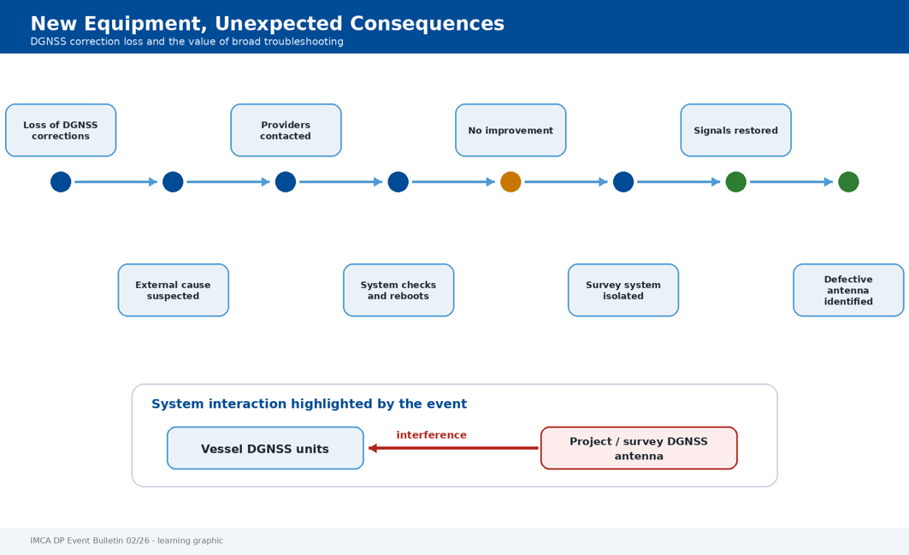
During the operation, a loss of DGNSS correction signals was experienced across multiple vessel DGNSS units.
At 14:47 LT, a loss of DGNSS corrections was experienced on DGPS No. 1 and DGPS No. 2. DGPS No. 3 continued receiving corrections, but only intermittently.
The DPO notified the relevant departments, operations were ceased and the ROV was released and moved clear of the pumping unit. The ROV was landed on the seabed to ensure a stable and reliable acoustic position reference.
The combination of the degraded DGPS No. 3 signal and the HPR system provided sufficient redundancy to maintain vessel position during the event, allowing time to investigate the loss of DGNSS corrections.
Findings
The initial symptoms suggested the possibility of an external influence affecting DGNSS correction services. Discussions with correction providers indicated elevated solar activity in the region, while troubleshooting measures were undertaken onboard.
The onboard Survey Team was consulted to verify whether their DGNSS units (two independent DGNSS systems separate from the vessel’s DGNSS) were receiving corrections normally. The surveyor also reported a drastic degradation of their correction signal. However, other vessels operating in the same field were contacted, and none of their units were experiencing any loss of DGNSS corrections.
With support from the DGNSS correction provider, several troubleshooting actions were carried out on the vessel’s systems, including rebooting the demodulator, replacing the antenna, swapping antennas, and reconfiguring constellations and frequencies.
Further investigation identified that an independently operated survey DGNSS system was generating interference that affected the vessel's DGNSS equipment. Isolation testing confirmed that a recently installed survey antenna was causing interference to all three vessel DGNSS units. Once the survey equipment was disconnected, normal DGNSS functionality was immediately restored. Subsequent testing identified defective newly installed antennas as the source of the problem.
Key findings
- Initial assumptions focused on external influences rather than onboard sources.
- Multiple troubleshooting activities were completed before interference testing was considered.
- Recently installed equipment had not previously exhibited any obvious faults.
- Independent systems operating onboard can adversely affect critical DP-related equipment.
- Sufficient position reference redundancy remained available throughout the event, allowing operations to be safely managed.
Conclusion
The event demonstrates the importance of adopting a structured and systematic troubleshooting process. Although external causes appeared credible, particularly during a period when scintillation and jamming were commonplace, standard fault finding should also thoroughly consider the possibility of hardware failure. The root cause was ultimately traced to onboard equipment interference.
The incident highlights the value of considering all recently installed or modified systems during fault investigations and reinforces the need to verify compatibility between vessel and project equipment before commencing operations.
Primary references
- IMCA M103 – Guidelines for the design and operation of dynamically positioned vessels
- IMCA M220 – Recommended practice on operational activity planning
- IMCA M252 – Guidance on position reference systems and sensors for DP operations
Additional reference
- IMCA HSS001 – Guidelines for management of change
Latest DP incidents
-
Know your equipment, or at least where to find the answers
During an update in the Follow Target Mode, the crew noticed an anomaly with joystick control.
DPE 02/26
1 September 2026
Observation
-
New equipment, unexpected consequences
During the operation, a loss of DGNSS correction signals was experienced across multiple vessel DGNSS units.
DPE 02/26
1 September 2026
Incident
-
A chain of small failures leads to a major consequence
While conducting cargo operations on DP a vessel experienced a partial blackout caused by an unexpected shutdown of generator 3
DPE 02/26
1 September 2026
Incident
-
Holding position, losing references
While approaching a turret-moored, weather-vaning offshore installation (FPSO), in preparation for cargo operations, a DP equipment class 2 vessel experienced significant rolling of up to 15–20° due to a long-period swell close to the vessel’s natural roll period, resulting in a resonance effect
DPE 02/26
1 September 2026
Observation
-
DP drill scenario – Loss of seawater cooling pump redundancy
Exercise scenario – Loss of seawater cooling pump redundancy
DPE 02/26
1 September 2026
Drill Scenario
The case studies and observations above have been compiled from information received by IMCA. All vessel, client, and operational data has been removed from the narrative to ensure anonymity. Case studies are not intended as guidance on the safe conduct of operations, but rather to assist vessel managers, DP operators, and technical crew.
IMCA makes every effort to ensure both the accuracy and reliability of the information, but it is not liable for any guidance and/or recommendation and/or statement herein contained.
Any queries should be directed to DP team at IMCA. Share your DP incidents with IMCA online. Sign-up to receive DP event bulletins straight to your email.