Broken right hand index finger
- Safety Flash
- Published on 27 January 2011
- Generated on 23 October 2026
- IMCA SF 01/11
- 3 minute read
A Member has reported an incident in which a worker broke the index finger on his right hand.
What happened?
A member has reported an incident in which a worker broke the index finger on his right hand. During a maintenance period it became necessary to deballast a methanol tank. As a result of the envisaged high work load there were three chief officers onboard and additional staff. The senior chief officer instructed the second chief officer to de-ballast the starboard tank through the port manifold Avery Hardoll connection to sea. It was known that the non-return valve (NRV) was not in place.
The second chief officer had noted on the previous day that the line was open and the Avery Hardoll cap was off, and therefore he started the pump. However, there was immediate back pressure showing on the gauge and no discharge was noted. The second chief officer concluded that the Avery Hardoll cap must in fact have still been on the line and so a deckhand was instructed to remove the cap. The deckhand stood to one side, and tried to move the cap by hand but was unsuccessful and therefore tapped it with a hammer. The cap was ejected from the manifold and struck the deckhand on his right hand, lacerating and breaking his index finger. The deckhand received first aid onboard and subsequently went to hospital for minor surgery to his finger.
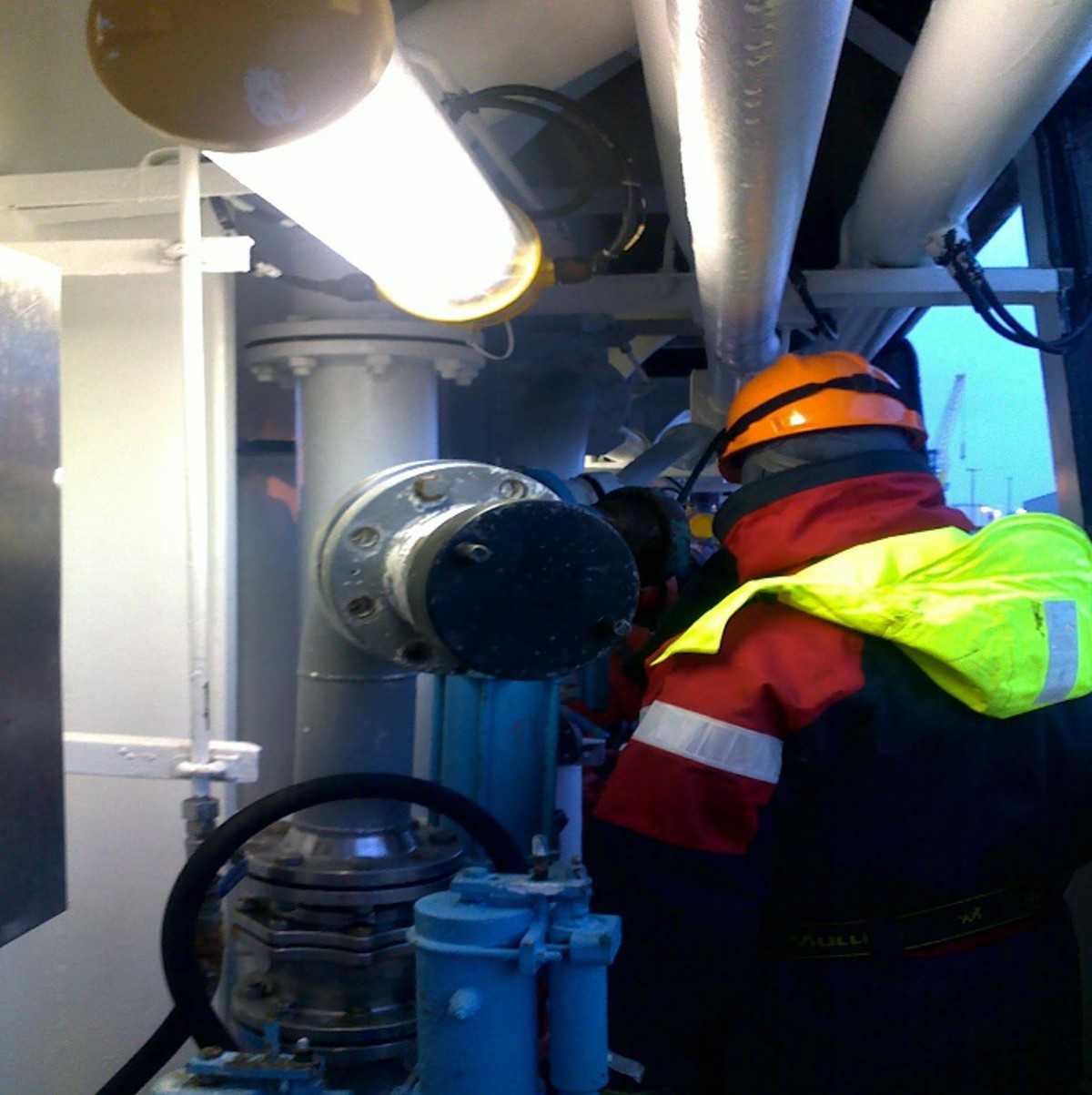
discharge manifold from which cap was blown
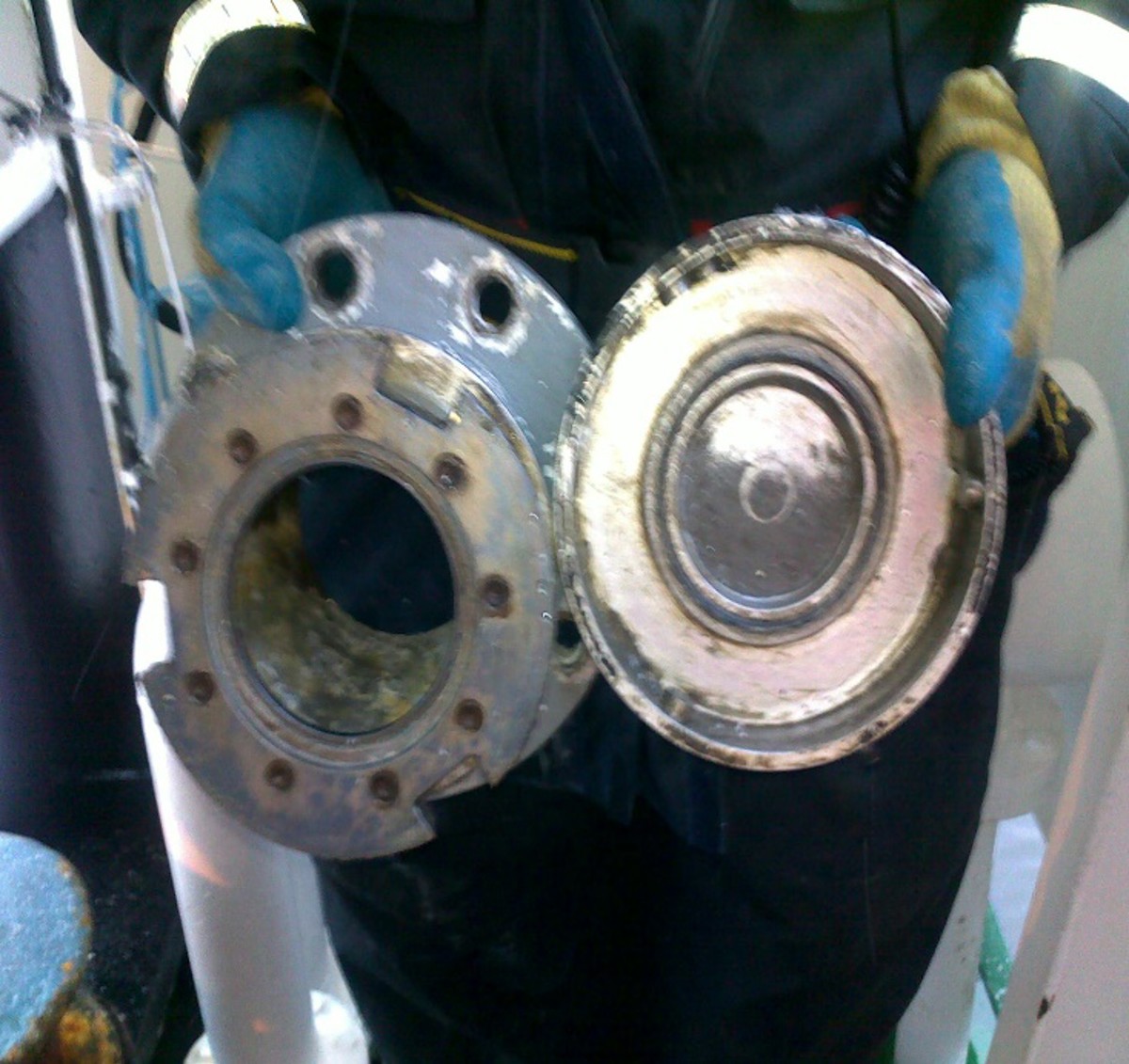
discharge manifold from which cap was blown
What were the causes?
Following investigation, the following points were noted:
- The cap had not been removed from the discharge manifold prior to energising the pump and pressurising the line.
- The second chief officer was experienced and the subject of good reports, who was not fatigued and acknowledged awareness of the procedure and the responsibility to ensure the lines were set up and the cap removed.
- The assumption that the line was open was incorrect – the second chief officer acted out of character, made an incorrect assumption and did not follow procedures.
- The risks associated with not having a NRV in place were not considered.
- Had procedures been followed the incident would have been prevented.
- The Avery Hardoll male connection was damaged and did not function as designed. Had it operated properly it would have sealed the pipework, preventing the pressure build up behind the cap.
- Whilst the decision to use the line cannot be faulted (i.e. the lack of a NRV made the configuration all but identical to a water ballast tank which does not have an Avery Hardoll) the presence of a NRV would still have been a barrier against incident.
- Having made the initial misjudgement and as a consequence pressurised the line, the task should have been stopped and a new toolbox talk convened to consider the risks and take appropriate action to mitigate them.
- The root cause of the incident was failure to follow procedure and to stop the job once a deviation from the norm was experienced.
Lessons learnt
A number of lessons were drawn from this incident:
- Had procedures been followed the accident would not have happened.
- The presence of an NRV in this context would act as an additional safety barrier.
- Having made the initial misjudgement and as a consequence pressurised the line, the task should have been stopped and a new tool box talk convened to consider the risks and take appropriate action to mitigate them.
IMCA Safety Flashes summarise key safety matters and incidents, allowing lessons to be more easily learnt for the benefit of the entire offshore industry.
The effectiveness of the IMCA Safety Flash system depends on the industry sharing information and so avoiding repeat incidents. Incidents are classified according to IOGP's Life Saving Rules.
All information is anonymised or sanitised, as appropriate, and warnings for graphic content included where possible.
IMCA makes every effort to ensure both the accuracy and reliability of the information shared, but is not be liable for any guidance and/or recommendation and/or statement herein contained.
The information contained in this document does not fulfil or replace any individual's or Member's legal, regulatory or other duties or obligations in respect of their operations. Individuals and Members remain solely responsible for the safe, lawful and proper conduct of their operations.
Share your safety incidents with IMCA online. Sign-up to receive Safety Flashes straight to your email.