Shifting cargo and deck spill during heavy weather
- Safety Flash
- Published on 14 May 2026
- Generated on 26 September 2026
- IMCA SF 09/26
- 2 minute read
A sodium chloride brine storage tank shifted approximately 0.5m during heavy weather conditions.
What happened?
While transiting to an offshore field in heavy weather conditions (winds 35-39 kts, swell 4-6m), the vessel experienced heavy rolling and pitching. Although deck cargo was reported as secured, a sodium chloride brine storage tank shifted approximately 0.5m. The tank struck the crash rail, causing the manifold valve to fail and resulting in a limited brine spill onto the main deck. The crew took immediate action to stop the leak, re-secured all deck cargo, and notified the relevant authorities. Limited environmental impact was observed.
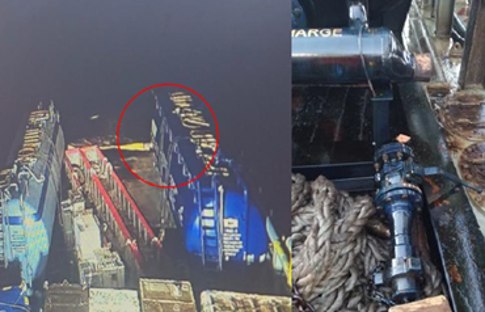 |
| Permanent brine tank shifted (right corner, left image), damaging the valve (right image) and causing a leak. |
Why did it happen?
- Heavy weather caused excessive rolling and pitching. Dynamic vessel motions led to slackening of lashing chains.
- The cargo securing arrangements were not sufficient for the weather conditions.
- The tank manifold valve was exposed and vulnerable to impact - not protected.
What do we learn?
- Cargo securing should be able to withstand extreme and forecasted weather, not just normal sea conditions.
- Heavy tanks require additional and redundant lashings when heavy weather is expected.
- Vulnerable fittings such as manifold valves should be protected or shielded from impact.
- Review weather risk assessments before transit, with consideration for speed reduction, course change or other operational changes.
- How do we safely monitor cargo when it is unsafe to go on deck? Prompt crew response and effective communication can significantly reduce consequences and escalation.
Related Safety Flashes
-
IMCA SF 11/22
4 May 2022
-
IMCA SF 07/19
18 April 2019
-
IMCA SF 04/22
10 February 2022
-
IMCA Safety Flashes summarise key safety matters and incidents, allowing lessons to be more easily learnt for the benefit of the entire offshore industry.
The effectiveness of the IMCA Safety Flash system depends on the industry sharing information and so avoiding repeat incidents. Incidents are classified according to IOGP's Life Saving Rules.
All information is anonymised or sanitised, as appropriate, and warnings for graphic content included where possible.
IMCA makes every effort to ensure both the accuracy and reliability of the information shared, but is not be liable for any guidance and/or recommendation and/or statement herein contained.
The information contained in this document does not fulfil or replace any individual's or Member's legal, regulatory or other duties or obligations in respect of their operations. Individuals and Members remain solely responsible for the safe, lawful and proper conduct of their operations.
Share your safety incidents with IMCA online. Sign-up to receive Safety Flashes straight to your email.