High Potential Near Miss: Dropped object due to contact with crane sheave
- Safety Flash
- Published on 14 May 2026
- Generated on 27 September 2026
- IMCA SF 09/26
- 3 minute read
A Dynamic Positioning (DP) beacon came into contact with sheave protection bars, resulting in the beacon and its holder assembly detaching and falling to the deck below.
What happened?
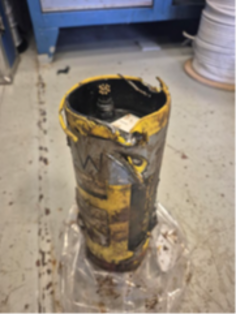
During crane operations on a vessel operating in deep water, the whip line was retrieved from approximately 2,200 meters depth to lift and deploy a hang-off sling over the vessel’s side. While lifting the sling from the deck, a Dynamic Positioning (DP) beacon (a subsea positioning aid mounted on the crane wire just above the hook socket) came into contact with the sheave protection bars. This resulted in the beacon and its holder assembly detaching and falling to the deck below.
The DP beacon weighed 4.3kg and fell 30m to the deck below. No personnel were in the immediate vicinity at the time of the incident; however, no direct controls were in place to restrict personnel access to the area. An investigation is ongoing.
 |
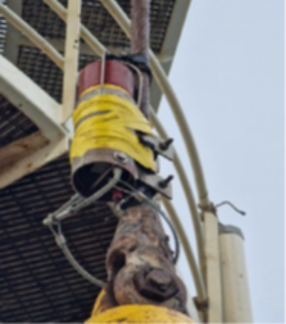 |
| Beacon fitted to crane hook |
What went right?
- No-one was hurt.
- The worksite team acted proactively by stopping the activity, implementing direct controls to prevent recurrence, and ensuring the appropriate return-to-work process was followed.
What went wrong?
- Although no personnel were in the direct line of fire during the event, there were insufficient controls to prevent access to this area.
Causal factors
- The DP beacon and clamp were fitted directly to the whip line wire rather than to the swivel/block, creating an inherent risk of snagging or clash.
- There was no secondary retention attached to the DP beacon/clamp arrangement.
- Management of Change (MoC) had not been considered before attaching the beacon to the crane wire.
- This process may have required resetting the relevant crane limits to prevent any clash or contact.
- The lifting team did not adequately monitor the beacon’s position relative to the crane sheave during lifting operations.
- Although the scope was managed by our member, the equipment and personnel involved were not directly under our members’ control.
Lessons and actions
- Can we ensure that similar beacon attachment mechanisms do not compromise equipment safety?
- Ensure that dropped object surveys and awareness programs do actually reflect the current condition of all equipment at the worksite.
- Check crane settings and limits are correct, particularly following deep-water deployments.
- When dealing with third-party contract workers and equipment, ensure there is a clear understanding of equipment limitations and conditions.
Related Safety Flashes
-
IMCA SF 18/25
2 October 2025
-
-
IMCA SF 26/23
13 November 2023
IMCA Safety Flashes summarise key safety matters and incidents, allowing lessons to be more easily learnt for the benefit of the entire offshore industry.
The effectiveness of the IMCA Safety Flash system depends on the industry sharing information and so avoiding repeat incidents. Incidents are classified according to IOGP's Life Saving Rules.
All information is anonymised or sanitised, as appropriate, and warnings for graphic content included where possible.
IMCA makes every effort to ensure both the accuracy and reliability of the information shared, but is not be liable for any guidance and/or recommendation and/or statement herein contained.
The information contained in this document does not fulfil or replace any individual's or Member's legal, regulatory or other duties or obligations in respect of their operations. Individuals and Members remain solely responsible for the safe, lawful and proper conduct of their operations.
Share your safety incidents with IMCA online. Sign-up to receive Safety Flashes straight to your email.