Worker suffered crush injury while handling unstable steel plates
- Safety Flash
- Published on 14 May 2026
- Generated on 26 September 2026
- IMCA SF 09/26
- 2 minute read
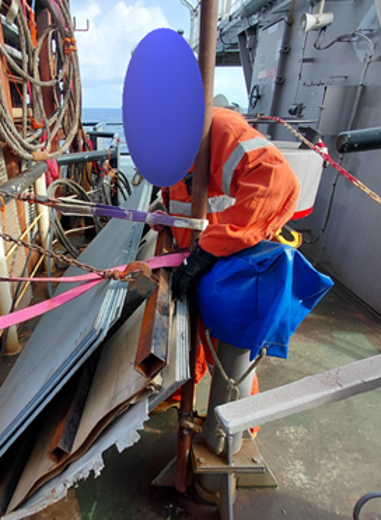
Steel plates suddenly toppled over to the side trapping a worker's left hand and wrist between a frame and an emergency stop pedestal.
What happened?
A worker was using their left hand to hold a number of steel plates in a vertical (balanced) position. One of the plates suddenly toppled over to the side trapping their left hand and wrist between a frame and an emergency stop pedestal. The worker suffered crush injuries resulting in multiple fractures to the hand, wrist and fingers requiring surgery. Also, the falling plate caught the worker on the left side, causing a superficial laceration to the abdomen.
Our member considered that a potential consequence could have been permanent disability to the hand, wrist or fingers and the potential for a more severe abdominal injury.
What were the circumstances?
- The steel plates were being stored in a temporary arrangement outside the designated steel rack:
- There had been no supervisory oversight of the decision to store the plates in this temporary way;
- There was limited space in which to work.
- Sea fastenings had been removed during voyage, increasing risk of plate movement.
- Work as planned, work as done: the risk assessment did not reflect real task conditions.
- The task had been done this way without any problems in the past. Perception of risk could have been better:
- The workers just got right on with the task and did not pause for a last minute risk assessment;
- No manual handling aids were used.
Lessons to learn
- Do our risk assessments always reflect the real world of work – i.e. work as DONE?
- Do risk assessments take into account “temporary” changes that sometimes become effectively permanent?
- Can we design and arrange storage to prevent this kind of thing happening? Have a look at the way materials are stored, particularly when “temporary” storage may be involved.
- Stop and think – take time out to think things through!
The circumstances show how local conditions, past experience and system constraints shaped work as done, rather than a conscious disregard for safety.
Related Safety Flashes
-
IMCA SF 09/25
16 May 2025
-
-
IMCA SF 05/22
28 February 2022
-
-
IMCA SF 12/21
27 April 2021
-
IMCA Safety Flashes summarise key safety matters and incidents, allowing lessons to be more easily learnt for the benefit of the entire offshore industry.
The effectiveness of the IMCA Safety Flash system depends on the industry sharing information and so avoiding repeat incidents. Incidents are classified according to IOGP's Life Saving Rules.
All information is anonymised or sanitised, as appropriate, and warnings for graphic content included where possible.
IMCA makes every effort to ensure both the accuracy and reliability of the information shared, but is not be liable for any guidance and/or recommendation and/or statement herein contained.
The information contained in this document does not fulfil or replace any individual's or Member's legal, regulatory or other duties or obligations in respect of their operations. Individuals and Members remain solely responsible for the safe, lawful and proper conduct of their operations.
Share your safety incidents with IMCA online. Sign-up to receive Safety Flashes straight to your email.