Minor chest burns suffered by rope access technician
- Safety Flash
- Published on 27 September 2010
- Generated on 27 October 2026
- IMCA SF 06/10
- 2 minute read
A Member has reported an incident in which a rope access technician suffered minor spot burns on the chest during cutting operations.
What happened?
A 24 inch pipe approximately 4 metres above the deck was being cut by the rope access technician (RAT), who was suspended by rope access gear and also standing on a ladder. The first cut and the access hole for a shackle, using a standard cutting torch, went smoothly. The internal pipe was covered with a 4 centimetre thick rust layer. When the second cut was nearly completed, some melted particles of rust fell onto the tip of the cutting torch. One of the particles from the tip of the cutting torch was blown away and somehow entered into/below the RAT’s protective clothing. The technician felt some very light pain on his chest and continued to work. After shift the technician felt some minor irritation on his chest and sought first aid. Three small burns on the middle of his chest were treated/covered by one plaster.
Our member’s investigation revealed the following:
- The direct cause of the incident was molten particles entering through an opening between the buttons of a fully closed leather protective jacket. This personal protective equipment (PPE) was not giving full body protection.
The following long-term corrective actions were suggested:
- Protective jackets used for hot work should close using ‘velcro’ closing straps rather than buttons.
- Consideration should be given to different kinds of protective clothing, including flexible fireproof hoods designed to cover shoulder, chest and neck area.
- It should be emphasised at toolbox talks and in preparation for hot work that molten particles can enter PPE through the smallest openings.
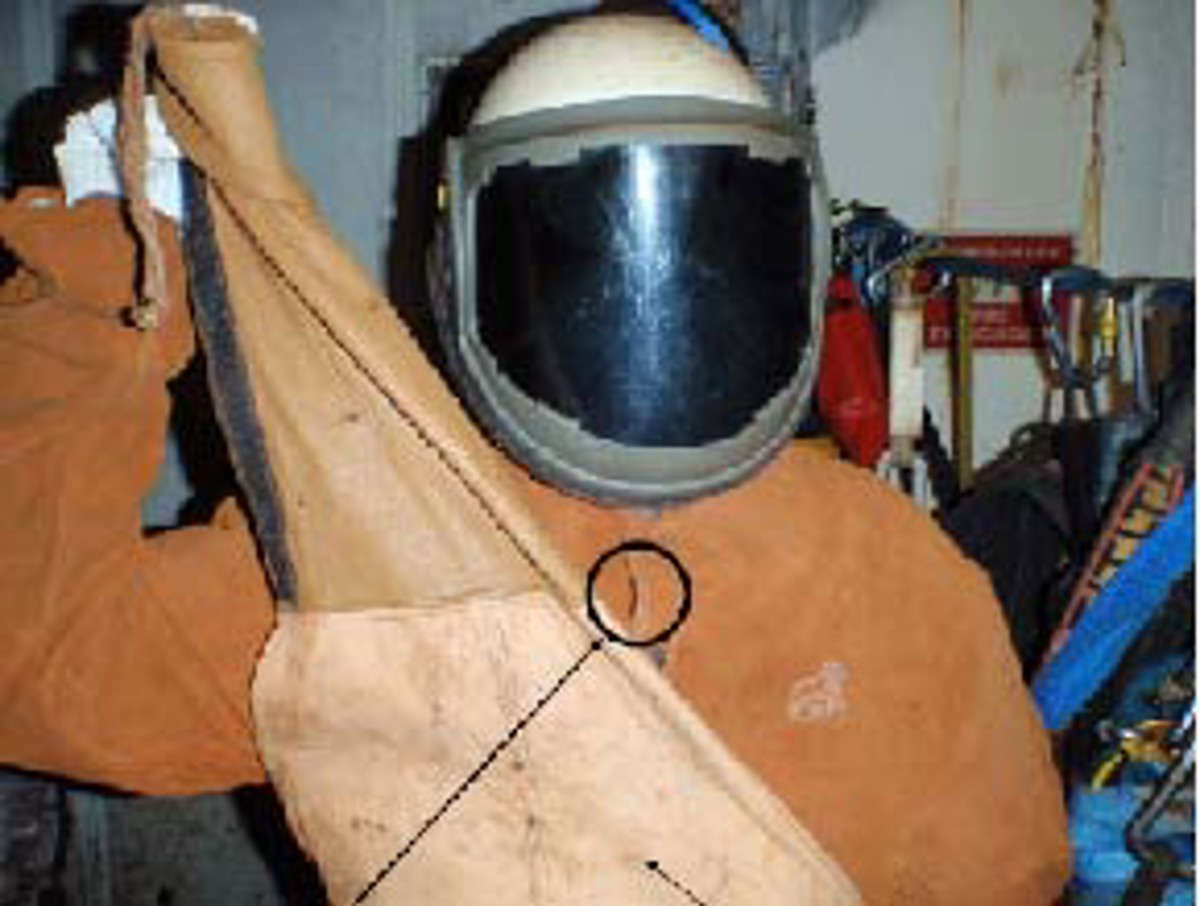
Protective clothing for rope access technicians showing small opening through which hot particle passed
IMCA Safety Flashes summarise key safety matters and incidents, allowing lessons to be more easily learnt for the benefit of the entire offshore industry.
The effectiveness of the IMCA Safety Flash system depends on the industry sharing information and so avoiding repeat incidents. Incidents are classified according to IOGP's Life Saving Rules.
All information is anonymised or sanitised, as appropriate, and warnings for graphic content included where possible.
IMCA makes every effort to ensure both the accuracy and reliability of the information shared, but is not be liable for any guidance and/or recommendation and/or statement herein contained.
The information contained in this document does not fulfil or replace any individual's or Member's legal, regulatory or other duties or obligations in respect of their operations. Individuals and Members remain solely responsible for the safe, lawful and proper conduct of their operations.
Share your safety incidents with IMCA online. Sign-up to receive Safety Flashes straight to your email.