Lost time injury (LTI): Serious hand injury – caught in the bight
- Safety Flash
- Published on 16 June 2014
- Generated on 26 May 2026
- IMCA SF 09/14
- 3 minute read
A Member has reported an incident in which a seaman sustained serious injuries to his hand resulting in the loss of his little finger.
What happened?
The incident occurred during when the vessel was engaged in the inter-field transfer of personnel and equipment. The vessel proceeded to an unfamiliar platform and disembarked five personnel during rising seas. Two personnel declined to transfer deeming the sea state unsafe for transfer operations, and the vessel was manoeuvred away to standby. Later that afternoon the vessel was instructed to pick up the five passengers from the platform. The weather had deteriorated further, with 3m swells and wind speeds of up to 15 knots, and the master deemed it unsafe to transfer passengers.
However, a suggestion was made to transfer the baggage via heaving line, to which the master agreed. The injured party passed the vessel’s heaving line across to the platform personnel who ran the heaving line up to the middle platform, securing the midsection to a railing. Platform personnel then lowered the first two bags one at a time to the vessel. The third and fourth bags were simultaneously lowered down to the crew boat via both ends of the heaving line. The injured party received one bag on the port side and the 2nd Officer received the second bag on the starboard side. Both proceeded to untie the knots at each end of the rope.
As the injured party was untying the line, the vessel took a sudden dip due to the high swells. He could not retract his left hand fast enough and three of his fingers were caught in the bight of the knot when the heaving line suddenly tensioned. The injured person pushed against the stern deck railing to prevent being pulled overboard. Subsequently the heaving line severed his little finger and lacerated the ring and middle fingers. The rope was finally cut and removed from his finger after crew fetched a knife from the accommodation.
The casualty was medivaced to shore hospital four hours later but his finger could not be saved.
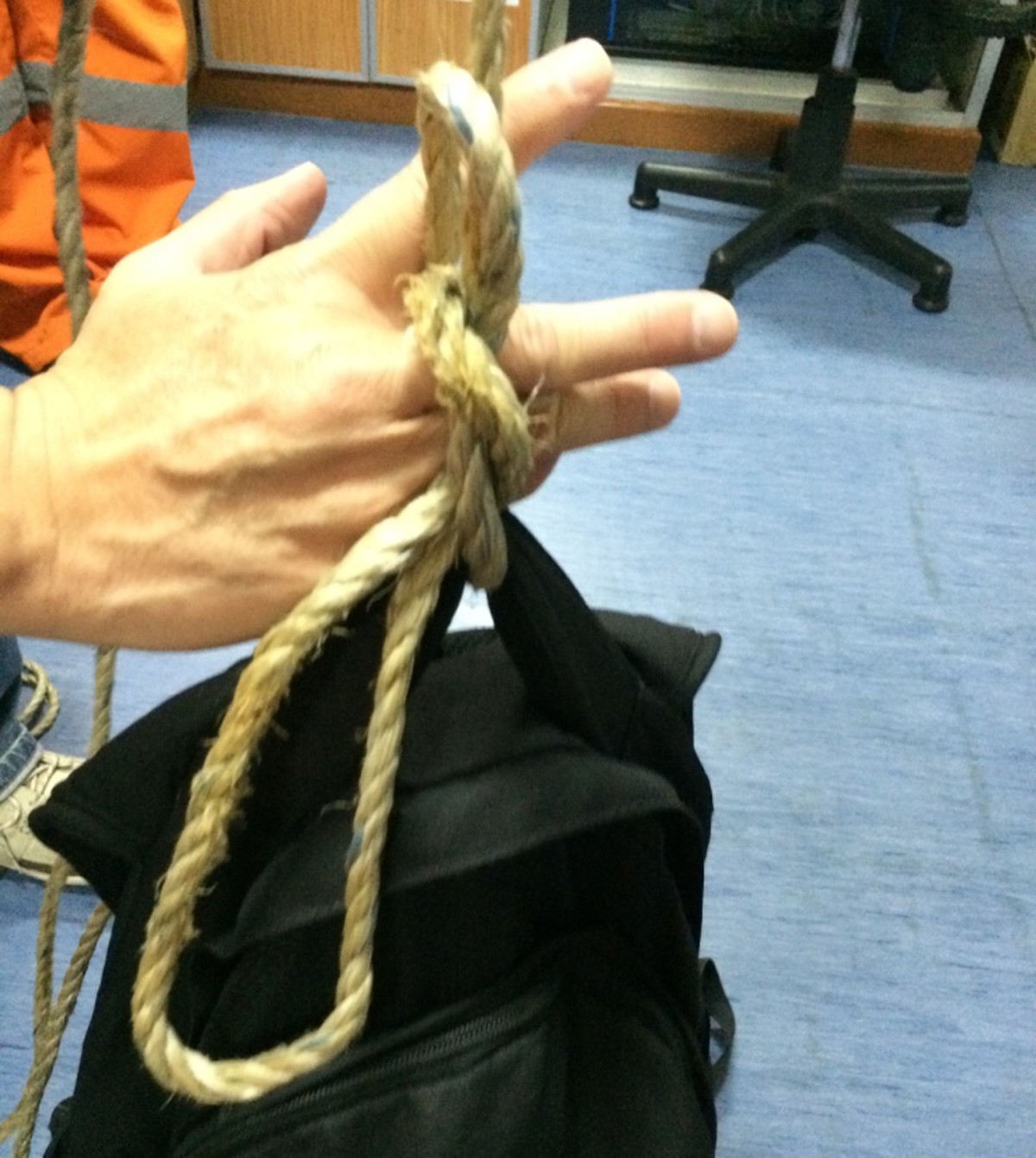
How fingers were caught in the bight (reconstruction)
Our member’s investigation revealed the following:
- This was the first time this method of baggage transfer had been used by any of the crew. It was initiated on the spur of the moment, without any thought, risk assessment or planning – there was no Management of Change.
- The rope was secured to the platform in such a way that it could not easily be released or slackened.
- The platform crew were inexperienced at tying appropriate knots and tied excessive knots in the small diameter polypropylene rope which were difficult and time consuming to untie.
- To speed up the transfer process two bags were lowered on each end of the secured heaving line, dividing the attention of the deck crew.
The following lessons were learnt:
- Always ensure operational risks are identified and assessed prior to starting operations.
- Don’t be tolerant of unacceptable risk.
- Always be mindful of the impact of changing customary methods of ‘routine’ operations.
- Always ensure operations are well planned, communicated and supervised.
- Don’t give in to external pressure to work beyond safe working limits, always exercise your right to stop work.
Finger and hand injuries are amongst the most common safety flashes reported.
Related safety flashes
-
IMCA SF 13/12
11 December 2012
-
IMCA SF 04/12
30 April 2012
-
IMCA SF 05/06
30 April 2006
-
IMCA SF 02/06
27 February 2006
IMCA Safety Flashes summarise key safety matters and incidents, allowing lessons to be more easily learnt for the benefit of the entire offshore industry.
The effectiveness of the IMCA Safety Flash system depends on the industry sharing information and so avoiding repeat incidents. Incidents are classified according to IOGP's Life Saving Rules.
All information is anonymised or sanitised, as appropriate, and warnings for graphic content included where possible.
IMCA makes every effort to ensure both the accuracy and reliability of the information shared, but is not be liable for any guidance and/or recommendation and/or statement herein contained.
The information contained in this document does not fulfil or replace any individual's or Member's legal, regulatory or other duties or obligations in respect of their operations. Individuals and Members remain solely responsible for the safe, lawful and proper conduct of their operations.
Share your safety incidents with IMCA online. Sign-up to receive Safety Flashes straight to your email.