Engine room fire
- Safety Flash
- Published on 31 October 2005
- Generated on 25 October 2026
- IMCA SF 10/05
- 2 minute read
IMCA has received a report of an engine room fire.
What happened?
The master and crew handled the critical situation swiftly by releasing carbon dioxide. The fire was brought under control, but the ship lost power. The ship was towed to port for investigation and repairs.
The fire caused damage to machinery components, piping, cables and bulkhead and the engine room was partially flooded.
What were the causes?
The probable cause of the fire was spraying of leaking hydraulic oil onto an exhaust flange which was not properly insulated (see pictures 1A and 1B).
The exposed flange must apparently have reached a temperature above 220 °C.
Lessons learnt
The information received reiterates the importance of identifying hot spots in the engine room, noting typical trouble areas such as:
- indicator valves
- exhaust pipes from each cylinder
- exhaust manifold, in particular overlaps between steel sheets and laggings
- turbochargers, in particular flanges to such
- cut-outs for pressure and temperature sensors
- exposed areas on boilers and incinerators.
After maintenance and repairs, attention should be paid to satisfactory reinstallation of the insulation.
SOLAS regulations require proper insulation of all surfaces1 with temperatures above 220 °C.
See picture 2 for an example of satisfactory insulation of a flange. SOLAS also includes requirements for jacketed piping of high pressure fuel lines and screening of pipe connections on flammable oil systems.
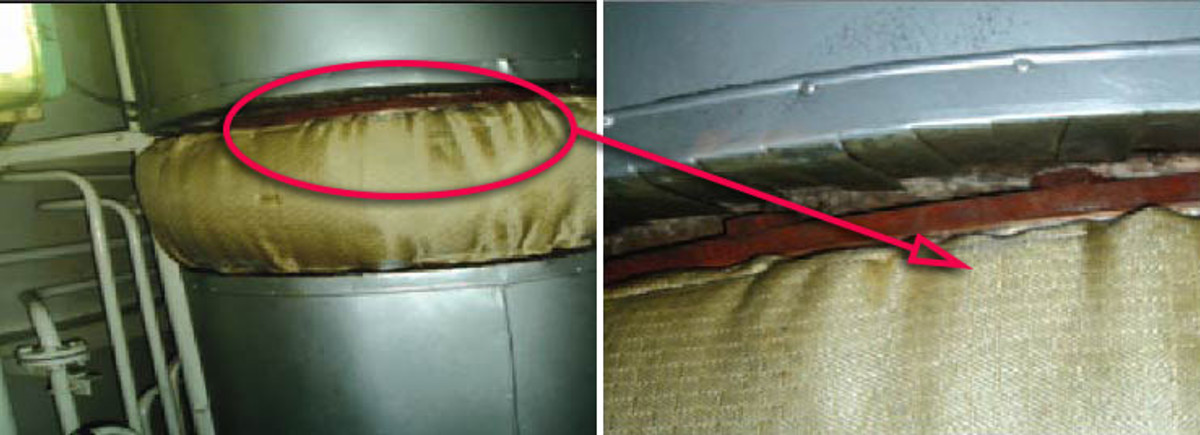
Pictures 1A and 1B – Main exhaust pipe
Such an arrangement may have caused the fire. Note the exposed flange of the expansion joint without insulation. The flange has a temperature normally above 220 °C. Hydraulic oil may hit this flange and start a fire.
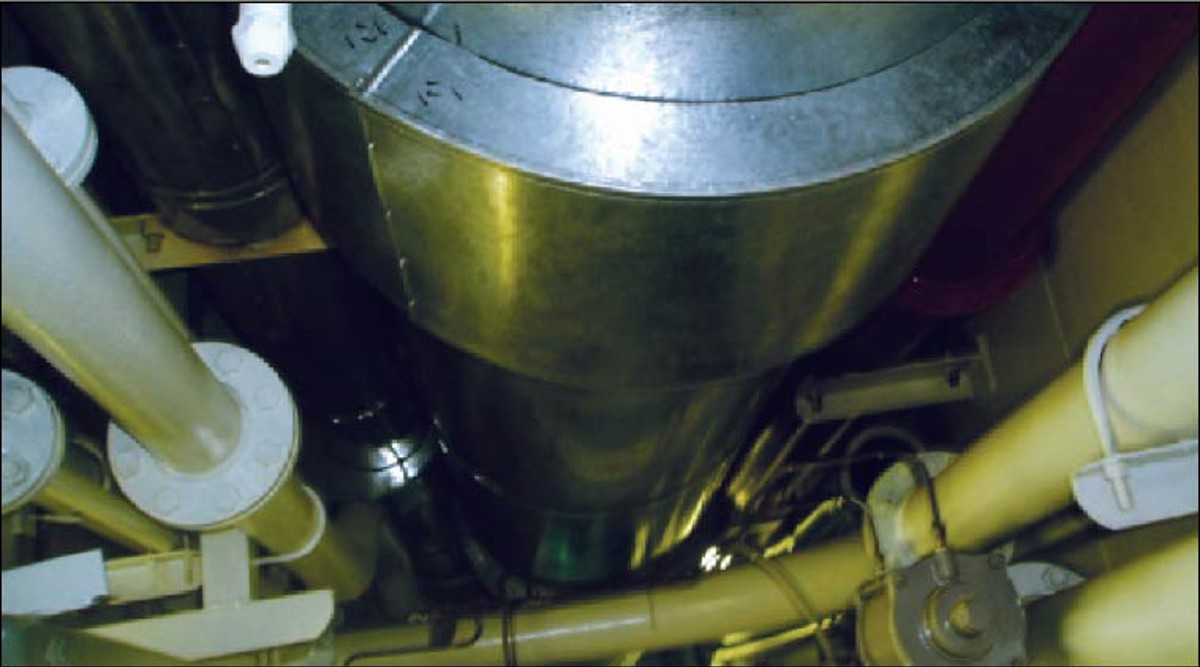
Picture 2 – Exhaust pipe
One example on how the flange can be properly insulated. The insulation and the metal sheath cover the flange completely.
The metal sheath protects and ensures proper geometry and location of the insulation material.
The sheath cover is only fixed on the upper side since it covers the expansion joint.
1 “For all ships above 500 gross tonnes, SOLAS requires insulation of surfaces with temperature above 220 °C, which may be impinged upon as a result of fuel system failure. For ships built after 1st July 1998 this also applies for system failure of lubricating oil, hydraulic oil and thermal oil.”
IMCA Safety Flashes summarise key safety matters and incidents, allowing lessons to be more easily learnt for the benefit of the entire offshore industry.
The effectiveness of the IMCA Safety Flash system depends on the industry sharing information and so avoiding repeat incidents. Incidents are classified according to IOGP's Life Saving Rules.
All information is anonymised or sanitised, as appropriate, and warnings for graphic content included where possible.
IMCA makes every effort to ensure both the accuracy and reliability of the information shared, but is not be liable for any guidance and/or recommendation and/or statement herein contained.
The information contained in this document does not fulfil or replace any individual's or Member's legal, regulatory or other duties or obligations in respect of their operations. Individuals and Members remain solely responsible for the safe, lawful and proper conduct of their operations.
Share your safety incidents with IMCA online. Sign-up to receive Safety Flashes straight to your email.