Engine failure and subsequent engine room fire
- Safety Flash
- Published on 22 May 2024
- Generated on 24 September 2026
- IMCA SF 10/24
- 2 minute read
There was a catastrophic failure of a diesel generator on a vessel working offshore.
What happened?
There was a catastrophic failure of a diesel generator on a vessel working offshore. The failure of the generator led to engine components being ejected by force, which in turn started an engine room fire. The Hi-Fog fixed firefighting system was activated, non-essential personnel were mustered, and onshore emergency response teams were assembled. Additional emergency procedures were deployed with fire teams instructed to assess the engine room conditions. Onshore emergency response teams stood by to support the vessel in case of need. The fire was extinguished with limited damage to any further machinery.
No-one was harmed. The vessel subsequently left the field for a port call before undertaking extensive dry dock repairs.
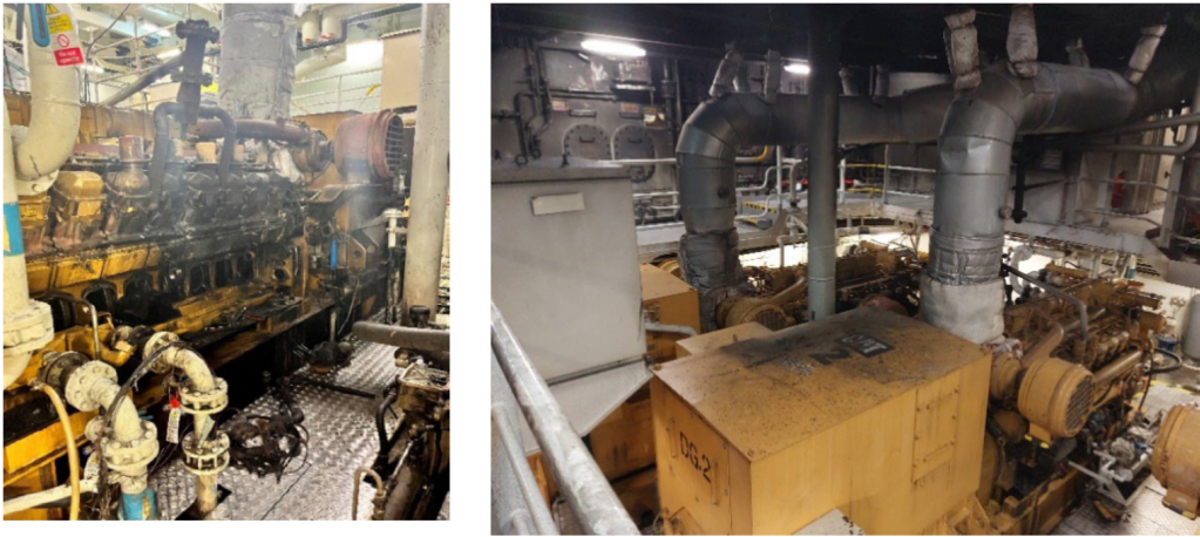
Findings – what went right and wrong
- Catastrophic failure within one diesel generator caused the engine room fire.
- Another diesel generator was damaged as a consequence of the force of ejected materials/components.
- The Hi-Fog fixed firefighting system worked and provided good extinguishing capabilities and allowed emergency teams early access to affected areas.
- Fire-suits and associated equipment provided good protection from heat and fire and communication and firefighting personal protective equipment (PPE) proved very effective.
- The offshore vessel management team and the emergency teams onboard demonstrated highly effective leadership in managing their response, addressing problem solving during the emergency as well as acting in a quick, decisive and effective way.
Lessons
- A Thermal Imaging Camera could be useful in support of firefighting teams.
- Ensure that persons on emergency response teams ARE familiar with all applicable emergency procedures.
- Introduce fire booklets at each fire station. These should give details on the general layout, equipment, search routes, isolations, length of hose runs of each major area or compartment of concern.
- Review and revise emergency response plans to determine if the chosen communications are correct and ensure that shore-based management are informed at the earliest opportunity.
Related Safety Flashes
-
IMCA SF 15/22
20 June 2022
-
IMCA SF 14/18
9 July 2018
-
IMCA Safety Flashes summarise key safety matters and incidents, allowing lessons to be more easily learnt for the benefit of the entire offshore industry.
The effectiveness of the IMCA Safety Flash system depends on the industry sharing information and so avoiding repeat incidents. Incidents are classified according to IOGP's Life Saving Rules.
All information is anonymised or sanitised, as appropriate, and warnings for graphic content included where possible.
IMCA makes every effort to ensure both the accuracy and reliability of the information shared, but is not be liable for any guidance and/or recommendation and/or statement herein contained.
The information contained in this document does not fulfil or replace any individual's or Member's legal, regulatory or other duties or obligations in respect of their operations. Individuals and Members remain solely responsible for the safe, lawful and proper conduct of their operations.
Share your safety incidents with IMCA online. Sign-up to receive Safety Flashes straight to your email.