Injury to thumb during lifting operations
- Safety Flash
- Published on 4 June 2025
- Generated on 17 October 2026
- IMCA SF 10/25
- 2 minute read
Whilst attempting to land a piece of equipment onto a flatbed trailer, a crew person suffered a thumb injury when the load descended on his hand.
What happened?
The incident occurred during vessel demobilization alongside. During the lift the truck driver encountered difficulties and asked for help. In response, the crew member stepped onto the trailer, positioning themselves at one end while the truck driver stood at the other. At the time of the incident, the crane was holding the load approximately 30cm above the trailer. A verbal command was given to lower the load, but the crew member was still repositioning a wooden block for better placement when the load came down trapping his thumb. He managed to pull his hand out from under the load, sustaining an injury. First aid was administered and crew member was then taken to hospital.
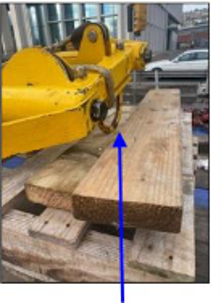
Point of contact
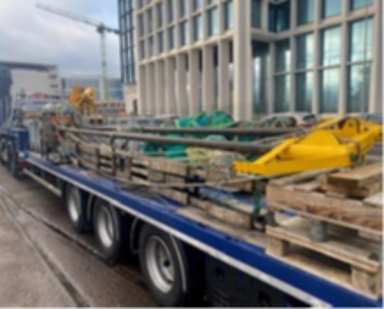
Loaded trailer
What went wrong?
- The crew members’ hand was still under the load as it descended.
- There was a lack of clear communication, leading to confusion:
̶ There was no standardized signalling procedure or banksman procedure in place, leading to confusion between the crane operator, truck driver, and the injured crew member; - The crew may have felt perceived pressure to “get the job done quickly”.
̶ Potential commercial and personal pressures may have influenced the decision-making of the team.
What do we learn?
- Plan the job properly; plan the lift properly.
- Hold a Toolbox talk beforehand and ensure everyone involved knows what their role is. This is particularly important when working with third-parties such as truck drivers or dock workers.
- Ensure there are agreed and understood clear verbal and visual communication protocols.
- Watch for safe positioning around loads – don’t accidently get in the way; don’t get under a load being lowered.
- No matter what – don’t rush. Work safely and steadily: resist the urge to complete tasks quickly; this can lead to rushed decisions and safety shortcuts.
Members may wish to refer to
· IMCA HSS 019 Guidelines for lifting operations
Related Safety Flashes
-
IMCA SF 13/11
25 November 2011
-
IMCA SF 10/22
21 April 2022
-
IMCA Safety Flashes summarise key safety matters and incidents, allowing lessons to be more easily learnt for the benefit of the entire offshore industry.
The effectiveness of the IMCA Safety Flash system depends on the industry sharing information and so avoiding repeat incidents. Incidents are classified according to IOGP's Life Saving Rules.
All information is anonymised or sanitised, as appropriate, and warnings for graphic content included where possible.
IMCA makes every effort to ensure both the accuracy and reliability of the information shared, but is not be liable for any guidance and/or recommendation and/or statement herein contained.
The information contained in this document does not fulfil or replace any individual's or Member's legal, regulatory or other duties or obligations in respect of their operations. Individuals and Members remain solely responsible for the safe, lawful and proper conduct of their operations.
Share your safety incidents with IMCA online. Sign-up to receive Safety Flashes straight to your email.