Finger trapped and injured while working on heavy equipment
- Safety Flash
- Published on 28 May 2026
- Generated on 11 October 2026
- IMCA SF 10/26
- 2 minute read
A third-party technician suffered a pinch injury to the right index finger.
What happened?
The incident – a Restricted Work Case (RWC) injury - occurred onboard a vessel while third-party technicians were conducting trials on pipelaying equipment. An Induction Heating Coil (IHC), suspended from a davit crane, did not open as intended. The technician, who was not part of the coating team, intervened to assist. During the intervention when the coil was subsequently prized opened, the technician’s hand was placed near the closing joint. The coil then closed suddenly, pinching the individual’s right index finger.
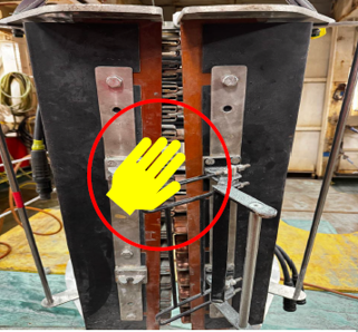
Showing the pinch point on the Induction Heating Coil
What went right?
- The job was stopped immediately, prompt medical treatment given.
- A safety stand‑down conducted, followed by task‑specific risk review to ensure that all controls established prior to return to work.
What went wrong?
- Change could have been managed better: The task was moved to a different work environment without acomplete risk review, preparatory checks, or a formal Management of Change (MoC) process.
- Equipment could have been better designed: The lifting configuration did not fully align with the operational environment, and restricted space limited safer alternatives. Visibility of safety signage and labelling required improvement.
- Use of generic rather than specific documentation: generic documentation was used instead of task‑specific controls. The lift was incorrectly classified, and the designated rigging was not used.
- Supervision: Roles and expectations across involved teams were not clearly aligned, which resulted in gaps in supervisory oversight.
- There were gaps in the contractor’s equipment assurance: Required compliance checks and supporting maintenance records for the contractor-supplied equipment were not available.
Actions taken in this case
- Ensuring task-specific risk reviews, and use of the Management of Change process when the work environment, set-up or method of work is changed.
- Improved equipment design visibility and usability, ensuring controls and labelling areclear and safe to operate.
- Ensured appropriate levels of supervision to cover multiple, complex or simultaneous tasks.
- Ensured that Short Service Employees are given adequate support and supervision.
IMCA Safety Flashes summarise key safety matters and incidents, allowing lessons to be more easily learnt for the benefit of the entire offshore industry.
The effectiveness of the IMCA Safety Flash system depends on the industry sharing information and so avoiding repeat incidents. Incidents are classified according to IOGP's Life Saving Rules.
All information is anonymised or sanitised, as appropriate, and warnings for graphic content included where possible.
IMCA makes every effort to ensure both the accuracy and reliability of the information shared, but is not be liable for any guidance and/or recommendation and/or statement herein contained.
The information contained in this document does not fulfil or replace any individual's or Member's legal, regulatory or other duties or obligations in respect of their operations. Individuals and Members remain solely responsible for the safe, lawful and proper conduct of their operations.
Share your safety incidents with IMCA online. Sign-up to receive Safety Flashes straight to your email.