Severe injuries following falling off a freight container
- Safety Flash
- Published on 6 July 2026
- Generated on 6 October 2026
- IMCA SF 12/26
- 2 minute read
A truck driver slipped and fell from a container leading to severe injury.
What happened?
A serious accident occurred at a logistics centre during de-rigging activity. While a freight container was positioned on a trailer, a truck driver was on top, working at height to handle slings. The truck driver slipped and fell from the container leading to severe injury.
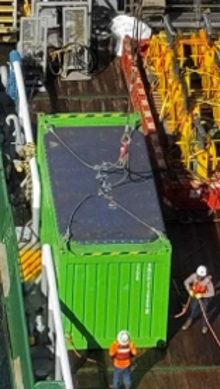
This type of container, mobilised for this company, was pre rigged with steel slings to allow hooking and unhooking at deck level. This eliminates the need for personnel to access the top of the container. The preparation of these containers is carried out at the logistics yards and involves rigging and de rigging activities. Prior to the incident, a truck driver climbed to the top of a container that was positioned on a truck to de-rig / handle a set of four legged slings which were connected to the container. While doing this the driver lost balance and fell from approximately 4.5 meters to the ground, resulting in severe injuries to the legs, back, and head.
 |
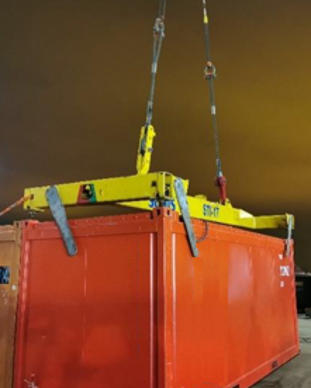 |
| Pre-rigged offshore container | “Stinis” frame to lift container |
What went wrong?
The investigation highlighted the need for clear instructions and strict controls: if, when and how containers may be pre-rigged for the purpose of offshore lifting.
- The top of the container was accessed by the truck driver without using Personal Fall Restraint Harness or other means for safe access.
- There were no active instructions in place anymore for both internal and external use on how to handle rigging for containers.
- No one nearby challenged these unsafe “normal work” practices.
What are the lessons?
Eliminate exposure to work at height for rigging and de-rigging of containers:
- Personnel should not be on top of containers.
- Installation or removal of slings from containers may only take place with an approved risk assessment and method statement in place.
- Use alternative equipment: a “Stinis” lifting frame (see image), a scissor lift / cherry picker and/or (mobile) cranes to remove / install rigging.
Related Safety Flashes
-
IMCA SF 34/20
16 December 2020
-
-
IMCA SF 03/25
20 February 2025
-

IMCA Safety Flashes summarise key safety matters and incidents, allowing lessons to be more easily learnt for the benefit of the entire offshore industry.
The effectiveness of the IMCA Safety Flash system depends on the industry sharing information and so avoiding repeat incidents. Incidents are classified according to IOGP's Life Saving Rules.
All information is anonymised or sanitised, as appropriate, and warnings for graphic content included where possible.
IMCA makes every effort to ensure both the accuracy and reliability of the information shared, but is not be liable for any guidance and/or recommendation and/or statement herein contained.
The information contained in this document does not fulfil or replace any individual's or Member's legal, regulatory or other duties or obligations in respect of their operations. Individuals and Members remain solely responsible for the safe, lawful and proper conduct of their operations.
Share your safety incidents with IMCA online. Sign-up to receive Safety Flashes straight to your email.