Fire in tumble dryer
- Safety Flash
- Published on 6 July 2026
- Generated on 5 October 2026
- IMCA SF 12/26
- 1 minute read
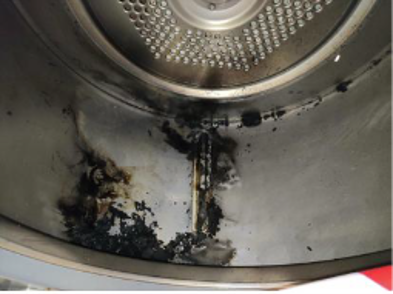
A fire was discovered within one of the vessel laundry dryers.
What happened?
The bridge was immediately informed and the vessel fire alarm triggered. All personnel were promptly mustered at the allocated muster stations and were maintained in this location until the residual smoke had cleared with the tumble dryer subsequently mechanically isolated. There were no injuries to personnel. The tumble dryer was damaged beyond repair.
Why did it happen?
Further technical investigation was undertaken by a specialist service provider, but initial investigation concluded that the probable cause of the fire was that washcloths from galley had spontaneously combusted in the final phase of the drying cycle, during the anti-crease routine. The spontaneous combustion being due to the washcloths containing suspected residues of cooking oil and animal fat, remaining within the washcloths after washing.
IMCA notes that its members have reported tumble dryer fires over many years, and that there is no cause for complacency in the context of fire safety in a vessel laundry. Of particular note in this case is the spontaneous combustion of oily or fatty residues from cloths used for catering purposes – this has been reported before.
Related Safety Flashes
-
IMCA SF 16/09
10 November 2009
-
IMCA SF 03/16
27 January 2016
-
IMCA SF 07/16
31 March 2016
-
IMCA SF 18/18
23 August 2018
-
-
IMCA SF 32/20
26 November 2020
-
IMCA SF 08/21
17 March 2021
-
IMCA SF 29/22
21 December 2022
-
-
IMCA SF 24/23
16 October 2023
IMCA Safety Flashes summarise key safety matters and incidents, allowing lessons to be more easily learnt for the benefit of the entire offshore industry.
The effectiveness of the IMCA Safety Flash system depends on the industry sharing information and so avoiding repeat incidents. Incidents are classified according to IOGP's Life Saving Rules.
All information is anonymised or sanitised, as appropriate, and warnings for graphic content included where possible.
IMCA makes every effort to ensure both the accuracy and reliability of the information shared, but is not be liable for any guidance and/or recommendation and/or statement herein contained.
The information contained in this document does not fulfil or replace any individual's or Member's legal, regulatory or other duties or obligations in respect of their operations. Individuals and Members remain solely responsible for the safe, lawful and proper conduct of their operations.
Share your safety incidents with IMCA online. Sign-up to receive Safety Flashes straight to your email.