Three crane incidents
- Safety Flash
- Published on 28 May 2026
- Generated on 10 October 2026
- IMCA SF 10/26
- 4 minute read
A member reports three separate but related crane incidents. The actual consequences were, cranes out of action, operational delays, reputational damage, and the potential consequences were injury and equipment damage.
 |
 |
Incident 1: Wire and pulley damaged
What happened?
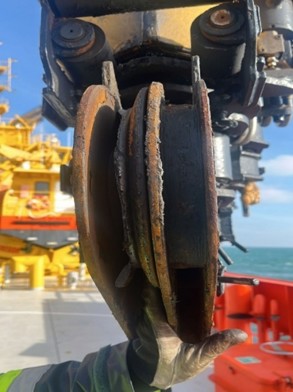
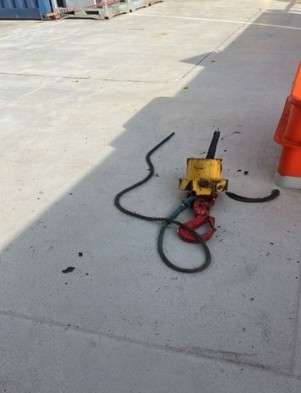
Whilst a crane was being parked after use, the crane operator unintentionally pulled out the telescopic boom while the hook block was fully retracted and secured in its resting position. As a result of extending the telescope without releasing or lowering the hook, excessive tension was applied to the wire rope and pulley system. This caused overloading of the wire and sheave assembly, leading to breakage of the wire rope and damage to the pulley.
What was the cause?
- Correct procedure not followed: The required parking sequence, which was to fold the knuckle first, and then lower the boom, was not followed. Instead, the operator extended the telescopic boom while the hook block was fully retracted and secured, pulling the hook into the fairlead and overstressing the wire until it parted.
- Lack of situational awareness: The operator selected the wrong function, extending the boom rather than folding and lowering it. This unintended movement, combined with the nearly retracted boom, generated excessive tension and led to the wire rope and pulley failure.
Incident 2: Movement malfunction
What happened?
During routine crane operations, the main boom was raised and extended. Whilst the boom reached the maximum upper position on the first cylinder, the upper limit switch was triggered. Following activation of this limit switch, all crane functions ceased and the system could not be reset or overridden. As a result, the boom remained locked in its maximum upper position. Standard control inputs could not retract or lower the boom, rendering the crane temporarily inoperative.
What was the cause?
- Correct procedure not followed: The correct steps in unfolding the crane were not followed. The process followed did not align with the established operational guidelines; this contributed to the incident.
- Inadequate practice: During the crane break-out process, the operator inadvertently selected the parking mode function on the remote control. Activating this mode disabled all limit switches and immediately halted all crane functions. As a result, the crane became unresponsive and no further movements were possible, effectively freezing the equipment in place.
Incident 3: Crane collision sensor damaged
What happened?
While preparing for lifting operations, the crane operator started to unpark the crane. During this process, the telescope tip slide out from parking socket, dropping approximately 0.5m. This drop caused the crane hook to swing and hit the collision sensor causing damage to the sensor and plate.
What was the cause?
- Inadequate practice: The start up sequence wasn’t followed correctly. Because the boom wasn’t fully knuckled in, hydraulic pressure was insufficient, causing the boom to drop and the hook to move uncontrollably. The operator’s experience suggests complacency played a role.
- Lack of situational awareness / risk perception / risk awareness: Although the operator had full visibility, a brief lapse in attention led the operator to overlook the risk of damaging the collision sensor. Having performed the task many times without issue, familiarity likely contributed to task fixation and reduced situational awareness.
Actions taken
- Refresher Training: Provided additional onboard training for all crane operators on the crane-specific start-up and stowing procedures, outlining the required steps for initiating and securing the crane and clarifying the correct operating modes to be selected on the remote control before each crane operation.
- Posters: Placed placards with the starting and stowing procedure steps in the crane pedestal.
- Pre-Operation Checks: Developed an onboard checklist and conduct thorough checks of wire ropes, pulleys, limit switches, boom and hook condition, to help to verify that all systems are fully functional and procedures are followed before starting operations.
Lessons
- Clear Communication during Operations: Maintain constant communication between operator and banksman during crane movements. Use standard signals and confirm instructions before execution.
- Stop Work Authority: Operators should feel able to stop operations immediately when unsure or when abnormalities occur.
- Effective Supervision: Ensure that newly joined or newly promoted crane operators are properly guided and supervised during all crane operations.
- Safe Mechanical Lifting: Always follow life saving rules for safe lifting and ensure that all lifting operations are properly planned with the surrounding area effectively controlled.
Members may wish to refer to:
- IMCA HSS 019 Guidelines for lifting operations
- Lifting – IMCA has two related videos on Lifting. One explores Lifting Operations; the second covers Lifting Equipment.
Related Safety Flashes
-
IMCA SF 18/25
2 October 2025
-
IMCA Safety Flashes summarise key safety matters and incidents, allowing lessons to be more easily learnt for the benefit of the entire offshore industry.
The effectiveness of the IMCA Safety Flash system depends on the industry sharing information and so avoiding repeat incidents. Incidents are classified according to IOGP's Life Saving Rules.
All information is anonymised or sanitised, as appropriate, and warnings for graphic content included where possible.
IMCA makes every effort to ensure both the accuracy and reliability of the information shared, but is not be liable for any guidance and/or recommendation and/or statement herein contained.
The information contained in this document does not fulfil or replace any individual's or Member's legal, regulatory or other duties or obligations in respect of their operations. Individuals and Members remain solely responsible for the safe, lawful and proper conduct of their operations.
Share your safety incidents with IMCA online. Sign-up to receive Safety Flashes straight to your email.