Arm injury – need for focus on safe isolation and task control
- Safety Flash
- Published on 11 June 2026
- Generated on 24 October 2026
- IMCA SF 11/26
- 2 minute read
A worker sustained an arm injury while troubleshooting a malfunctioning garbage compactor.
What happened?
The compactor unexpectedly activated while the person was manually testing a proximity sensor through an opening at the top of the unit, resulting in their arm being trapped between the ram and the top cover. The worker ended up on restricted duty for a day due to bruising/stiffness.
What went wrong?
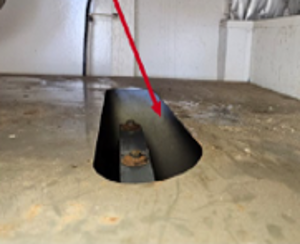
The individual accessed the top opening of the compactor, which was later determined to be part of the ram’s movement path. During manual sensor testing using pliers, the compactor activated unexpectedly and the ram began to move, resulting in the individual's arm becoming caught between the ram and the top cover. The situation required immediate response, and nearby personnel provided timely assistance.
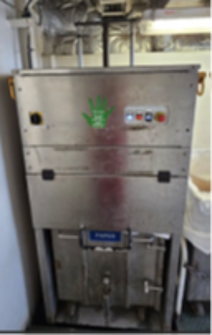 |
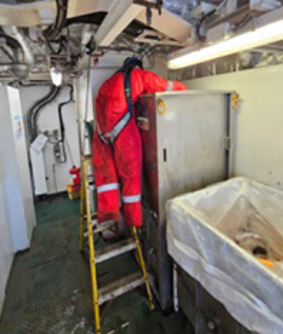 |
| Compactor | Position of person while reaching into compactor (re-enactment) |
 |
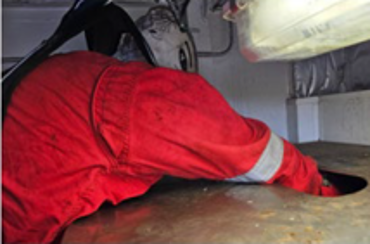 |
| Top view of compactor with ram in low position, showing hole where arm was inserted | Position of person while reaching into compactor (re-enactment) |
What can we learn?
- Permit to Work and Isolation Protocols: The compactor was operated in a non-routine manner without a documented Permit to Work (PTW), and isolation measures were not fully effective. This indicates an opportunity to reinforce PTW procedures and ensure robust verification of energy isolation prior to equipment interaction.
- Equipment Safety Features – Protective Cover: The compactor’s design includes a protective cover over the top opening, as specified in the Original Equipment Manufacturer (OEM) manual. Screw holes were present, suggesting the cover may have been removed or not installed. The absence of this feature was not identified prior to this incident and highlights the importance of maintaining OEM safety components.
- Where can we safely put ourselves? What might move suddenly? The top opening was used as an access point without clear awareness of its function within the equipment’s movement path. This underscores the need for improved equipment marking and user awareness regarding operational zones.
- Risk Assessment and Access Planning: The troubleshooting activity involved accessing internal components without a documented risk assessment or access plan. The use of a ladder without fall protection suggests a need to strengthen planning and hazard control for non-routine tasks.
- Task Classification and Control Measures: There was no documented distinction between standard and non-standard tasks.
Related Safety Flashes
-
IMCA SF 12/20
31 March 2020
-
-
IMCA SF 04/21
2 February 2021
-


IMCA Safety Flashes summarise key safety matters and incidents, allowing lessons to be more easily learnt for the benefit of the entire offshore industry.
The effectiveness of the IMCA Safety Flash system depends on the industry sharing information and so avoiding repeat incidents. Incidents are classified according to IOGP's Life Saving Rules.
All information is anonymised or sanitised, as appropriate, and warnings for graphic content included where possible.
IMCA makes every effort to ensure both the accuracy and reliability of the information shared, but is not be liable for any guidance and/or recommendation and/or statement herein contained.
The information contained in this document does not fulfil or replace any individual's or Member's legal, regulatory or other duties or obligations in respect of their operations. Individuals and Members remain solely responsible for the safe, lawful and proper conduct of their operations.
Share your safety incidents with IMCA online. Sign-up to receive Safety Flashes straight to your email.