BSEE: Prevent fires by inspecting cords, plugs and welding leads before use
- Safety Flash
- Published on 11 June 2026
- Generated on 24 October 2026
- IMCA SF 11/26
- 4 minute read
The United States Bureau of Safety and Environmental Enforcement (BSEE) has published Safety Alert 515, relating to recent fire incidents involving damaged extension cords, plugs and welding leads.
What happened?
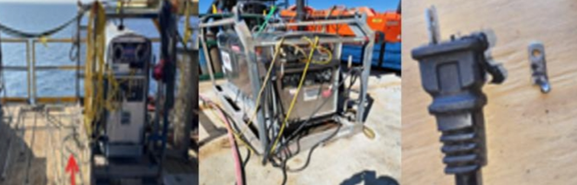
Incident 1: While walking past a welding machine, a worker saw the ground wire and plastic insulation on the welding lead melting. The worker immediately activated the machine’s emergency shutdown to prevent further damage and reduce the risk of injury. During the follow-up inspection, an extension cord was found plugged into the machine that ran into the well bay area, along with the welding lead. A safety team member then doused the affected wires with water. The crew remained on standby and monitored the ground wire and welding lead to ensure the situation was stable and no further problems developed. BSEE note: Applying water to potentially live (energized) conductors create a serious electrocution hazard and may spread a fire if the conductors remain energized.
Incident 2: During routine construction operations, personnel noticed flickering at an electrical cord connection. At first, it appeared the light inside the clear head connection was flickering. Small flames then appeared at the side of the plug. Personnel told the welder to stop working, and as the welder turned to inspect the cord, it began to smoke. Personnel quickly unplugged the cord from the welding machine. They red-tagged the cord and removed it from service. They also inspected all other cords for visible damage and found no other problems.
Incident 3: Instrumentation and electrical crews connected their "Rothenberger Tubing Bender" to bend one-inch (2.5cm) tubing for two sample sinks. When they plugged it in, they saw the plug begin to melt. They quickly unplugged the equipment and notified platform management. An investigation found that the platform receptacle and extension cord were not the source of the problem. Instead, the tubing bender plug had a loose prong that was not detected during the pre-job inspection. The prong fell onto the workbench when the plug was removed. The tubing bender was taken out of service. This incident underscores the need to verify plug integrity and prong security during equipment inspections, not just the condition of the cord and receptacle.
What went wrong?
Contributing factors in all three incidents include inadequate inspections and equipment failure.
Recommendations (from BSEE)
- Ensure extension cords, plugs, and welding leads comply with appropriate local legislation and industry best practice for electrical safety.
- Ensure that extension cords, plugs, and welding leads are all correctly rated for what they are being used for.
- Ensure all cords are three-wire types with intact grounding conductors and secure terminations. Inspect cords, plug prongs, strain reliefs, and terminations before each use.
- Limit extension cord length and regularly inspect, tag, and replace cords used to transmit power in accordance with company procedures and industry best practice.
- Conduct regular hazard hunts that include a check for proper use of extension cords, plugs, and welding leads.
- Confirm proper separation of extension cords, plugs and welding leads before work begins to prevent abrasion and abnormal wear of their protective sheathes/coatings.
- Follow permit-to-work and job safety analysis requirements to identify and assess electrical hazards before work begins.
- Ensure personnel performing electrical work or operating welding equipment are trained and competent in recognizing electrical hazards, including hazards involving temporary equipment.
Members may wish to refer to
- Bureau of Safety and Environmental Enforcement Safety Alert 410 - Damaged Electric Cord Results in Arc
- Bureau of Safety and Environmental Enforcement Safety Alert 314 - Operator Electrocuted Trying to Charge a Battery
Related Safety Flashes
-
IMCA SF 19/21
12 July 2021
-
-
IMCA SF 24/21
31 August 2021
-
IMCA Safety Flashes summarise key safety matters and incidents, allowing lessons to be more easily learnt for the benefit of the entire offshore industry.
The effectiveness of the IMCA Safety Flash system depends on the industry sharing information and so avoiding repeat incidents. Incidents are classified according to IOGP's Life Saving Rules.
All information is anonymised or sanitised, as appropriate, and warnings for graphic content included where possible.
IMCA makes every effort to ensure both the accuracy and reliability of the information shared, but is not be liable for any guidance and/or recommendation and/or statement herein contained.
The information contained in this document does not fulfil or replace any individual's or Member's legal, regulatory or other duties or obligations in respect of their operations. Individuals and Members remain solely responsible for the safe, lawful and proper conduct of their operations.
Share your safety incidents with IMCA online. Sign-up to receive Safety Flashes straight to your email.