High potential near miss – unsecured sheave
- Safety Flash
- Published on 28 May 2019
- Generated on 27 October 2026
- IMCA SF 12/19
- 2 minute read
A hydraulic control lever on a console was inadvertently activated, resulting in the unplanned movement of part of the equipment on a drilling derrick on a vessel.
What happened?
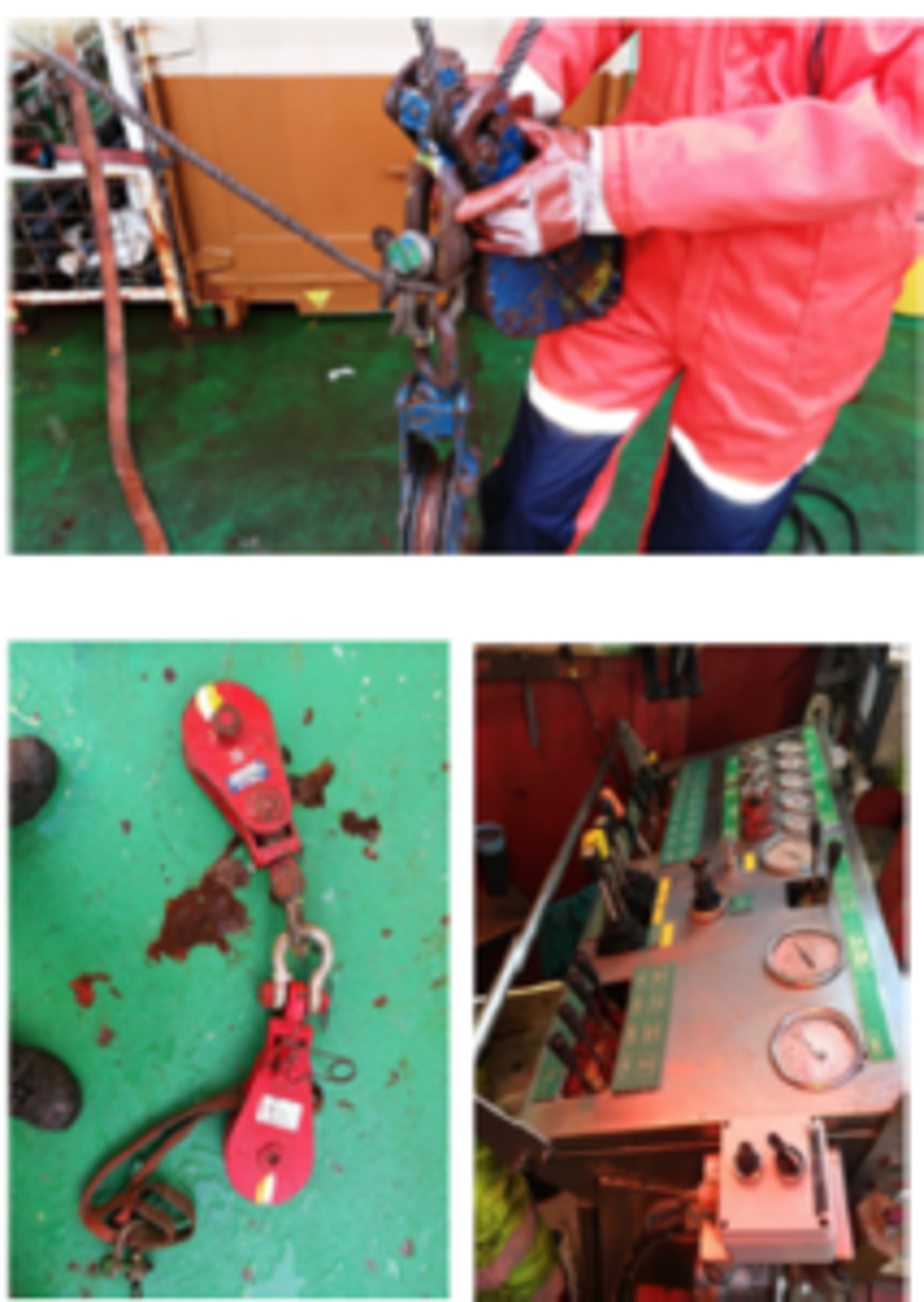
A power swivel crept upwards making contact with a tagline connected to a sheave assembly, leading to a situation where equipment weighing 40 kg was left suspended over crew.
What went wrong?
Investigation identified that the tagline’s change in orientation caused the upper sheave to invert, resulting in the sheave’s hinged gate to open.
With the sheave gate open, an assembly with a combined mass of 40 kg was left hanging on its winch wire above the manned working platform.
What were the causes?
It was concluded that:
- The potential for unintended activation of the control lever(s) had not been adequately considered during the console’s design.
- Once in service, lessons learned from similar incidents had not been consistently applied to all similar consoles.
- There was poor situational awareness: crew failed to notice the uncontrolled rise of the power swivel – they were alerted by a member of crew positioned on the bridge who observed the power swivel making contact with the sheave assembly.
- Safe systems of work across departments with overlapping responsibilities for the inspection, supply, installation and use of the sheave assembly, had failed to identify the sheave’s lack of a secondary restraint and subsequent DROPS risk.
What actions were taken? What lessons were learned?
- Review similar control panels and consoles to mitigate or remove risks arising from inadvertent activation of controls.
- Review and develop a common company standard for winch sheaves and their installation in the context of company operations.
- Improve visibility for workers involved in control locations for this kind of operation – e.g. through better use CCTV systems to better aid operator visibility.
- Review all operations where there is shared or overlapping business or project responsibility to ensure that task risk assessments and associated methodologies clearly define roles and responsibilities.
Related Safety Flashes
-
IMCA SF 11/13
26 June 2013
-
IMCA SF 04/13
15 February 2013
-
IMCA SF 04/06
31 March 2006
IMCA Safety Flashes summarise key safety matters and incidents, allowing lessons to be more easily learnt for the benefit of the entire offshore industry.
The effectiveness of the IMCA Safety Flash system depends on the industry sharing information and so avoiding repeat incidents. Incidents are classified according to IOGP's Life Saving Rules.
All information is anonymised or sanitised, as appropriate, and warnings for graphic content included where possible.
IMCA makes every effort to ensure both the accuracy and reliability of the information shared, but is not be liable for any guidance and/or recommendation and/or statement herein contained.
The information contained in this document does not fulfil or replace any individual's or Member's legal, regulatory or other duties or obligations in respect of their operations. Individuals and Members remain solely responsible for the safe, lawful and proper conduct of their operations.
Share your safety incidents with IMCA online. Sign-up to receive Safety Flashes straight to your email.