Near-miss: Dropped taut wire clump weight
- Safety Flash
- Published on 25 November 2011
- Generated on 22 October 2026
- IMCA SF 13/11
- 3 minute read
A Member has reported an incident in which a winch wire parted and a taut wire clump weight was dropped onto the seabed during diving operations.
The incident occurred when a vessel was engaged in flow line flushing. Owing to a change in wind direction and a forecast of poor weather, it had been agreed to alter the heading of the vessel.
At the time of the incident two divers were in the water and positioned aft and to starboard of the diving bell, and the starboard taut wire was deployed and active as a dynamic positioning (DP) reference. Just before the heading alteration the starboard clump weight was lifted 20 m clear of the seabed and closely monitored by remotely operated vehicles (ROVs). The heading alteration was carried out and the ROV inspected the seabed where the starboard clump weight would land, to check it was clear to land back on the seabed. The seabed at this location was not clear and therefore the decision was made to deploy the port taut wire instead, because the seabed on the port side appeared to be clear of obstruction. The port clump weight was lowered to 100 m above the seabed, in preparation for landing.
The ROV continued to monitor the starboard clump weight and identified an area under it suitable for landing. The starboard taut wire was then deployed and taken back into the DP system, and the port taut wire and clump weight recovered to the surface. During recovery, as the port taut wire was being slewed inboard, the wire parted and the clump weight (315 kg) fell straight downward, well away from the divers working on the seabed, and landed clear of any subsea assets.
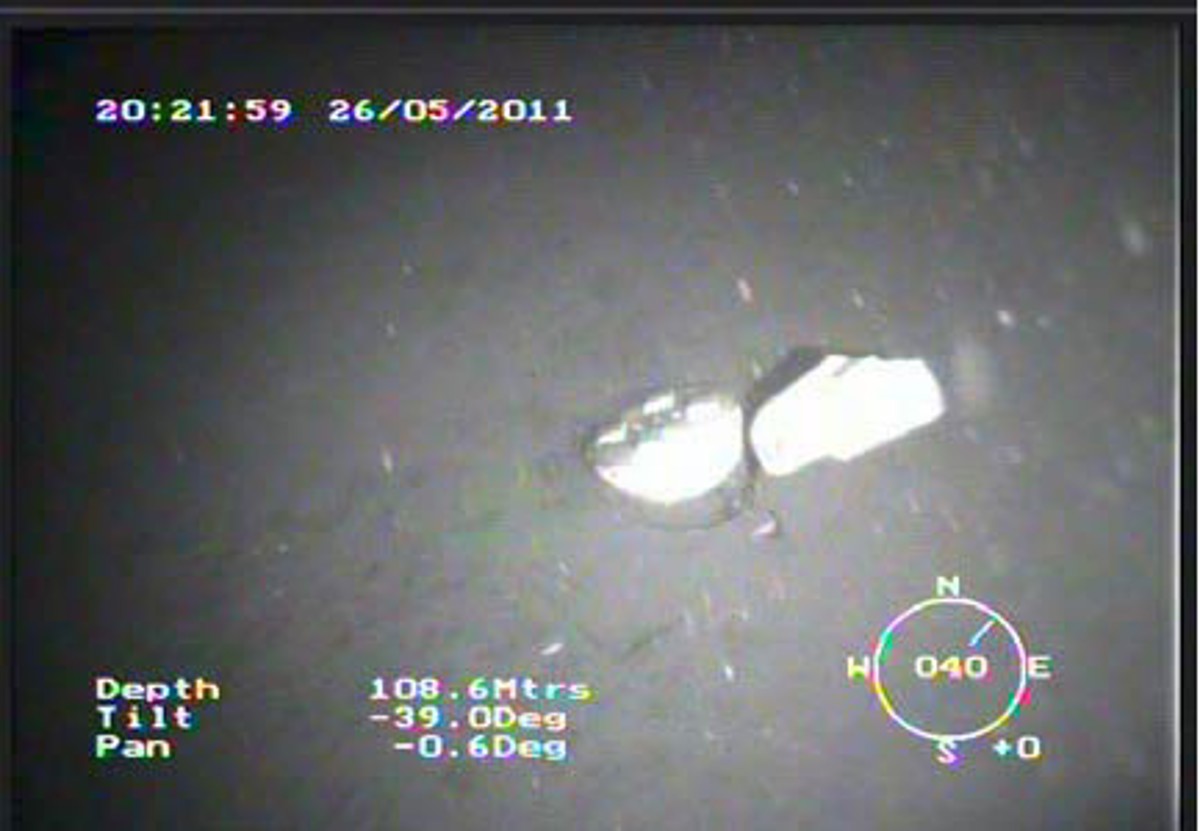
clump weights landed on seabed
What were the causes?
An investigation revealed that:
- A worn wire guide with sharp edges caused unnoticed damage to the taut wire, resulting in the wire parting.
- Procedures for protecting divers and subsea assets from dropped objects were properly followed and this prevented a potentially much more serious incident.
Actions
The following preventative actions were taken:
- The existing starboard taut wire was replaced in its entirety in case further damage had been sustained.
- The damaged wire guide was assessed and temporary repairs were undertaken.
- A complete new unit would be fitted at the next opportunity (dry dock).
- A complete new unit would be fitted at the next opportunity (dry dock).
- There would be a review of relevant inspection and maintenance routines.
Lessons learnt
The following lessons were learnt:
- The 30° dropped object cone employed during the deployment and recovery of loads to and from the surface ensured that the divers were not in a location where they may have been struck by the falling clump weight.
- Loads falling out of control through the water column have a tendency to deviate from a vertical fall. Depending on the shape of the falling load, the water depth, and currents and tides, they can land within a dropped object cone of between 6° and 30° from the vertical.
- Tubular loads have a tendency to deviate even further from the vertical, up to 45°.
- The oversight and checking (by ROV) of the clump weight landing locations prevented any potential damage to subsea infrastructure.
- Taut wires are normally lowered from the surface at the start of DP operations before diving operations start, and recovered to surface after diving and DP operations come to an end. When recovering them to surface during diving operations they should be treated as potential dropped objects which can affect divers, and divers should be clear of the area at these times.
IMCA Safety Flashes summarise key safety matters and incidents, allowing lessons to be more easily learnt for the benefit of the entire offshore industry.
The effectiveness of the IMCA Safety Flash system depends on the industry sharing information and so avoiding repeat incidents. Incidents are classified according to IOGP's Life Saving Rules.
All information is anonymised or sanitised, as appropriate, and warnings for graphic content included where possible.
IMCA makes every effort to ensure both the accuracy and reliability of the information shared, but is not be liable for any guidance and/or recommendation and/or statement herein contained.
The information contained in this document does not fulfil or replace any individual's or Member's legal, regulatory or other duties or obligations in respect of their operations. Individuals and Members remain solely responsible for the safe, lawful and proper conduct of their operations.
Share your safety incidents with IMCA online. Sign-up to receive Safety Flashes straight to your email.