Diver sustains laceration to right hand
- Safety Flash
- Published on 31 July 2025
- Generated on 4 October 2026
- IMCA SF 13/25
- 3 minute read
A diver suffered a deep laceration to his right hand.
What Happened?
The incident occurred during air/nitrox diving at 18m depth. A diver was assigned to retrieve tooling from the forward downline, which had over 2m of slack to accommodate vessel movement. The tooling was dispatched via the messenger but exceeded the acceptable depth range within the dive table due to the slack. To rectify this, a decision was made to come up slightly on the downline to bring the tooling within range.
During this adjustment, the diver used his left hand to pull the tooling toward the structure while his right hand was positioned on the wire for additional leverage. However, an unexpected vessel movement caused the breaker/weak link to part, resulting in the diver’s right hand being drawn toward the snatch block, and his glove becoming entrapped and torn off.
Upon surfacing the diver was immediately taken to the sickbay / hospital for assessment and treatment. He sustained a deep laceration to the base of his right thumb. The wound was stitched, and the diver made a full recovery, retaining full range of motion with no evident ligament involvement or neurological impairment.
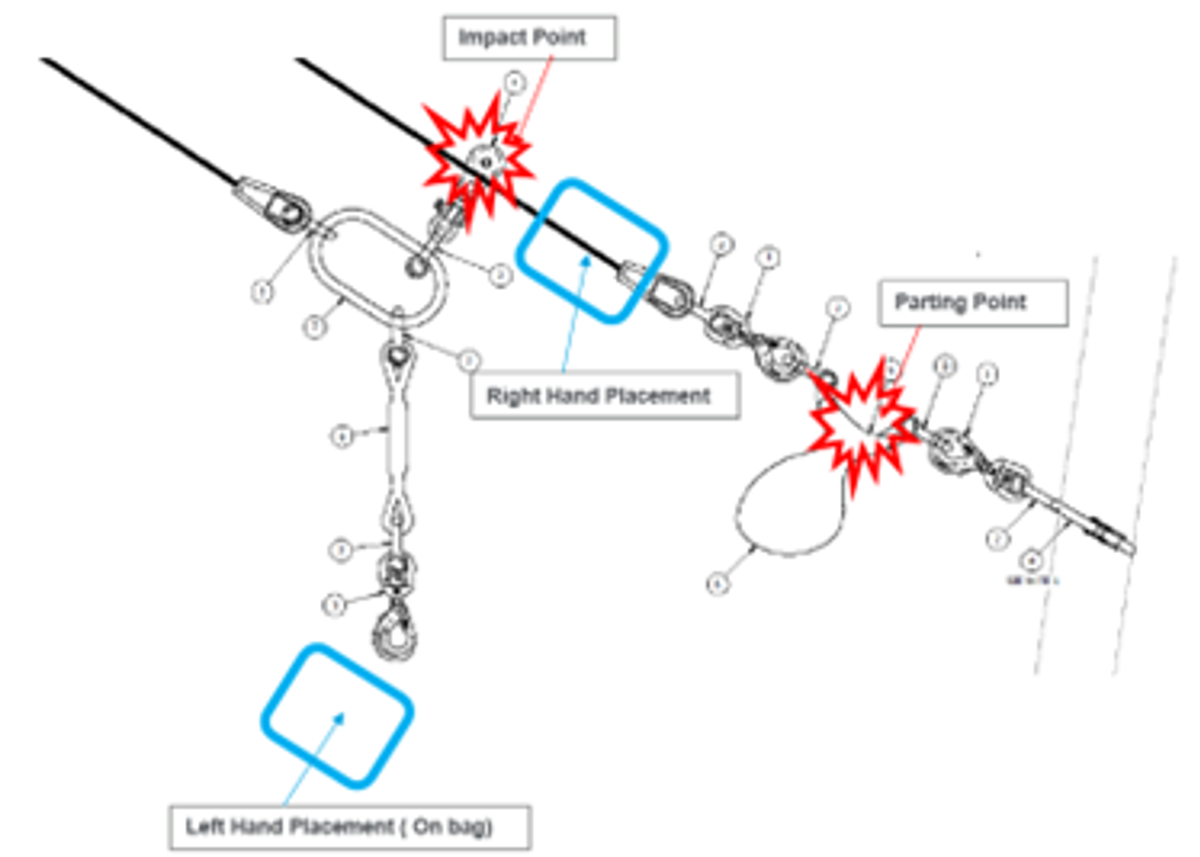
Hand Placement of injured person and rigging arrangement
What went wrong?
Key factors contributing to this incident likely include the unpredictability of vessel movement, tension within the downline, and the closeness of the diver to high-risk equipment (line of fire) such as the snatch block.
The event underscores the importance of maintaining situational awareness and ensuring stability in marine operations to prevent unintentional force transfers that can result in potential serious injury.
Actions and lessons learned
- Engineer out the risk: configure a new engineered solution for downline arrangement / set up - reconfigure the downline to ensure diver remains out of line of fire during retrieval of work equipment.
- Amendments have been made to the divers tool bag with the addition of a lanyard to ensure diver remains out the line of fire.
- Is our communication – particularly in the context of activities such as diving – effective enough?
- Are our risk assessments stringent and detailed enough?
- Could we be more proactive with hazard mitigation strategies, including ensuring proper positioning of personnel and securing lines to withstand potential forces?
- Look out for, assess the risk of, and prepare for, unexpected vessel movements, particularly during diving and lifting operations and when winches or moving machinery may be involved.
Related Safety Flashes
-
IMCA SF 09/25
16 May 2025
-
-
IMCA SF 14/20
28 April 2020
-
-
IMCA SF 20/23
15 August 2023
-
-
IMCA SF 04/25
6 March 2025
-

IMCA Safety Flashes summarise key safety matters and incidents, allowing lessons to be more easily learnt for the benefit of the entire offshore industry.
The effectiveness of the IMCA Safety Flash system depends on the industry sharing information and so avoiding repeat incidents. Incidents are classified according to IOGP's Life Saving Rules.
All information is anonymised or sanitised, as appropriate, and warnings for graphic content included where possible.
IMCA makes every effort to ensure both the accuracy and reliability of the information shared, but is not be liable for any guidance and/or recommendation and/or statement herein contained.
The information contained in this document does not fulfil or replace any individual's or Member's legal, regulatory or other duties or obligations in respect of their operations. Individuals and Members remain solely responsible for the safe, lawful and proper conduct of their operations.
Share your safety incidents with IMCA online. Sign-up to receive Safety Flashes straight to your email.