Crane cab access platform collapsed
- Safety Flash
- Published on 2 October 2025
- Generated on 6 October 2026
- IMCA SF 18/25
- 2 minute read
On a vessel crane, the access platform to the crane cab failed catastrophically.
What happened?
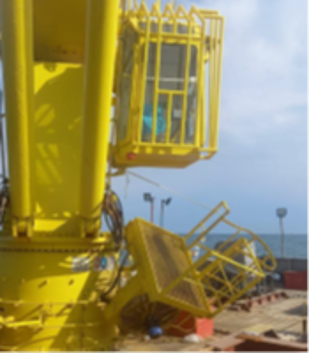
The incident occurred as the Crane Operator (Bosun) was starting work. While the Bosun was climbing the ladder to the cab, the access platform with its protective cage, connected to the crane base, suddenly failed. As a result, the Crane Operator fell within the ladder's protective enclosure, which partially mitigated the fall. The Crane Operator was shaken but not injured.
What went wrong?
- The platform and ladder protection structure failed at the connection point to the crane base while the operator was ascending. The failure was caused by a hidden crack and corrosion at the weld seam.
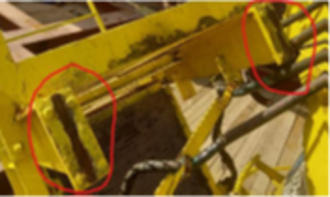
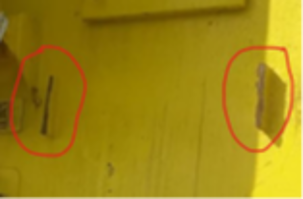
- The ladder platform was connected to the crane pedestal via a structural flange connection. Due to the narrow gap between the flange and the pedestal, visual inspection of the weld area was not feasible, which resulted in undetected deterioration over time.
- The crane structure had been recently painted by a third-party shipyard contractor. It appeared that the old paint was not fully removed during surface preparation. This likely masked existing cracks and corrosion, allowing the defects to remain unnoticed during maintenance.
What can we learn?
- Think about inspection and verification in places that are very difficult to access – can we be sure there is no hidden corrosion?
- Can we design or modify equipment so as to allow easy visual inspection?
- Can we use other inspection techniques such as non-destructive testing (NDT) (e.g., ultrasonic or magnetic particle testing)?
- How do we better manage, check and verify the work of third parties, particularly when that work is done unsupervised in a dock yard or dry-dock setting?
- Be vigilant for visible signs of structural deterioration such as cracks or rust – promptly report such findings.
- During maintenance, are we cleaning and preparing surfaces properly? All old paint layers need to be removed, and surfaces thoroughly inspected before new coating is applied. Failure to do so may result in hidden defects, such as corrosion or cracks, being overlooked.
Related Safety Flashes
-
IMCA SF 25/22
10 November 2022
-
IMCA SF 12/25
3 July 2025
-
-
IMCA SF 12/16
6 May 2016
IMCA Safety Flashes summarise key safety matters and incidents, allowing lessons to be more easily learnt for the benefit of the entire offshore industry.
The effectiveness of the IMCA Safety Flash system depends on the industry sharing information and so avoiding repeat incidents. Incidents are classified according to IOGP's Life Saving Rules.
All information is anonymised or sanitised, as appropriate, and warnings for graphic content included where possible.
IMCA makes every effort to ensure both the accuracy and reliability of the information shared, but is not be liable for any guidance and/or recommendation and/or statement herein contained.
The information contained in this document does not fulfil or replace any individual's or Member's legal, regulatory or other duties or obligations in respect of their operations. Individuals and Members remain solely responsible for the safe, lawful and proper conduct of their operations.
Share your safety incidents with IMCA online. Sign-up to receive Safety Flashes straight to your email.