Japan Transport Safety Board: two confined space fatalities
- Safety Flash
- Published on 27 October 2025
- Generated on 27 October 2026
- IMCA SF 19/25
- 2 minute read
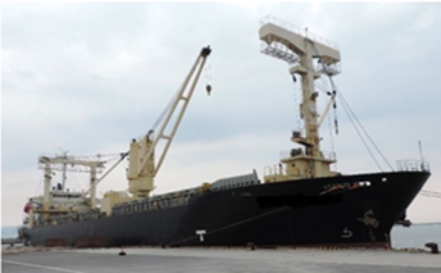
The Japan Transport Safety Board has published report MA2025-4 into a fatal incident which occurred in May 2024 on a bulk carrier moored at a port in Japan.
What happened?
Two stevedores collapsed inside the cargo hold of the vessel during unloading operations. One died and the other was seriously injured. The incident occurred shortly after they entered the hold without conducting atmospheric testing.
What went wrong?
The atmosphere in the hold had low oxygen and high carbon dioxide levels, likely caused by fermentation of the cargo – palm kernel shells.
- There was no testing of the atmosphere in the hold before entry – a very basic confined space entry protocol not followed.
- There was a lack of management oversight:
- No adequate risk assessment.
- No safe system of work or procedures.
- Failure to comply with local (Japanese) regulatory requirements on workplace health and safety.
- There was an “assumption of safety”.
- “Task seen as routine” – as loading and unloading was a routine operation, there was some complacency.
- There was a lack of awareness: there was insufficient understanding of the risks associated with this cargo and of confined space hazards in general.
Similarities exist between this incident and other enclosed space fatality incidents where: - Access to a hold was not properly controlled.
- Consideration was not made for a seemingly non-toxic cargo to generate an atmosphere which is unsafe for humans.
Actions taken
The recommendations of the Japan Transport Safety Board included:
- Mandatory Atmospheric Testing before entry into cargo holds, especially with cargoes of organic materials.
- Further and enhanced training for stevedores and supervisors on confined space risks.
- Development of “Cargo Risk Profiling” - guidelines for handling high-risk cargoes.
Members may wish to refer to:
IMCA Safety Flashes summarise key safety matters and incidents, allowing lessons to be more easily learnt for the benefit of the entire offshore industry.
The effectiveness of the IMCA Safety Flash system depends on the industry sharing information and so avoiding repeat incidents. Incidents are classified according to IOGP's Life Saving Rules.
All information is anonymised or sanitised, as appropriate, and warnings for graphic content included where possible.
IMCA makes every effort to ensure both the accuracy and reliability of the information shared, but is not be liable for any guidance and/or recommendation and/or statement herein contained.
The information contained in this document does not fulfil or replace any individual's or Member's legal, regulatory or other duties or obligations in respect of their operations. Individuals and Members remain solely responsible for the safe, lawful and proper conduct of their operations.
Share your safety incidents with IMCA online. Sign-up to receive Safety Flashes straight to your email.