Watertight door and emergency hatch found open at sea
- Safety Flash
- Published on 7 November 2025
- Generated on 5 October 2026
- IMCA SF 20/25
- 2 minute read
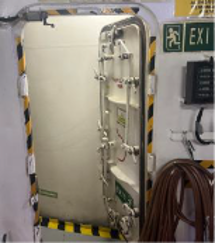
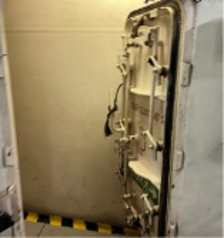
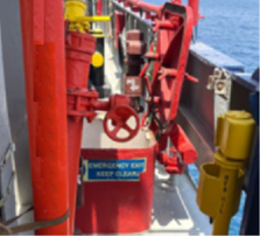
Watertight doors and an emergency hatch were observed open in the ER (Engine Room) during an offshore audit.
What happened?
These critical safety barriers prevent water ingress and provide escape routes, and their improper closure compromises vessel integrity, increases flooding risk, and endangers crew safety.
SOLAS Chapter II-1, Part B-4, Regulation 22: All watertight doors shall be kept closed during navigation, except under conditions specified in the same regulation, and shall be closed immediately after use.
 |
 |
 |
Why it happened?
- It’s always hot in the engine room, and crew may have left these watertight doors open to reduce temperature and improve ventilation.
- It may be considered a routine practice to leave open, doors that should be kept shut. Our member notes that this has been observed on other vessels.
- Some crew were not aware of SOLAS II-1/22 and company requirements to keep these doors shut, nor of the importance of keeping watertight doors closed during navigation.
What do we do next?
- Watertight integrity is critical: Doors and hatches are safety barriers, not comfort measures, and should remain closed at sea.
- Crew practices matter: Even small routine shortcuts (leaving doors open after walkarounds) can create major risks in emergencies.
- Awareness and training are essential: Not all crew fully understand SOLAS or company requirements, showing the need for regular refreshers.
- Can we make it easier to be safe?
- Environmental challenges require solutions: Engine room conditions, whilst aways hot, should be addressed through proper ventilation systems, rather than by compromising safety barriers.
Related Safety Flashes
-
IMCA SF 01/22
10 January 2022
-
-
IMCA SF 08/24
16 April 2024
-
-
IMCA SF 02/23
11 January 2023
-
IMCA Safety Flashes summarise key safety matters and incidents, allowing lessons to be more easily learnt for the benefit of the entire offshore industry.
The effectiveness of the IMCA Safety Flash system depends on the industry sharing information and so avoiding repeat incidents. Incidents are classified according to IOGP's Life Saving Rules.
All information is anonymised or sanitised, as appropriate, and warnings for graphic content included where possible.
IMCA makes every effort to ensure both the accuracy and reliability of the information shared, but is not be liable for any guidance and/or recommendation and/or statement herein contained.
The information contained in this document does not fulfil or replace any individual's or Member's legal, regulatory or other duties or obligations in respect of their operations. Individuals and Members remain solely responsible for the safe, lawful and proper conduct of their operations.
Share your safety incidents with IMCA online. Sign-up to receive Safety Flashes straight to your email.