Structural failure of rescue boat
- Safety Flash
- Published on 17 December 2024
- Generated on 4 October 2026
- IMCA SF 24/24
- 4 minute read
A rescue boat suffered a catastrophic structural failure whilst unattended on the davit.
What happened?
Whilst no activities were being performed by crew on the rescue boat station, the structure of the boat failed causing the lifting frame and the console assembly to be torn off the hull. The hull then dropped into the sea. The remains of the rescue boat were retrieved for further investigation. There were no injuries.
Immediately after the incident, a general alarm was sounded and a muster was conducted to ensure everyone was present and no-one was injured or overboard. The area near the rescue boat station was isolated, and a supply ship with available rescue boat was contracted to be in the vicinity of vessel having lost her rescue boat.
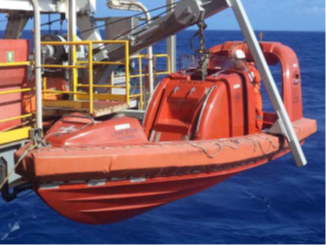
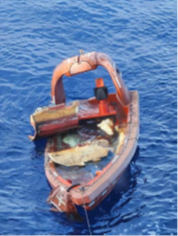
What went wrong?
Investigation showed that
- Forces applied to the fall wire were either equal to or greater than a 1.1 x overload test, as observed on the shock absorber displacement during factory acceptance testing of the boat.
- There were signs that the hydraulic cylinder (shock absorber) was being over-compressed.
- The accumulator of the hydraulic cylinder (shock absorber) was found to be pre-charged with a pressure above that used during the factory acceptance testing of the boat.
- The operations manual provided did not make it clear enough that manual cranking of the davit could cause a possible overload of the load-bearing structure of the rescue boat.
- It was possible for an average crew person to apply sufficient force to the manual cranking handle as to overload and collapse the load-bearing structure of the rescue boat.
What was the cause?
Constant excessive force applied to the lifting frame of the boat, eventually led to the lifting frame and the console assembly being torn off the hull. There was constant excessive force applied to the lifting frame of the boat because the shock absorber was unable to absorb the forces caused by excessive manual hand cranking. This happened because:
· The operations manual did not make it clear that it was possible to overload the boat lifting frame by hand cranking the davit.
· The crank lever system available had no means of monitoring or controlling the loads being applied.
· The ongoing damage to the boat and its lifting structure had not been spotted by OEM yearly inspections.
· The shock absorber hydraulic cylinder (shock absorber) was not properly maintained.
· The method of stowing the fast rescue boat not using a cradle but pulling the boat structure against the vertical stoppers increased the likelihood of severe structural damage.
Actions taken
· A technical alert was issued to the fleet and all similar rescue boats were duly inspected.
· The hand crank assembly was replaced by a torque wrench, which permitted some control of the hand cranking forces applied to the rescue boat.
· The stopper on the davit was modified.
· Improved site acceptance and on-site assessment when installing equipment from an OEM, including thorough toolbox meetings between vessel engineers and third-party (OEM) representatives on site.
Lessons learnt
· Ensure authorised service personnel service and maintain critical components of lifting equipment.
· Ensure that pressures in hydraulic components such as accumulators are set correctly and are fully understood by the users.
Related Safety Flashes
-
IMCA SF 17/21
16 June 2021
-
IMCA SF 10/17
12 May 2017
-
-
IMCA SF 21/19
4 September 2019
All incidents and events used as part of IMCA Safety Flashes are dealt with, and will continue to be dealt with, using full anonymity and the strictest confidentiality. However for this particular incident our member Constellation Oil Services is happy to be contacted for any further information. Please contact [email protected] in this instance.
IMCA Safety Flashes summarise key safety matters and incidents, allowing lessons to be more easily learnt for the benefit of the entire offshore industry.
The effectiveness of the IMCA Safety Flash system depends on the industry sharing information and so avoiding repeat incidents. Incidents are classified according to IOGP's Life Saving Rules.
All information is anonymised or sanitised, as appropriate, and warnings for graphic content included where possible.
IMCA makes every effort to ensure both the accuracy and reliability of the information shared, but is not be liable for any guidance and/or recommendation and/or statement herein contained.
The information contained in this document does not fulfil or replace any individual's or Member's legal, regulatory or other duties or obligations in respect of their operations. Individuals and Members remain solely responsible for the safe, lawful and proper conduct of their operations.
Share your safety incidents with IMCA online. Sign-up to receive Safety Flashes straight to your email.