High potential near miss: Dropped Paraguard stretcher during drill
- Safety Flash
- Published on 13 November 2023
- Generated on 27 October 2026
- IMCA SF 26/23
- 2 minute read
During a rescue from height /evacuation drill within the top of the main crane pedestal, a Paraguard stretcher (12 kg) slipped out from the dummy and fell approx. 50 m to the crane winch room below.
What happened?
The incident occurred just as the descent was starting. The area below the drill was a restricted access area; there were no injuries.
What went wrong?
For the first transfer through the top hatch, using the tripod, the lifting point on the stretcher itself was correctly used. However, after the transfer to the descending davit, the descending cable was attached to the Dummy harness, not to the stretcher lifting point.
This led to the stretcher and dummy not being secured to each other, and the stretcher slipping during the descent.
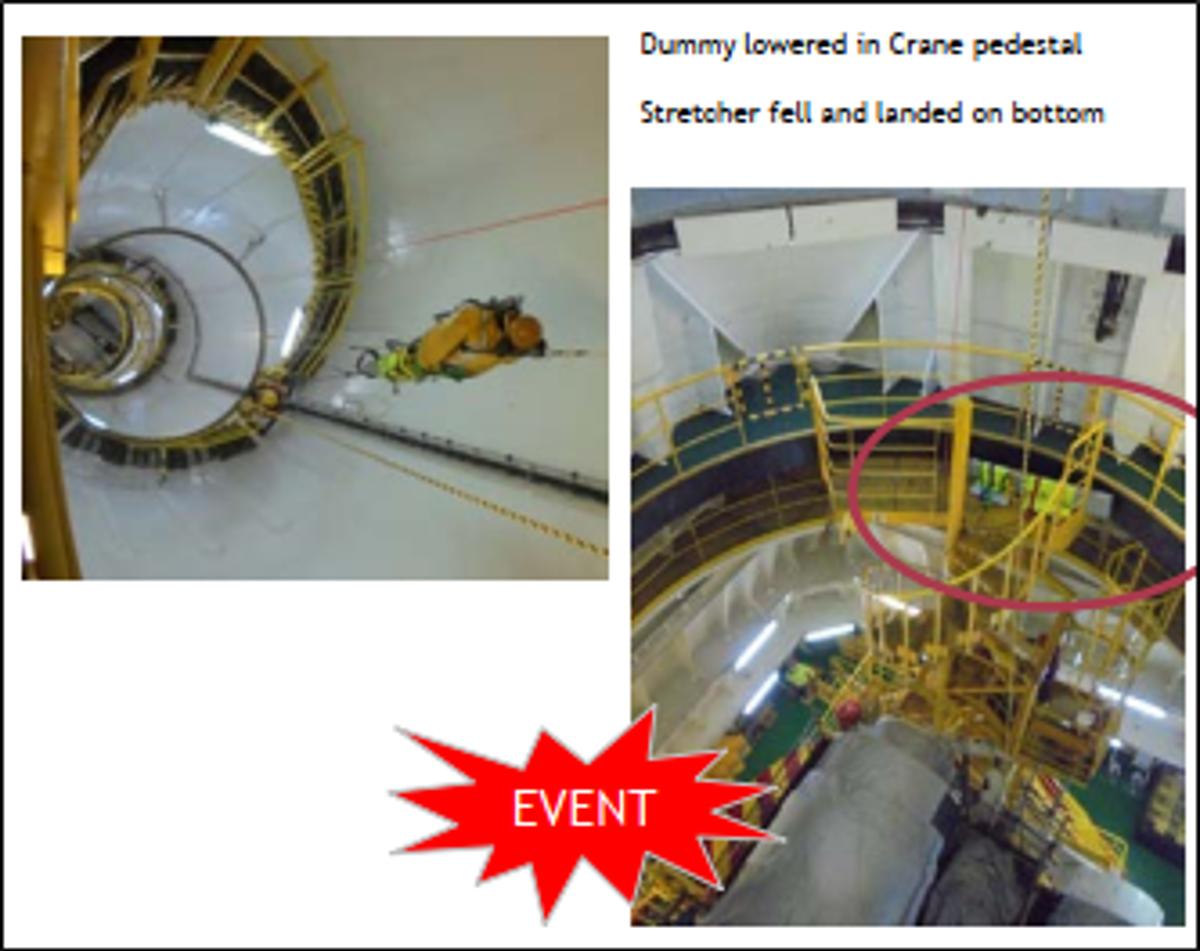
During a rescue from height /evacuation drill within the top of the main crane pedestal, a Paraguard stretcher (12 kg) slipped out from the dummy and fell approx. 50 m to the crane winch room below
Our member noted the following:
- The rescue plan was too generic and did not address specifically the process by which the injured person in a stretcher would be lowered.
- Despite the presence of several rescue team members, nobody noticed that the rope was connected to the wrong attachment point.
Lessons learned and actions
-
Rescue teams ought to be familiar with the stretchers used on board, and follow the manufacturer’ instructions.
-
Rescue plans should be specific and contain detailed information related to the equipment used (Stretcher, Tripod, Davit) and the descent/lowering process, load transfers and connections. The Plan should be reviewed at the toolbox talk before the drill, and this should include as much as possible hands-on practice with the specific stretcher.
-
The Potential DROPS area below the area where the drill is occurring should be barricaded, marked, and vacated during the descent. Special attention may be required to ensure that the medical team stood by, are kept outside of the potential line of fire.
-
Review the rescue plan in this case to
-
Ensure that suitable rescue equipment is used (if space is limited, the use of a stretcher can pose additional hazards and use of a harness may be an acceptable alternative);
- Incorporate more specific details on the process of lowering the casualty.
-
Related safety flashes
-
IMCA SF 01/22
10 January 2022
-
IMCA SF 22/21
11 August 2021
-
IMCA SF 07/20
26 February 2020
-
IMCA Safety Flashes summarise key safety matters and incidents, allowing lessons to be more easily learnt for the benefit of the entire offshore industry.
The effectiveness of the IMCA Safety Flash system depends on the industry sharing information and so avoiding repeat incidents. Incidents are classified according to IOGP's Life Saving Rules.
All information is anonymised or sanitised, as appropriate, and warnings for graphic content included where possible.
IMCA makes every effort to ensure both the accuracy and reliability of the information shared, but is not be liable for any guidance and/or recommendation and/or statement herein contained.
The information contained in this document does not fulfil or replace any individual's or Member's legal, regulatory or other duties or obligations in respect of their operations. Individuals and Members remain solely responsible for the safe, lawful and proper conduct of their operations.
Share your safety incidents with IMCA online. Sign-up to receive Safety Flashes straight to your email.