MAIB: Crush fatality during lifting operations
- Safety Flash
- Published on 1 October 2021
- Generated on 26 April 2026
- IMCA SF 27/21
- 2 minute read
The UK Marine Accident Investigation Branch (MAIB ) has published Report 12/2021 into a fatal crush accident which occurred while a gantry crane was moving a hatch cover, on board the general cargo vessel Cimbris, at Antwerp, Belgium, on 14 July 2020.
What happened?
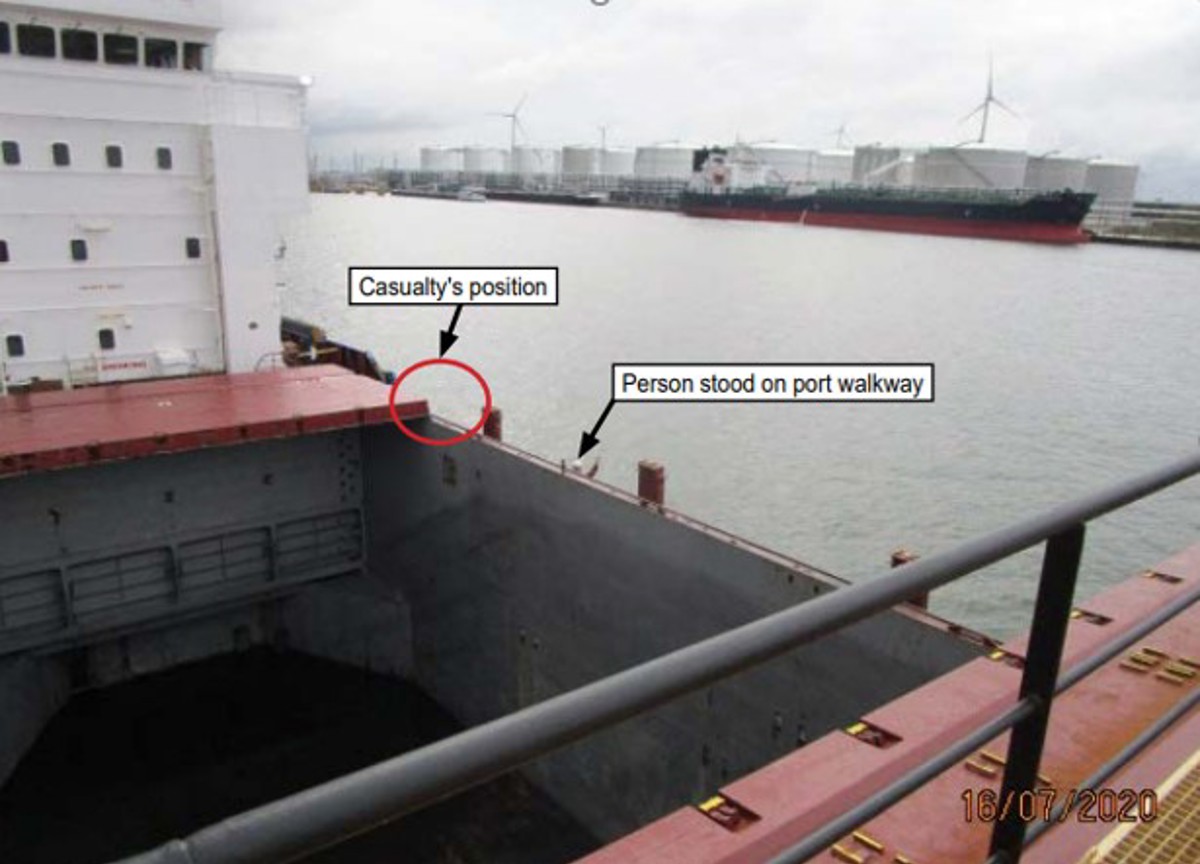
A crew member was fatally crushed when he became trapped between the vessel’s gantry crane and a cargo hatch cover.
No one saw the crew member position himself between the moving gantry crane and the hatch cover, but his likely intent was to assess the progress being made by his team working in the hold.
What went wrong?
- The crew member was fatally crushed between the gantry crane and the hatch cover because he placed himself in the path of the moving crane and the crane did not stop.
- The crew member almost certainly knew the gantry crane was moving but was probably confident that he could achieve his objective and move out of its path.
- The ship’s gantry crane operator did not stop the crane because he did not know the crew member was in the way.
What were the causes?
- The Chief Officer did not have a full view of the crane’s path from his control position.
- Contrary to the vessel’s documented procedures, a second crew member was not used to act as a lookout or banksman.
- The hatch cover lifting operation was not properly planned, adequately supervised, or executed in a safe manner.
- Communication between the ship’s crew and port crew was poor and the safety culture demonstrated by both was weak.
Excellent detailed report including many informative photographs, here.
Actions taken
The company involved:
- Made it mandatory that there be a second person to act as safety sentry during the operation of cranes, gantry cranes or hatch cover machinery.
- Reviewed its safety procedures for such operations.
- Issued a safety instruction card, defining the role of safety lookout for all crane operations.
Members may wish to refer to:
- IMCA HSS019 Guidelines for lifting operations
IMCA Safety Flashes summarise key safety matters and incidents, allowing lessons to be more easily learnt for the benefit of the entire offshore industry.
The effectiveness of the IMCA Safety Flash system depends on the industry sharing information and so avoiding repeat incidents. Incidents are classified according to IOGP's Life Saving Rules.
All information is anonymised or sanitised, as appropriate, and warnings for graphic content included where possible.
IMCA makes every effort to ensure both the accuracy and reliability of the information shared, but is not be liable for any guidance and/or recommendation and/or statement herein contained.
The information contained in this document does not fulfil or replace any individual's or Member's legal, regulatory or other duties or obligations in respect of their operations. Individuals and Members remain solely responsible for the safe, lawful and proper conduct of their operations.
Share your safety incidents with IMCA online. Sign-up to receive Safety Flashes straight to your email.