LTI – crew member squeezed between buoy and cargo rail
- Safety Flash
- Published on 15 April 2026
- Generated on 15 October 2026
- IMCA SF 07/26
- 2 minute read
A crew member was crushed between a large buoy and a cargo rail.
What happened?
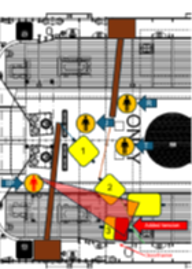
During anchor handling operations, a crew member was crushed between a large buoy and a cargo rail. The crew member was freed and had to be med-evaced. The incident occurred when the deck crew was in the process of connecting two 5-ton sub-surface buoys to a chain adapter as part of a multi-step hookup sequence. After securing an 800m fibre rope in the shark jaw, the team began preparing the buoys for connection. The first buoy had already been positioned using the starboard crane. The second buoy was then dragged toward the connection point using the port crane, while the buoys remained partly interconnected through their stock eyes.
Because the buoys had been stored in pairs, one lashing between the buoys and the cargo rail had not been removed. The remaining lashing created a slight lift on the buoy as it was dragged, storing tension in the system. This was noticed, and the operation was stopped.
One crew member entered the narrow space between the buoy and the cargo rail to reach the ratchet handle and release the strap. As the lashing was opened, the built-up energy caused the buoy to spring back to its resting position. The buoy moved suddenly and forcefully, trapping the crew member against the cargo rail.
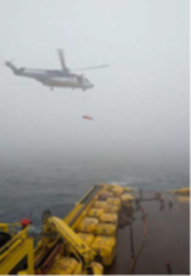
The deck crew attempted first to move the buoy with the crane, then switched to using a tugger line on the aft capstan, successfully freeing the injured person. Medical personnel arrived promptly, and the crew member was evacuated by helicopter after initial stabilization on board.
 |
 |
Lessons learned
- Take particular attention when moving complex loads, such as interconnected buoy, in this case. Could there be stored energy which might lead to unexpected movement?
- Are we moving items that are still partly secured or tied down? Check!
- Don’t put yourself “in the line of fire” – in this instance the crew member went between the large buoy and the cargo rail.
Please see the attached short animation provided by our member: imca-int.com/media/cbgakbll/video-accompanying-sf-07-26-incident-1.mp4
Related Safety Flashes
-
IMCA SF 27/21
1 October 2021
-
-
IMCA SF 15/22
20 June 2022
-
-
IMCA SF 23/22
24 October 2022
-
IMCA Safety Flashes summarise key safety matters and incidents, allowing lessons to be more easily learnt for the benefit of the entire offshore industry.
The effectiveness of the IMCA Safety Flash system depends on the industry sharing information and so avoiding repeat incidents. Incidents are classified according to IOGP's Life Saving Rules.
All information is anonymised or sanitised, as appropriate, and warnings for graphic content included where possible.
IMCA makes every effort to ensure both the accuracy and reliability of the information shared, but is not be liable for any guidance and/or recommendation and/or statement herein contained.
The information contained in this document does not fulfil or replace any individual's or Member's legal, regulatory or other duties or obligations in respect of their operations. Individuals and Members remain solely responsible for the safe, lawful and proper conduct of their operations.
Share your safety incidents with IMCA online. Sign-up to receive Safety Flashes straight to your email.