BSEE: Exterior Walkway separates from temporary living quarters, putting workers at risk
- Safety Flash
- Published on 15 April 2026
- Generated on 15 October 2026
- IMCA SF 07/26
- 3 minute read
The United States Bureau of Safety and Environmental Enforcement (BSEE) has published Safety Alert 513, relating to an incident involving a third-floor walkway outside temporary living quarters on an offshore platform.
What happened?
Three workers were standing on an external third-floor walkway outside of their room located on the platform’s temporary living quarters when the walkway detached from the structure. Two of the workers were able to open the door and returned inside their room. The third worker moved away from the detached section while remaining on the walkway. After the crew confirmed all workers were safe, personnel secured the stairway and walkway with chain bindings to prevent dropped objects and further movement.
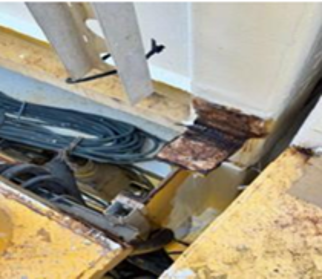 |
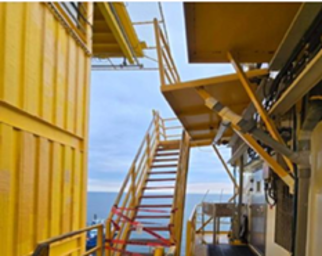 |
| Walkway separated outward from temporary living quarters, exposing a significant gap. | View from below of walkway shifted outward from temporary living quarters, revealing a significant gap. |
What went wrong?
The operator installed the living quarters as a temporary structure designed for removal or dismantling. (The quarters remained in service for 23 years.) As such, the operator’s inspections did not account for the structure’s age or the offshore environment. Inspection criteria did not address corrosion, fatigue or age-related deterioration of welds.
Contributing factors
- Design not intended for long-term service: The living quarters were built as temporary housing for overflow workers but remained in place for 23 years.
- Inspections were not adequate: The operator relied on visual inspections only. Those inspections did not verify the condition of the tab welds connecting the walkway to the living quarters.
- Insufficient structural support: The welded tabs at the walkway connection points did not provide enough welded surface for support. The stairway’s south side lacked support, which may have increased stress and contributed to the failure.
- Marine environment and aging: Corrosion and age-related fatigue affected the tab welds over time.
- Inspection management weaknesses: The operator used inspection criteria based on the structure’s original “temporary” intent. Visual inspections did not identify hazards related to structural support of the living quarters and walkways.
What happened next?
To help prevent similar incidents, BSEE recommends that operators and their contractors, where appropriate, consider the following:
- Design and build “temporary” structures with potential long-term use in mind.
- Update inspection programs for temporary living quarters and similar installations to address marine corrosion, fatigue, weld condition and structural integrity.
- Use non-destructive testing with visual inspections, such as ultrasonic testing, to evaluate weld thickness and detect structural degradation.
Related Safety Flashes
-
IMCA SF 18/25
2 October 2025
-
IMCA SF 10/25
4 June 2025
-
IMCA SF 24/24
17 December 2024
-
IMCA Safety Flashes summarise key safety matters and incidents, allowing lessons to be more easily learnt for the benefit of the entire offshore industry.
The effectiveness of the IMCA Safety Flash system depends on the industry sharing information and so avoiding repeat incidents. Incidents are classified according to IOGP's Life Saving Rules.
All information is anonymised or sanitised, as appropriate, and warnings for graphic content included where possible.
IMCA makes every effort to ensure both the accuracy and reliability of the information shared, but is not be liable for any guidance and/or recommendation and/or statement herein contained.
The information contained in this document does not fulfil or replace any individual's or Member's legal, regulatory or other duties or obligations in respect of their operations. Individuals and Members remain solely responsible for the safe, lawful and proper conduct of their operations.
Share your safety incidents with IMCA online. Sign-up to receive Safety Flashes straight to your email.