BSEE: Failure to identify and restrict access to faulty gratings
- Safety Flash
- Published on 4 June 2025
- Generated on 17 October 2026
- IMCA SF 10/25
- 2 minute read
The Bureau of Safety and Environmental Enforcement of the United States (BSEE) has published Safety Alert 496 relating to faulty gratings.
What happened?
During a facility walkthrough, operator personnel had identified grating near a skid as a hazard due to corrosion and installed hard barricades to prevent access. However, shortly thereafter, operator personnel installed two scaffolding boards on top of the previously identified grating hazard and removed the hard barricades so work could proceed (Figure 1).
Images
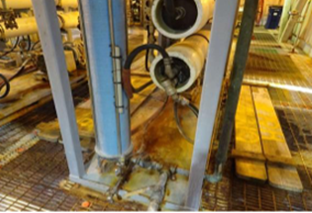
Figure 1: Faulty grating covered in scaffold boards
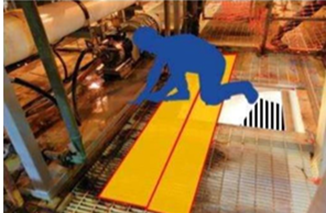
Figure 2: Operator’s body position at time of incident
A worker tasked with installing a pump in the skid above the unsafe grating was kneeling on the scaffolding boards with the tip of his boots resting on the grating when the corroded section of grating suddenly gave way (Figure 2). The worker was able to quickly react, grabbing hold of a nearby section of piping to support himself. Upon further inspection, the worker later realized the 90cm x 90cm piece of grating beneath the scaffolding boards he was kneeling on had collapsed and fallen into the water. Following the incident, operator personnel placed additional boards over the resulting open hole in the grating but did not install hard barricades or identify the area as a hazard. Hard barricades were later reinstalled, and the grating was subsequently replaced.
Recommendations
· On regular walk-arounds, identify any open holes and check that potentially unsafe surfaces can safely support the weight of individuals working on or around them. If such an area or open hole is identified, ensure it has been properly barricaded and/or covered.
· Ensure everyone clearly understands the requirements and expectations for the use of barricades. Effective hard barricades should be rigid, immovable structures that create a barrier to restrict access to hazardous or unsafe areas.
· Design: Ensure that management of safety hazards and environmental impacts is an integral part of the design, construction, maintenance, operation, and monitoring of vessels and facilities.
Related Safety Flashes
-
IMCA SF 09/24
30 April 2024
-
IMCA SF 24/23
16 October 2023
-
-
IMCA SF 03/25
20 February 2025
-

IMCA Safety Flashes summarise key safety matters and incidents, allowing lessons to be more easily learnt for the benefit of the entire offshore industry.
The effectiveness of the IMCA Safety Flash system depends on the industry sharing information and so avoiding repeat incidents. Incidents are classified according to IOGP's Life Saving Rules.
All information is anonymised or sanitised, as appropriate, and warnings for graphic content included where possible.
IMCA makes every effort to ensure both the accuracy and reliability of the information shared, but is not be liable for any guidance and/or recommendation and/or statement herein contained.
The information contained in this document does not fulfil or replace any individual's or Member's legal, regulatory or other duties or obligations in respect of their operations. Individuals and Members remain solely responsible for the safe, lawful and proper conduct of their operations.
Share your safety incidents with IMCA online. Sign-up to receive Safety Flashes straight to your email.