Death of seafarer due to fall from crane cabin
- Safety Flash
- Published on 15 April 2026
- Generated on 16 October 2026
- IMCA SF 07/26
- 3 minute read
The Directorate General of Shipping (DGS) of India published Circular 04-2025 relating to an incident in which a seafarer took a fatal fall from a crane cabin.
What happened?
On a vessel at anchor awaiting berthing instructions, two crew members were tasked with cleaning the interiors of the cargo crane cabins, which required maintenance after recent cargo operations. About 30 minutes into the work, one of the seafarers fell 12m from the cabin of one of the cargo cranes to the deck below. The seafarer was fatally injured by the fall.
There was no evidence that fatigue, substance use, or adverse weather played a role in the incident.
Immediate cause
The safety investigation determined that the most probable cause of the fall was the failure of the sealing mechanism of the bottom window in the cabin of the cargo crane. The crew member fell through the bottom window, which gave under their weight.
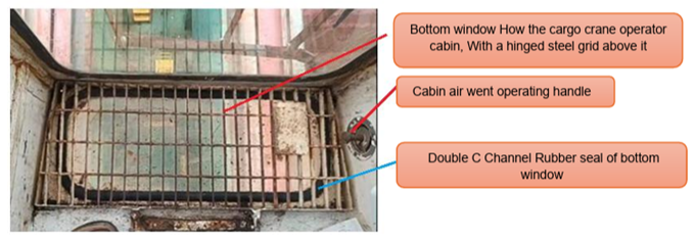
Contributory factors (Directorate General of Shipping)
- Grating Removal: The protective steel grating over the window was removed to access the glass for cleaning due to a seized cabin air vent handle. Normally, the grating is swung out to clean the glass, but due to the obstruction from seized air vent handle, the seafarer had to remove it completely, leaving the fragile glass exposed.
- The glass pane and rubber seal were not designed to support any weight. Also, the glass may have been previously weakened.
- Seal Failure: The rubber seal (double C-channel type) possibly failed under weight of the seafarer.
- Corrosion: Thinning of metal around the window frame may have weakened the structure.
- There was no fall arrest nor PPE used.
- There were no safety barriers:
- No physical guard remained after grating was removed.
- No alarms or interlocks to prevent or warn against barrier removal.
- No warning signs to alert the seafarer to the hazard.
Lessons learned
- Routine Task Risk: Familiar tasks can lead to complacency. Hazards in routine jobs are often underestimated, highlighting the need for vigilant risk assessments.
- Barrier Integrity: The removal of physical protections (like gratings) can expose hidden risks. Such components must be treated as critical safety barriers.
- Structural Inspections: Equipment such as window assemblies and sealing mechanisms can deteriorate over time and should be regularly inspected to prevent structural failure.
- Training on Equipment Hazards: Lack of awareness about equipment limitations (e.g., glass not designed to bear weight) can result in incidents.
- Use of Safety Signage: Absence of visual warnings may cause workers to overlook hazards. Clear signage could have reinforced awareness.
- A proactive Safety Culture: Unsafe conditions often go unnoticed when safety practices are reactive. A proactive approach to inspections and hazard identification is essential.
Related Safety Flashes
-
IMCA SF 28/19
6 December 2019
-
-
IMCA SF 10/25
4 June 2025
-
IMCA SF 18/25
2 October 2025

IMCA Safety Flashes summarise key safety matters and incidents, allowing lessons to be more easily learnt for the benefit of the entire offshore industry.
The effectiveness of the IMCA Safety Flash system depends on the industry sharing information and so avoiding repeat incidents. Incidents are classified according to IOGP's Life Saving Rules.
All information is anonymised or sanitised, as appropriate, and warnings for graphic content included where possible.
IMCA makes every effort to ensure both the accuracy and reliability of the information shared, but is not be liable for any guidance and/or recommendation and/or statement herein contained.
The information contained in this document does not fulfil or replace any individual's or Member's legal, regulatory or other duties or obligations in respect of their operations. Individuals and Members remain solely responsible for the safe, lawful and proper conduct of their operations.
Share your safety incidents with IMCA online. Sign-up to receive Safety Flashes straight to your email.