Finger injury during work with rotating machinery
- Safety Flash
- Published on 7 November 2017
- Generated on 27 October 2026
- IMCA SF 28/17
- 2 minute read
Whilst working with a pillar drilling machine, a crewman got his glove caught in the rotating bit and dislocated his left thumb.
What happened?
The incident happened on an ocean-going cargo vessel. Two engine room crewmen were using a drilling machine in the engine room workshop to fabricate a small part.
One of the crewmen put on leather gloves and tried to remove some metal chips that came out during the drilling process. His glove got entangled with the drill bit resulting in him dislocating his left thumb.
Both hand and foot operated emergency stop was immediately activated. The injured person was assisted by other crew members to cut off the glove and he was accompanied to the vessel hospital. After consultation with medical authorities over the radio, treatment was given on board.
A splint with bandage was applied to immobilise the thumb and painkillers administered. Ten days later when the vessel came to port, the injured person was sent to the doctor, where he was declared medically unfit and signed off.
What went wrong? What were the causes?
- There was no evidence of risk assessment, no toolbox talk was conducted.
- The injured person was wearing gloves while using the drilling machine – there was a warning sign prohibiting wearing of gloves when operating the drill, posted in front of the drilling machine.
- Lack of safety awareness/habits.
- The immediate causes were:
- Improper use of personal protective equipment (PPE) – the glove got entangled with the drill bit.
- Carelessness and lack of safety awareness – the warning sign prohibiting wearing of gloves when operating drilling machine was ignored.
- Improper use of equipment – the proper cleaning tools were not available for drilling and machining jobs.
- Improper use of personal protective equipment (PPE) – the glove got entangled with the drill bit.
- Causal factors were:
- Inadequate planning – this potential risk was not identified.
- Inadequate supervision.
- Inadequate planning – this potential risk was not identified.
- The root cause was, the injured person did not follow instructions: he was not compliant with existing company requirement on PPE when working with rotating equipment.
Actions taken
- Suitable and sufficient risk assessment to be carried out for routine and non-routine work.
- More effective toolbox talks to be held discussing hazards and controls.
- Reiteration of company policy that gloves are NOT TO BE WORN when working with rotating machinery.
- Warning signage if posted to be clearly visible.
- Consider additional supervision for less experienced crew.
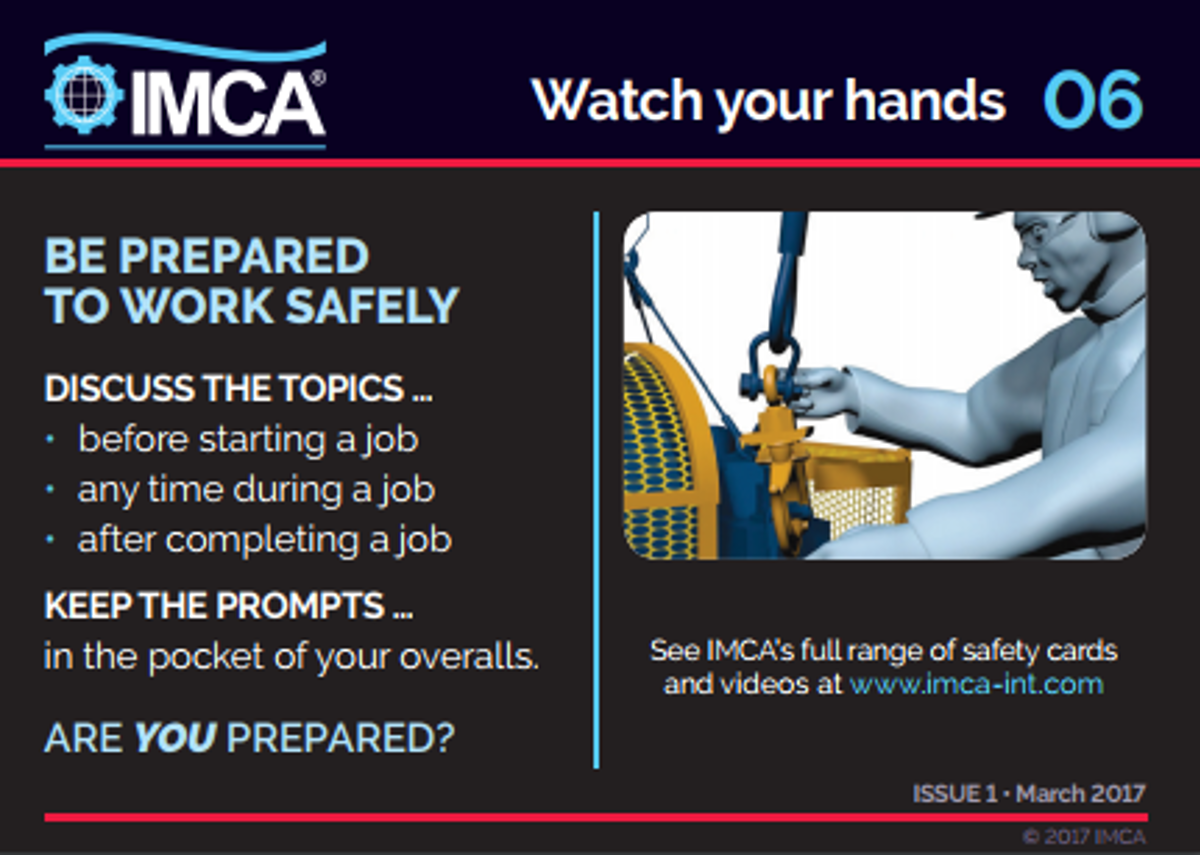
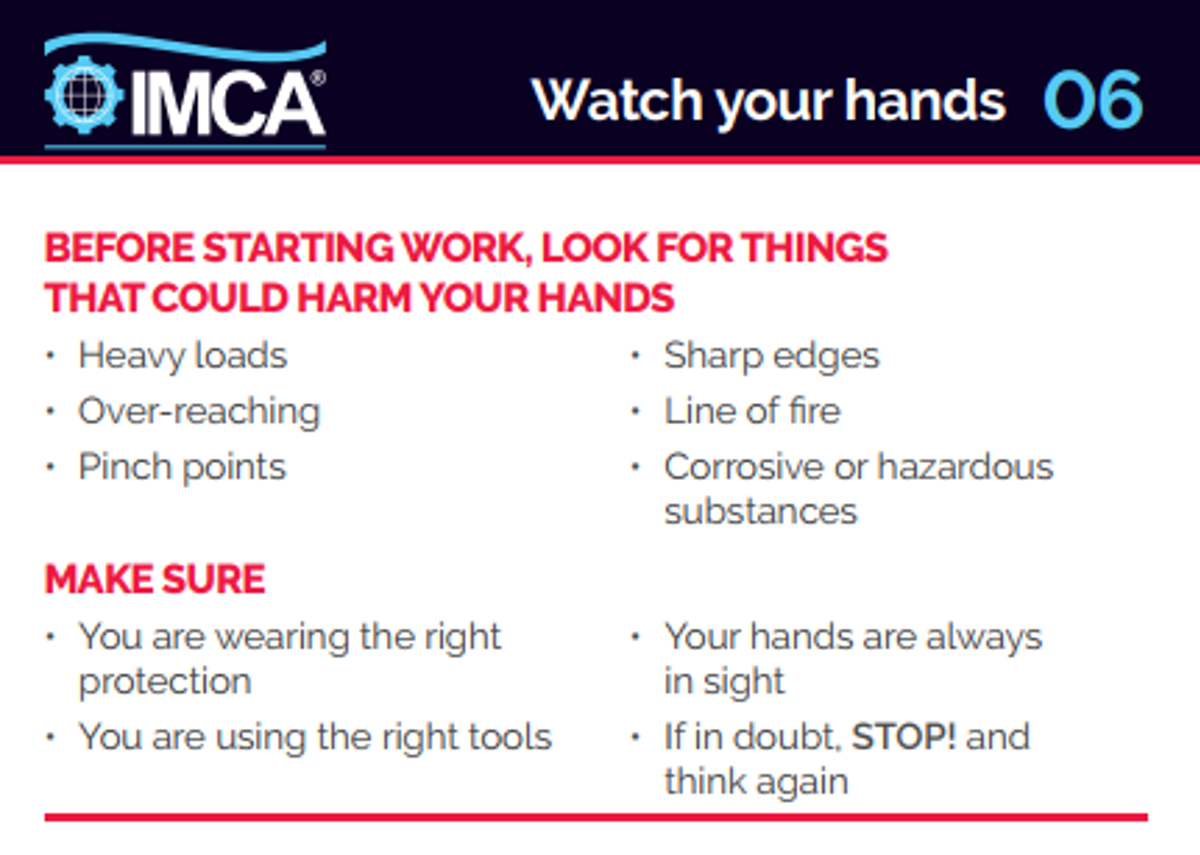
Please refer to IMCA’s short video on Be prepared to work safely – watch your hands
Related safety flashes
-
IMCA SF 19/17
2 August 2017
IMCA Safety Flashes summarise key safety matters and incidents, allowing lessons to be more easily learnt for the benefit of the entire offshore industry.
The effectiveness of the IMCA Safety Flash system depends on the industry sharing information and so avoiding repeat incidents. Incidents are classified according to IOGP's Life Saving Rules.
All information is anonymised or sanitised, as appropriate, and warnings for graphic content included where possible.
IMCA makes every effort to ensure both the accuracy and reliability of the information shared, but is not be liable for any guidance and/or recommendation and/or statement herein contained.
The information contained in this document does not fulfil or replace any individual's or Member's legal, regulatory or other duties or obligations in respect of their operations. Individuals and Members remain solely responsible for the safe, lawful and proper conduct of their operations.
Share your safety incidents with IMCA online. Sign-up to receive Safety Flashes straight to your email.