Thorough preparation is key
- DP Event
- Published on 5 November 2024
- Generated on 16 September 2026
- DPE 03/24
- 3 minute read
Incident
While making a 10-degree heading change, a DP equipment class 3 MODU was struck by a large wave, causing an instant load spike and generator fault alarm on all running generators.
1. Overview
With 4 of 8 diesel generators running and connected to a closed ring bus, and 7 of the 8 thrusters selected to DP, a DP equipment class 3 MODU was set up in Green mode whilst on standby.
The weather at the time was poor, with wind speeds of 43 knots and 2.2 knots of current. The rig was positioned in a drift-off position, with the nearest vessel approximately 1.9 NM away.
2. What happened?
Generators 1, 3, 5 & 7 were operating at approx. 45% when the DPO initiated a 10-degree heading change to provide better protection of the rig against the weather.
During the heading change, the rig was struck by a large wave, which resulted in an instant load spike and generator fault alarm on all running generators.
The power management system initiated automatic start of the first standby generator ‘DG 6’. DG 6 started, paralleled and the breaker closed on to the ring, before the power management system opened the breakers and shut down DGs 1, 3, 5 & 7.
Auto starts were initiated for the three remaining stand-by engines, but before they could synchronise and connect, DG6 ramped to 100% and tripped on overload. The MODU blacked out, and the blackout recovery system was initiated.
Due to the standby generators already going through the start-up & synchronise process at the time of the blackout, the vessel was able to restore power within 12 seconds, the MODU recorded a 7m shift in position.
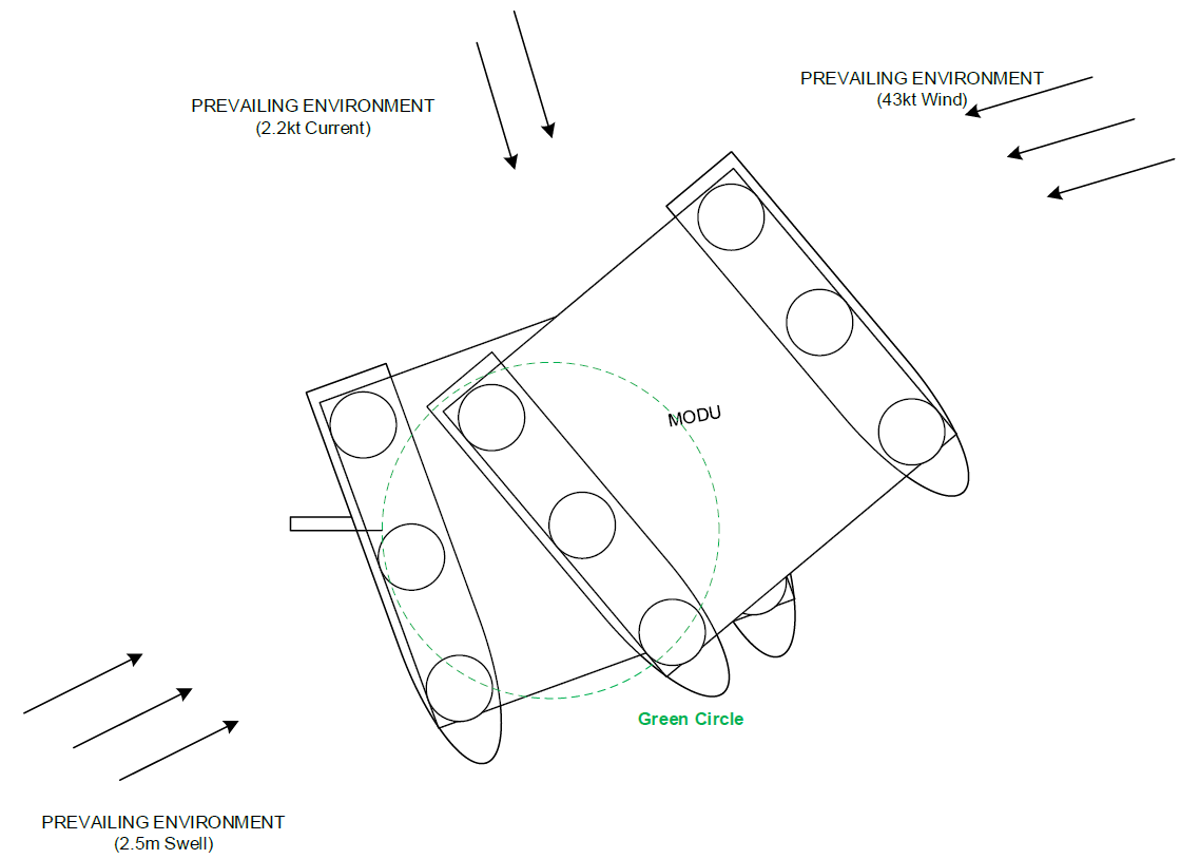
Figure 1 - Forced out the green circle
3. Findings
Following investigation, the following was found:
- The DP system automatically switched temporarily to high precision control mode, as designed to when a position or heading change is made in Green Mode.
- The system was set to high gain.
- The large wave during the heading move forced the vessel out of the green area.
- The sudden power load increase initiated the auto-start system, as required.
- The system was set to Droop mode, and it was later identified that the droop curve limits were too tight to cater for the large load step changes of the generators.
- The power management system disconnected multiple generators when the first standby
generator connected.
4. Conclusion
It was reported that following visits from the manufacturers of the DP and PMS systems, the software was upgraded, and extensive testing was carried out in both droop and isochronous modes, including scenarios of load step changes and blackout recovery.
The incident highlights the importance of performance testing of the power generation system and in all applicable load sharing modes (i.e. droop and isochronous). Testing during commissioning and DP trials, of the overall power and propulsion systems must include sufficient testing of generator load acceptance and rejection, blackout protection, DP & PMS thrust limitation, standby start of generators etc.
The incident report did not specify the verified and validated load sharing mode or the defined CAM configuration.
Latest DP incidents
-
Know your equipment, or at least where to find the answers
During an update in the Follow Target Mode, the crew noticed an anomaly with joystick control.
DPE 02/26
1 September 2026
Observation
-
New equipment, unexpected consequences
During the operation, a loss of DGNSS correction signals was experienced across multiple vessel DGNSS units.
DPE 02/26
1 September 2026
Incident
-
A chain of small failures leads to a major consequence
While conducting cargo operations on DP a vessel experienced a partial blackout caused by an unexpected shutdown of generator 3
DPE 02/26
1 September 2026
Incident
-
Holding position, losing references
While approaching a turret-moored, weather-vaning offshore installation (FPSO), in preparation for cargo operations, a DP equipment class 2 vessel experienced significant rolling of up to 15–20° due to a long-period swell close to the vessel’s natural roll period, resulting in a resonance effect
DPE 02/26
1 September 2026
Observation
-
DP drill scenario – Loss of seawater cooling pump redundancy
Exercise scenario – Loss of seawater cooling pump redundancy
DPE 02/26
1 September 2026
Drill Scenario
The case studies and observations above have been compiled from information received by IMCA. All vessel, client, and operational data has been removed from the narrative to ensure anonymity. Case studies are not intended as guidance on the safe conduct of operations, but rather to assist vessel managers, DP operators, and technical crew.
IMCA makes every effort to ensure both the accuracy and reliability of the information, but it is not liable for any guidance and/or recommendation and/or statement herein contained.
Any queries should be directed to DP team at IMCA. Share your DP incidents with IMCA online. Sign-up to receive DP event bulletins straight to your email.