Duty/not duty, which is the question?
- DP Event
- Published on 29 July 2024
- Generated on 21 September 2026
- DPE 02/24
- 3 minute read
Undesired event
With no steering control of the port azimuth thruster, and no other thrusters operational, the heading of the FPU could not be maintained.
1. Overview
This DP event occurred on an FPSO. The FPSO is fitted with one bow tunnel thruster and two stern azimuth thrusters; however, at the time of the event the starboard aft thruster was out of operation due to an ongoing upgrade project and the forward thruster had been stopped and isolated due to diving operations occurring at the time.
Diving was being undertaken from a light diving craft (LDC). The FPSO was lying with the wind to its side in order to shelter the LDC during the diving operations. The FPSO turret was locked in line with the diving isolation matrix.
2. What happened?
The engineer on duty was completing planned maintenance and had a routine job to grease the port azimuth thruster steering gear pump, 2.
The engineer went down to the local controls of the port azimuth thruster, the steering pump that was due to be greased was running and set up as the duty pump, so the engineer switched the control over to place pump 1 as lead steering pump. As he switched the duty pump over pump 2 stopped and pump 1 started, as per the logic; however, the pressure dropped after stopping the running steering pump and the low-pressure alarm did not clear within the time limit set in the logic. The system shut down running pump 1 as a protective measure, leaving the port azimuth thruster with no steering. Pump 2 did not auto-start.
With no steering control of the port azimuth thruster, and no other thrusters operational, the heading of the FPU could not be maintained.
The Central Control Room (CCR) directly notified the LDC diving supervisor that they had lost power on one thruster and the diving operations were aborted. The divers were able to safely return to the surface without incident, whilst the LDC coxswain monitored the FPSO heading.
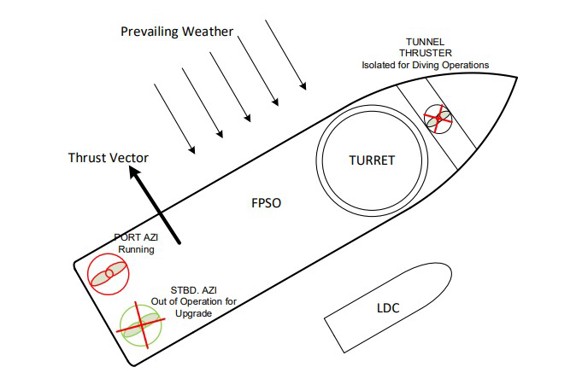
Figure – Setup prior to loss
3. Findings
Investigation of the event concluded that:
- The quick response of the CCR to notify the LDC meant for a swift recovery of the divers to the craft with no incident; however, at the time of the event the CCR were not actually aware of whether the divers were in the water or onboard the LDC.
- The CCR did not relay the entire severity of the incident. No alarm was raised onboard the vessel.
- Due to the routine nature of the planned maintenance, insufficient risk assessment had been conducted.
- There was no consideration for if a failure were to occur and how this would affect the heading control.
- A thorough risk assessment of the diving operations had not been considered, including emergency preparedness.
4. Conclusions
This case shows the importance of clear communication between all departments when diving or any SIMOPS (Simultaneous Operations) are taking place.
Prior to diving operations, a thorough risk assessment and clear toolbox talk should be undertaken with all parties and all shifts involved. Maintenance on critical equipment must be risk assessed to ensure whether safe to proceed. If in doubt, wait!
No redundancy was in place on the FPSO during critical operations.
Latest DP incidents
-
Know your equipment, or at least where to find the answers
During an update in the Follow Target Mode, the crew noticed an anomaly with joystick control.
DPE 02/26
1 September 2026
Observation
-
New equipment, unexpected consequences
During the operation, a loss of DGNSS correction signals was experienced across multiple vessel DGNSS units.
DPE 02/26
1 September 2026
Incident
-
A chain of small failures leads to a major consequence
While conducting cargo operations on DP a vessel experienced a partial blackout caused by an unexpected shutdown of generator 3
DPE 02/26
1 September 2026
Incident
-
Holding position, losing references
While approaching a turret-moored, weather-vaning offshore installation (FPSO), in preparation for cargo operations, a DP equipment class 2 vessel experienced significant rolling of up to 15–20° due to a long-period swell close to the vessel’s natural roll period, resulting in a resonance effect
DPE 02/26
1 September 2026
Observation
-
DP drill scenario – Loss of seawater cooling pump redundancy
Exercise scenario – Loss of seawater cooling pump redundancy
DPE 02/26
1 September 2026
Drill Scenario
The case studies and observations above have been compiled from information received by IMCA. All vessel, client, and operational data has been removed from the narrative to ensure anonymity. Case studies are not intended as guidance on the safe conduct of operations, but rather to assist vessel managers, DP operators, and technical crew.
IMCA makes every effort to ensure both the accuracy and reliability of the information, but it is not liable for any guidance and/or recommendation and/or statement herein contained.
Any queries should be directed to DP team at IMCA. Share your DP incidents with IMCA online. Sign-up to receive DP event bulletins straight to your email.