Human Factors caused a DP undesired event
- DP Event
- Published on 21 April 2021
- Generated on 23 September 2026
- DPE 01/21
- 2 minute read
Undesired event
Heading changes, particularly in strong current, should be completed at low rates of turn with the vessel position independently monitored.
Comments
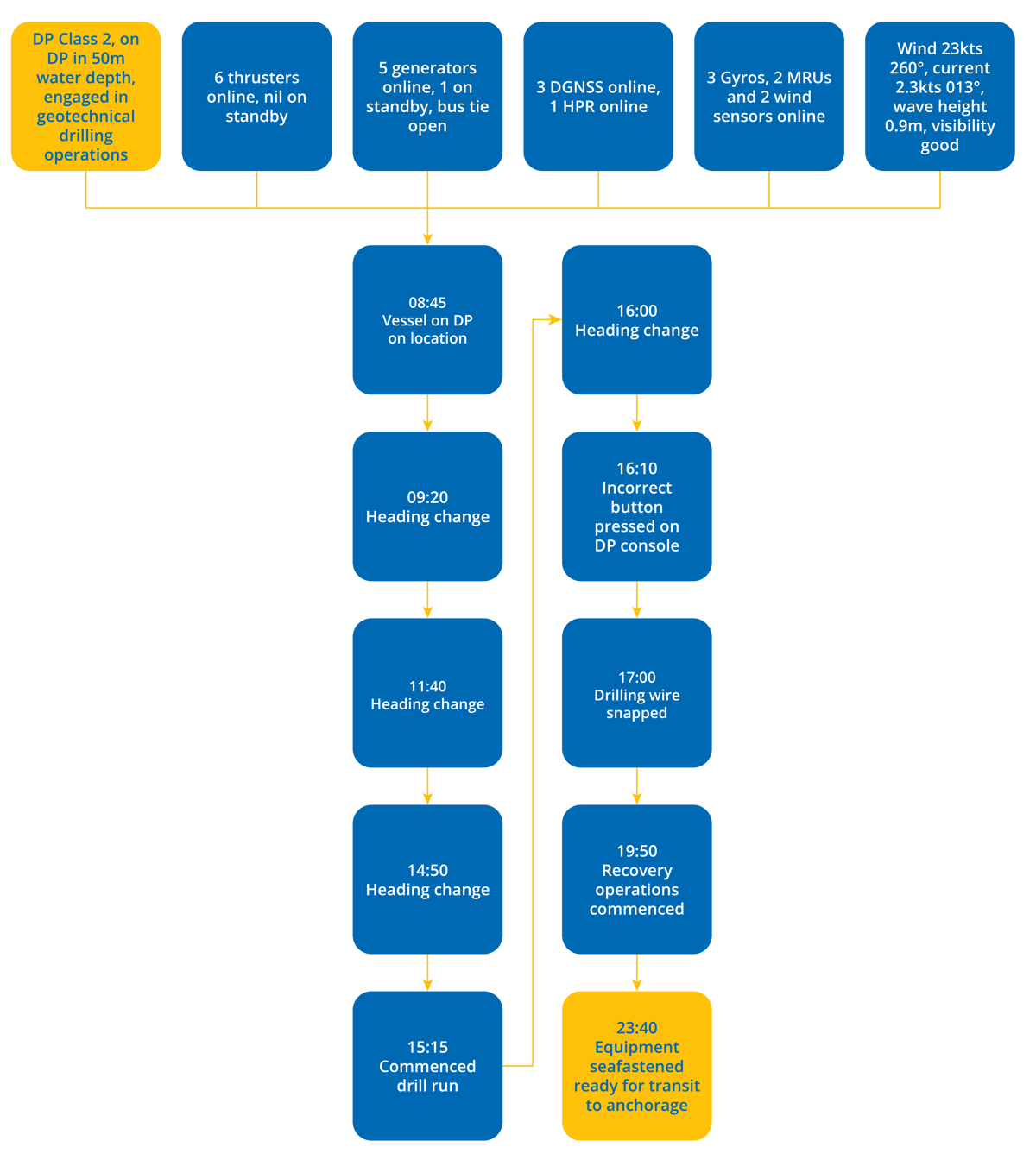
The vessel was operating in shallow water and a strong current. There were several heading changes prior to the event. It was noted that heading changes, particularly in strong current should be completed at very low rates of turn. In such a situation the report commented that the vessel position should be independently monitored, such as by a survey screen, to ensure the required position setpoint remains as required.
Other actions taken:
- CAMO updated, maximum Rate of Turn (ROT) & maximum allowance for heading change amended.
- Heading change procedure generated; including position of personnel, drillers to be evacuated from Rooster box, checks to be performed, and communication protocols.
- 6 hourly checklist revised: offsets of DGNSS added & tick box added for survey position.
- Revised DP standing orders: Offset of DGNSS to be checked after rebooting OS PC. Compare survey position with DP all times during operations.
Considerations
- There is a lack of information available within the report however, it states that the drill string snapped 50 minutes after an “incorrect button” was pressed. It also appears that the ROT used for heading changes was too high for the operation and the offsets for the DGNSS were incorrect. Therefore, it is assumed that there was a position excursion.
- Following the installation or relocation of position reference sensors, offsets should be permanently changed in the controllers. On at least one DP control system, position reference system offsets can be changed at the operator stations but revert to the original setting when the controllers are reset. Offsets should therefore be verified as part of operational planning.
- Rapid heading changes in such environmental conditions may destabilise the DP model resulting in unpredictable behaviour with significant consequences. Heading and position changes should be carried out in small increments and with adequate waiting time to enable the model to stabilise between increments.
- The use of three DGNSS is an over reliance on one PRS operating principle (DGNSS) at the expense of the other single PRS.
Latest DP incidents
-
Know your equipment, or at least where to find the answers
During an update in the Follow Target Mode, the crew noticed an anomaly with joystick control.
DPE 02/26
1 September 2026
Observation
-
New equipment, unexpected consequences
During the operation, a loss of DGNSS correction signals was experienced across multiple vessel DGNSS units.
DPE 02/26
1 September 2026
Incident
-
A chain of small failures leads to a major consequence
While conducting cargo operations on DP a vessel experienced a partial blackout caused by an unexpected shutdown of generator 3
DPE 02/26
1 September 2026
Incident
-
Holding position, losing references
While approaching a turret-moored, weather-vaning offshore installation (FPSO), in preparation for cargo operations, a DP equipment class 2 vessel experienced significant rolling of up to 15–20° due to a long-period swell close to the vessel’s natural roll period, resulting in a resonance effect
DPE 02/26
1 September 2026
Observation
-
DP drill scenario – Loss of seawater cooling pump redundancy
Exercise scenario – Loss of seawater cooling pump redundancy
DPE 02/26
1 September 2026
Drill Scenario
The case studies and observations above have been compiled from information received by IMCA. All vessel, client, and operational data has been removed from the narrative to ensure anonymity. Case studies are not intended as guidance on the safe conduct of operations, but rather to assist vessel managers, DP operators, and technical crew.
IMCA makes every effort to ensure both the accuracy and reliability of the information, but it is not liable for any guidance and/or recommendation and/or statement herein contained.
Any queries should be directed to DP team at IMCA. Share your DP incidents with IMCA online. Sign-up to receive DP event bulletins straight to your email.