Line of fire: pinched finger between door and frame
- Safety Flash
- Published on 11 March 2022
- Generated on 23 September 2026
- IMCA SF 06/22
- 2 minute read
A finger was pinched between the door frame of an ROV control van as it swung closed.
What happened?
An ROV operator suffered a serious injury, after their finger was pinched between the door frame of an ROV control van and the door as it swung closed. The ROV operator was returning to the work area after lunch and made his way to the ROV control van to speak with the supervisor. He opened the door outwards and rested his left hand on door frame as he moved his body inside the control van. The door swung closed, resulting in the door pinching his left index finger against the door frame. He automatically moved his hand away on impact which caused a laceration injury to the fingertip that required a medivac and reconstructive surgery.
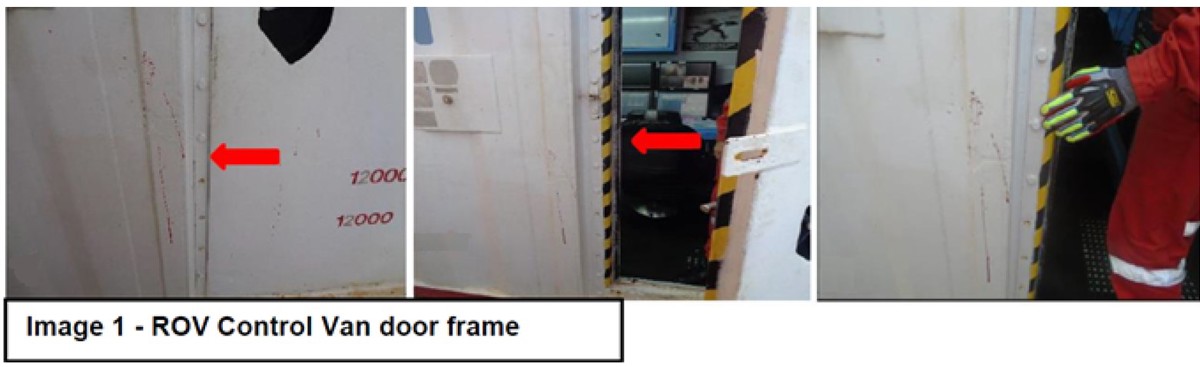
What went wrong?
Investigation found that:
- The spring device mechanism to control the speed at which the door closed was faulty and had not been repaired. The ROV team had not identified this hazard nor corrected it before the incident.
- There was a lack of situational awareness in that the ROV operator left his hand in the line of fire.
- The induction/familiarization process had not been effective in identifying hazards associated with the work area.
- This was the first day of the trip for the ROV operator; he had two months experience on the vessel.
Actions
- Ensure that such doors (in this case, to ROV control vans) are fitted with a functioning spring device mechanism to control the speed at which the door closes.
- Ensure these door closing spring device mechanisms are included in the planned maintenance system, and subject to regular inspection.
- Ensure there is suitable induction / familiarization process on site, to safely integrate new workers, and provide them with mentoring and effective supervision.
Related Safety Flashes
-
IMCA SF 04/16
5 February 2016
-
IMCA SF 06/19
5 April 2019
-
-
IMCA SF 27/19
22 November 2019
-
IMCA Safety Flashes summarise key safety matters and incidents, allowing lessons to be more easily learnt for the benefit of the entire offshore industry.
The effectiveness of the IMCA Safety Flash system depends on the industry sharing information and so avoiding repeat incidents. Incidents are classified according to IOGP's Life Saving Rules.
All information is anonymised or sanitised, as appropriate, and warnings for graphic content included where possible.
IMCA makes every effort to ensure both the accuracy and reliability of the information shared, but is not be liable for any guidance and/or recommendation and/or statement herein contained.
The information contained in this document does not fulfil or replace any individual's or Member's legal, regulatory or other duties or obligations in respect of their operations. Individuals and Members remain solely responsible for the safe, lawful and proper conduct of their operations.
Share your safety incidents with IMCA online. Sign-up to receive Safety Flashes straight to your email.