Two injuries
- Safety Flash
- Published on 6 May 2021
- Generated on 13 October 2026
- IMCA SF 13/21
- 2 minute read
A Member reports two injuries during operations, highlighting the need for continued vigilance and care in everyday activities.
Incident 1: Crew member injured head on girder
What happened?
Around eight hours into their shift, a crew member was stowing tools and equipment in the port side aft engine room stowage, and as he bent down to open the lid of the toolbox, he hit the corner of a girder and gashed the top left-hand side of his scalp.
He was attended to with first aid treatment to stop the bleeding, clean and dress the wound.

What went wrong?
- The crew member was a very tall person in relation to the limited working space.
- The crew member was complacent and lacked situational awareness.
- He was not wearing proper PPE (a bump cap).
- There was no protective material on the girder, nor were there warning signs or hazard ID tapes on the girder.
- There was a lack of viable and safe stowage space in the Engine Room.
Actions
- Follow your company rules for PPE.
- Develop a higher level of situational awareness.
- Impact protection (high density foam) wrapped on the edge of the girder, also, safety warning signs, and hazard tapes to indicate line of fire.
Incident 2: Finger injury when heavy door closed
What happened?
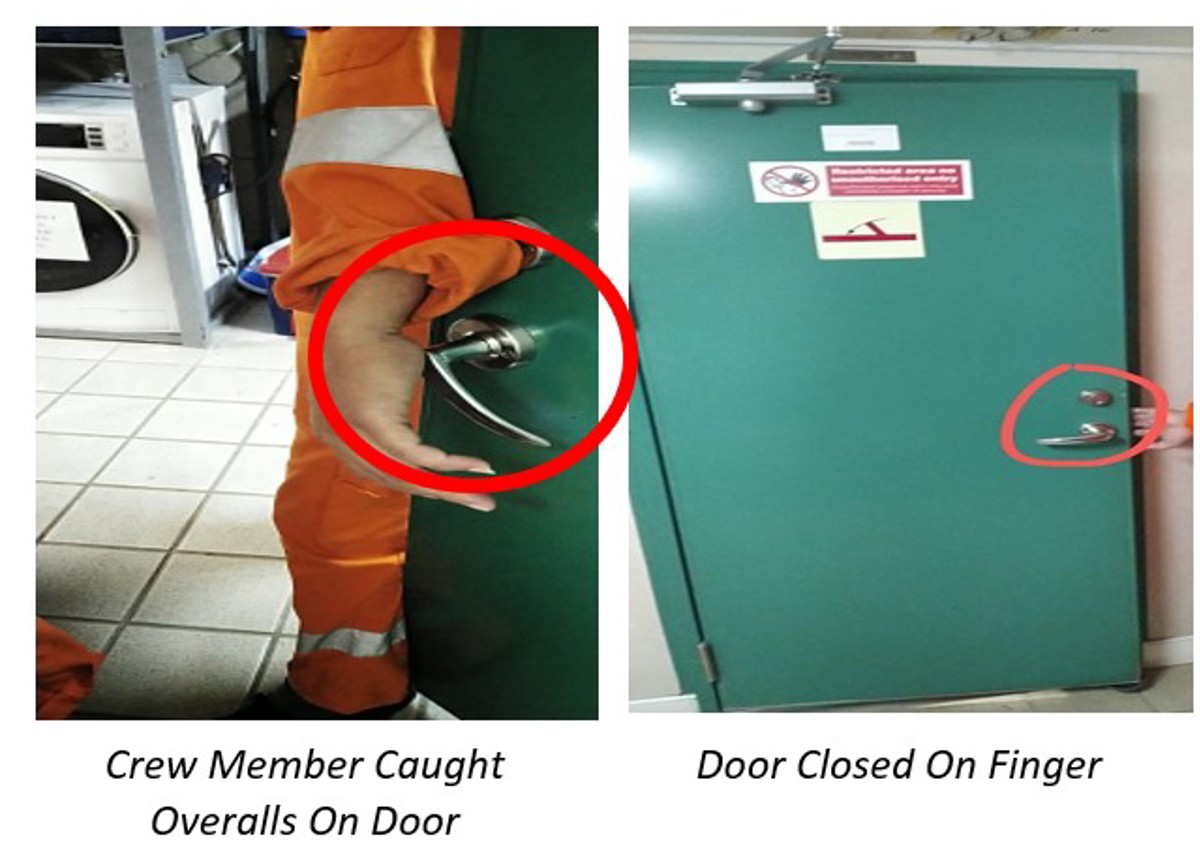
During a routine inspection of the air conditioning plant room, the engineer caught his sleeve on the latch of the AC room door and due to the lower pressure within the room, the door closed and slammed shut catching the tip of his finger.
He was immediately given first aid, and subsequently transferred to another company vessel for transit to port for further medical check-up including an X-ray.
What went wrong?
- He had his sleeves rolled up making snagging more likely.
- There was no indication that the AC room door would slam shut because the room was at a lower pressure than elsewhere.
- The spring loaded self-closing device on the door was set to slam the door shut due to the lower pressure in the AC room, as it would not close properly under any other setting.
Actions
- A sign was posted indicating that the door was a pinch point owing to its tendency to be pulled shut by the lower pressure in the AC room.
IMCA Safety Flashes summarise key safety matters and incidents, allowing lessons to be more easily learnt for the benefit of the entire offshore industry.
The effectiveness of the IMCA Safety Flash system depends on the industry sharing information and so avoiding repeat incidents. Incidents are classified according to IOGP's Life Saving Rules.
All information is anonymised or sanitised, as appropriate, and warnings for graphic content included where possible.
IMCA makes every effort to ensure both the accuracy and reliability of the information shared, but is not be liable for any guidance and/or recommendation and/or statement herein contained.
The information contained in this document does not fulfil or replace any individual's or Member's legal, regulatory or other duties or obligations in respect of their operations. Individuals and Members remain solely responsible for the safe, lawful and proper conduct of their operations.
Share your safety incidents with IMCA online. Sign-up to receive Safety Flashes straight to your email.