NTSB: Fire on vessel – escaped exhaust gases
- Safety Flash
- Published on 14 October 2024
- Generated on 23 October 2026
- IMCA SF 20/24
- 2 minute read
The National Transportation Safety Board of the United States (NTSB) published "Safer Seas Digest 2023", which includes a number of incidents which may be of interest to IMCA members.
What happened?
A fire broke out in a stateroom on board a small towing vessel on the Gulf Intracoastal Waterway. The fire was extinguished and the crew were evacuated safely. There were no injuries, and no pollution was reported, but the vessel was destroyed.
An off-watch pilot was awakened by a smoke alarm and the smell of smoke in his stateroom. About the same time, the captain, who was on watch in the wheelhouse, heard a smoke detector beep (but didn’t smell smoke) in the wheelhouse, and the other sleeping deckhand woke up to “a burnt smell.”
A fire had started behind panels in the pilot’s stateroom, which was located between the vessel’s two stacks, each containing engine exhaust mufflers and piping. Cracks in the welds on the upper section of the starboard muffler located inside the starboard stack—which may have been caused by a latent issue, such as a defect in the muffler during construction or the exhaust system design’s allowance for thermal expansion and contraction of exhaust piping above the muffler outlet—allowed the hot exhaust gases from the operating starboard engine to escape into the stack area and increase the temperature of the space and its bulkheads.
What was the (probable) cause
The NTSB’s investigation suggested that undetected cracks in the starboard muffler allowed exhaust gases from an operating engine to escape and ignite wooden structures affixed to the common bulkhead of an accommodation space. Contributing to the extent of the fire damage was the substantial use of combustible materials in the joinery, outfitting, and furnishings in the accommodation spaces.
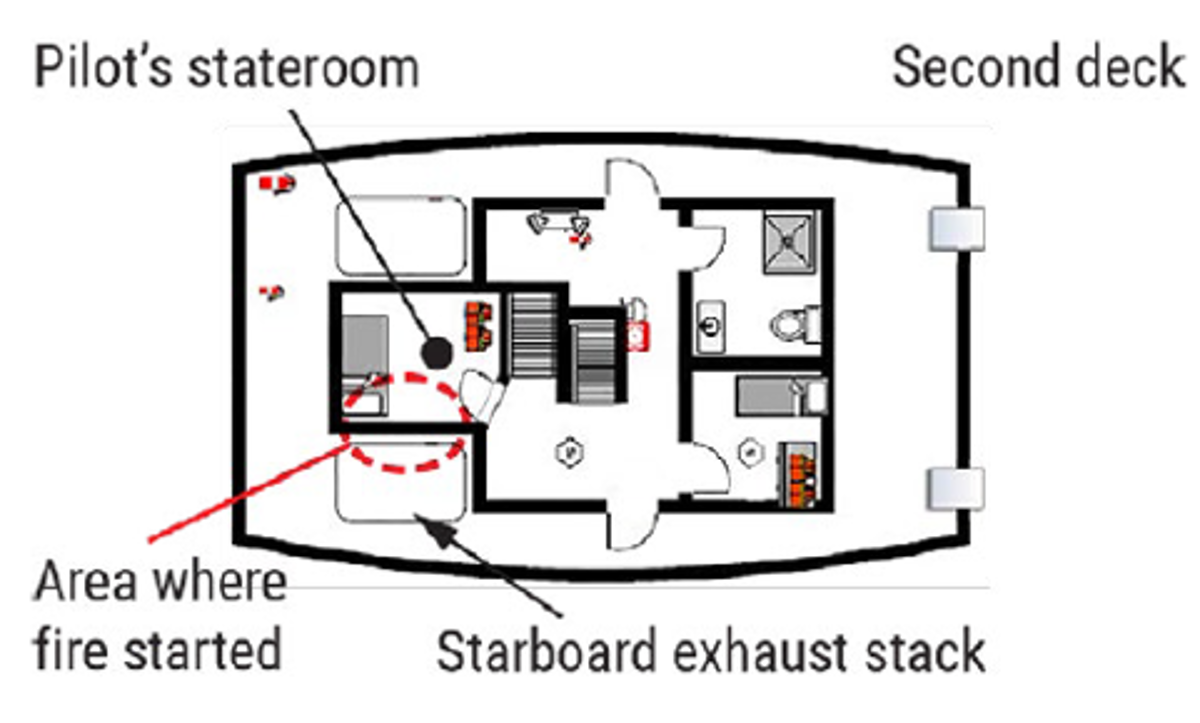
Layout of part of the vessel. The dashed oval identifies where fire started.
Photos

Burnt out stateroom

Crack in weld below the upper (outlet) flange of the starboard muffler
Lessons learned
- Remember that engine and other machinery exhaust systems generate tremendous amounts of heat. These systems often run through tight spaces that are difficult to access and inspect and are often located near materials or equipment that obstruct entry and direct observation.
- Consider inspection of welding and other potential weak points in such areas.
Related Safety Flashes
-
IMCA SF 12/17
25 May 2017
-
-
IMCA SF 21/15
7 December 2015

IMCA Safety Flashes summarise key safety matters and incidents, allowing lessons to be more easily learnt for the benefit of the entire offshore industry.
The effectiveness of the IMCA Safety Flash system depends on the industry sharing information and so avoiding repeat incidents. Incidents are classified according to IOGP's Life Saving Rules.
All information is anonymised or sanitised, as appropriate, and warnings for graphic content included where possible.
IMCA makes every effort to ensure both the accuracy and reliability of the information shared, but is not be liable for any guidance and/or recommendation and/or statement herein contained.
The information contained in this document does not fulfil or replace any individual's or Member's legal, regulatory or other duties or obligations in respect of their operations. Individuals and Members remain solely responsible for the safe, lawful and proper conduct of their operations.
Share your safety incidents with IMCA online. Sign-up to receive Safety Flashes straight to your email.