Dropped object – Bailout cylinder inside diving bell
- Safety Flash
- Published on 18 December 2025
- Generated on 5 October 2026
- IMCA SF 23/25
- 2 minute read
During bell preparations for saturation diving operations, an incident occurred within the vessel’s saturation system.
What happened?
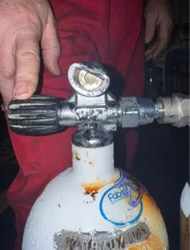
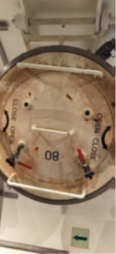
While conducting routine bell checks, a bailout set that had not been correctly secured slipped from its stowed position inside the bell. As the bellman positioned himself to open the bell door in preparation for diver entry, he inadvertently leaned against the unsecured bailout set, causing it to slide through the bell door opening and fall approximately 2.5 metres, striking the Transfer Under Pressure (TUP) door below. No-one was injured. The bailout cylinder was damaged.
 |
 |
 |
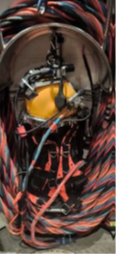 |
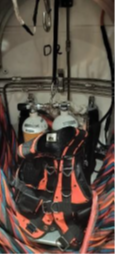
| Damaged bailout | TUP door | Incorrect securing “S” ring | Correct method using a Carabiner |
What went wrong?
- The bailout cylinder was not correctly attached to the seat cradle (carabiner and elastic strap).
- Post-dive securing checks following bell runs were not completed.
- The process for securing and verifying bailout cylinders was not formally described or included in checklists.
- Divers had become desensitised to the hazard of dropped objects within the bell environment.
Also noted as part of the investigation was:
- Bailouts were being suspended using S-hooks rather than carabiners, increasing the likelihood of dislodgement in the confined space of the diving bell.
Lessons to learn
- Even minor lapses in routine checks can lead to high-potential events when dealing with pressurised systems.
- Tasks we do habitually, need periodic review to maintain hazard awareness.
- Verification and documentation of simple tasks prevent repeated errors.
- Positive-locking devices (carabiners) should be used in confined spaces where movement or contact can occur.
Actions taken in this case
- Developed a formal work instruction/checklist for securing and verifying bailout cylinders.
- Replaced all S-hooks in the diving system with carabiners or positive locking brackets.
- Updated risk assessments and JHAs to include hazards related to dropped objects inside the bell.
- Re-briefed and retrained all bellmen and divers on proper securing methods.
- Introduced a cross-check process requiring both incoming and outgoing bellmen to confirm that all bailouts are secured before and after each dive.
Related Safety Flashes
-
IMCA SF 01/24
9 January 2024
-
IMCA Safety Flashes summarise key safety matters and incidents, allowing lessons to be more easily learnt for the benefit of the entire offshore industry.
The effectiveness of the IMCA Safety Flash system depends on the industry sharing information and so avoiding repeat incidents. Incidents are classified according to IOGP's Life Saving Rules.
All information is anonymised or sanitised, as appropriate, and warnings for graphic content included where possible.
IMCA makes every effort to ensure both the accuracy and reliability of the information shared, but is not be liable for any guidance and/or recommendation and/or statement herein contained.
The information contained in this document does not fulfil or replace any individual's or Member's legal, regulatory or other duties or obligations in respect of their operations. Individuals and Members remain solely responsible for the safe, lawful and proper conduct of their operations.
Share your safety incidents with IMCA online. Sign-up to receive Safety Flashes straight to your email.