Pallet failure: High potential dropped object during lifting operations
- Safety Flash
- Published on 30 October 2018
- Generated on 27 October 2026
- IMCA SF 24/18
- 2 minute read
A wooden pallet broke whilst it was being lifted during mobilisation, causing its load to fall to deck.
What happened?
There was no injury to personnel nor was there any damage to equipment. The pallet load consisted of two drums containing lifting master links and was lifted onboard from the quay using basket slung arrangements. When the load was approaching its final laydown area, part of the pallet broke, causing the load to invert and the drums to drop onto the ROV hydraulic power unit (HPU) equipment on deck and then onto the deck itself. Part of the contents of one of the drums was also released.
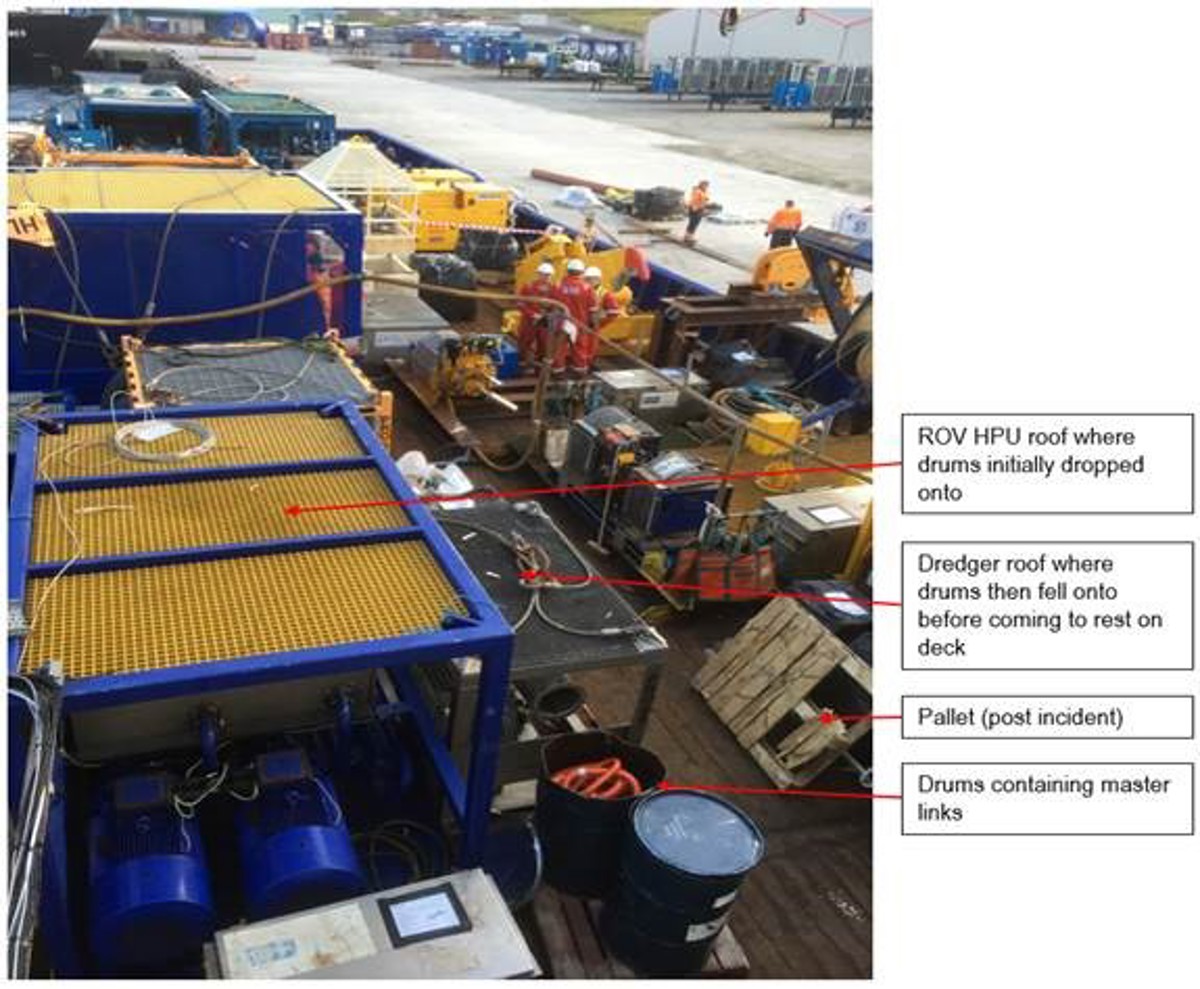
What went wrong? What were the causes?
- The practice to basket sling a pallet had become the ‘norm’ following the pallet lifter being sent away for repair 5 weeks earlier; a replacement was not sourced.
- Personnel failed to comply with lifting guidelines, best practice, lift plans and task risk assessments.
- Personnel involved in the lifting operations did not intervene or challenge this unsafe lifting practice.
- There was ineffective and inadequate supervision and control of lifting operations.
- The drums containing the master links were not decanted into dedicated lift baskets prior to arrival at quayside.
What actions were taken? What lessons were learned?
- Further discussion of ‘stop work authority’ and the importance of feeling able to intervene or challenge when faced with unsafe practices.
- Ensure that there is a pallet lifter onboard, fit for purpose and certified for use.
- Consider decanting lifting equipment and accessories into dedicated lift baskets prior to transportation to the quayside/vessel (this is also relevant to all other equipment too).
- Ensure and verify all personnel involved in, supporting and controlling lifting operations fully understand lifting operations processes, procedures and good practice compliance requirements.
- Ensure and verify all personnel involved in supporting and controlling lifting operations review and sign off on existing vessel and site-specific lift plans and lifting operations task risk assessments, to verify their compliance and understanding of risk control measures and mitigations.
Members may wish to review:
- Guidelines for lifting operations (IMCA HSS019)
Related Safety Flashes
-
IMCA SF 23/16
13 September 2016
-
IMCA SF 14/11
23 December 2011
-
IMCA SF 16/08
30 October 2008
IMCA Safety Flashes summarise key safety matters and incidents, allowing lessons to be more easily learnt for the benefit of the entire offshore industry.
The effectiveness of the IMCA Safety Flash system depends on the industry sharing information and so avoiding repeat incidents. Incidents are classified according to IOGP's Life Saving Rules.
All information is anonymised or sanitised, as appropriate, and warnings for graphic content included where possible.
IMCA makes every effort to ensure both the accuracy and reliability of the information shared, but is not be liable for any guidance and/or recommendation and/or statement herein contained.
The information contained in this document does not fulfil or replace any individual's or Member's legal, regulatory or other duties or obligations in respect of their operations. Individuals and Members remain solely responsible for the safe, lawful and proper conduct of their operations.
Share your safety incidents with IMCA online. Sign-up to receive Safety Flashes straight to your email.