Near miss: Incorrectly set lifeboat hook
- Safety Flash
- Published on 14 August 2020
- Generated on 16 October 2026
- IMCA SF 24/20
- 2 minute read
What happened?
During a routine launch and recovery drill, the lifeboat crew became concerned that the forward hook was not engaging correctly despite the ‘padlock’ symbol indicating correct closure.
With the lifeboat in the water the crew had experienced some difficulty in releasing the hook and the hook release mechanism was operated several times before it finally released. Prior to lifeboat recovery, the coxswain became concerned that the forward hook was not correctly aligned and an all-stop was called to investigate the situation.
Site management assessed the launch and recovery system and it was decided the boat could be lifted safely back on board, as per the original task plan, with confirmation that both hooks were secure. The lifeboat was recovered without incident.
What were the causes? What went wrong?
The following findings were made:
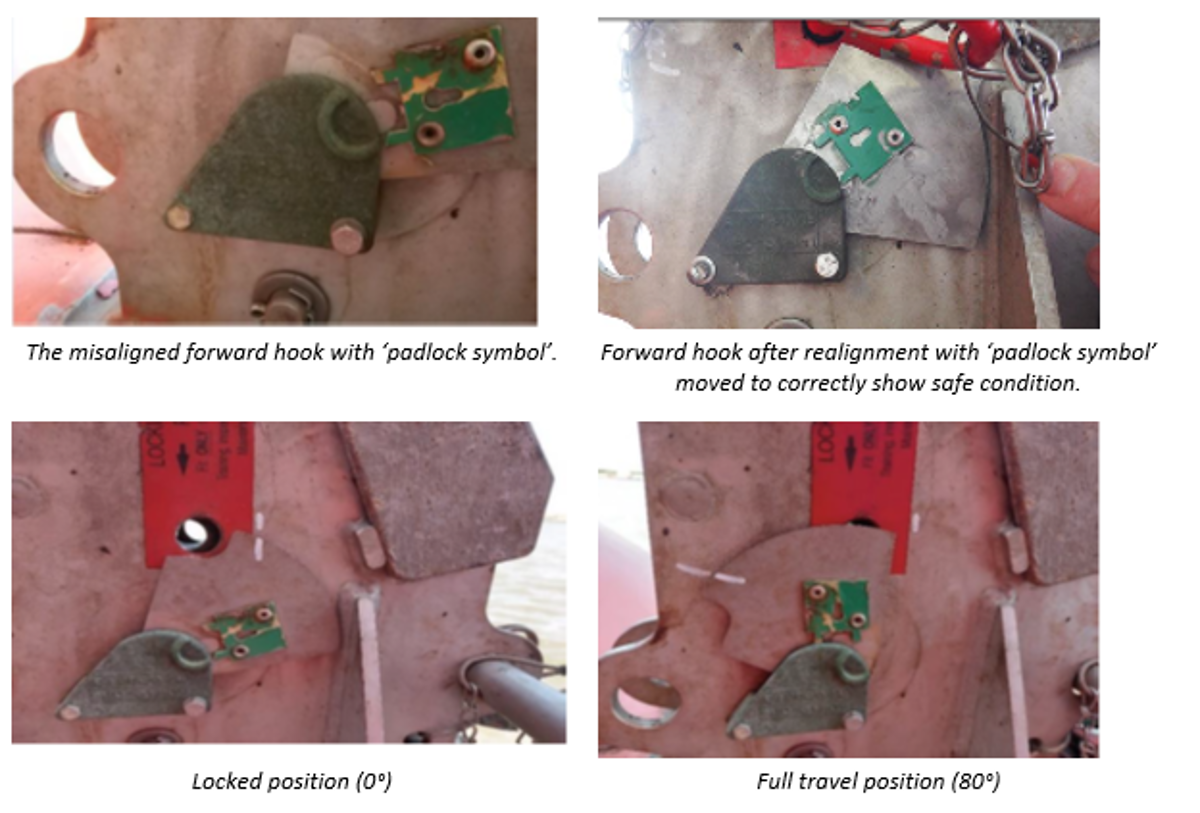
- The alignment of the cast plate was also aligned differently to all other hooks. The padlock symbol indicated the hook was correctly closed when it was not.
- The ‘padlock symbol’ was not mounted at the edge of the quadrant as the other hooks on board were.
- The mechanism was incorrectly assembled with the forward ‘Duplex-E Hook’ locking mechanism misaligned.
- The forward hook was incorrectly set to release at 35° instead of 55° as required by the manufacturer.
- Previous records made no reference to any alterations being made to the system and it could therefore not be established when the incorrect alignment occurred.
- No damage to any components was found; no components needed to be replaced.
- The forward hook required adjustment to release at the correct setting of 55°.
- Once the cam had been realigned to release at 55°, the ‘padlock symbol’ was moved to correctly indicate that the hooks were closed.
Actions
Our member took the following actions:
- Confirmed and checked the hook settings of all lifeboats, and fully investigated any unexpected difficulties with release mechanisms.
- Ensured that third-party contractors servicing lifeboat hooks are properly qualified and approved.
- Reiterated the importance of always following the manufacturer’s instructions and company procedures for maintenance-related launch and recovery of small boats/lifeboats.
- Communicated that lifeboat that do not show the correct setting of the hooks should not be used.
Related Safety Flashes
-
IMCA SF 21/18
17 September 2018
-
-
IMCA SF 17/15
26 October 2015
-
IMCA SF 13/14
17 July 2014

IMCA Safety Flashes summarise key safety matters and incidents, allowing lessons to be more easily learnt for the benefit of the entire offshore industry.
The effectiveness of the IMCA Safety Flash system depends on the industry sharing information and so avoiding repeat incidents. Incidents are classified according to IOGP's Life Saving Rules.
All information is anonymised or sanitised, as appropriate, and warnings for graphic content included where possible.
IMCA makes every effort to ensure both the accuracy and reliability of the information shared, but is not be liable for any guidance and/or recommendation and/or statement herein contained.
The information contained in this document does not fulfil or replace any individual's or Member's legal, regulatory or other duties or obligations in respect of their operations. Individuals and Members remain solely responsible for the safe, lawful and proper conduct of their operations.
Share your safety incidents with IMCA online. Sign-up to receive Safety Flashes straight to your email.