Serious leg injury from falling winch sheave
- Safety Flash
- Published on 15 September 2020
- Generated on 25 September 2026
- IMCA SF 27/20
- 3 minute read
What happened?
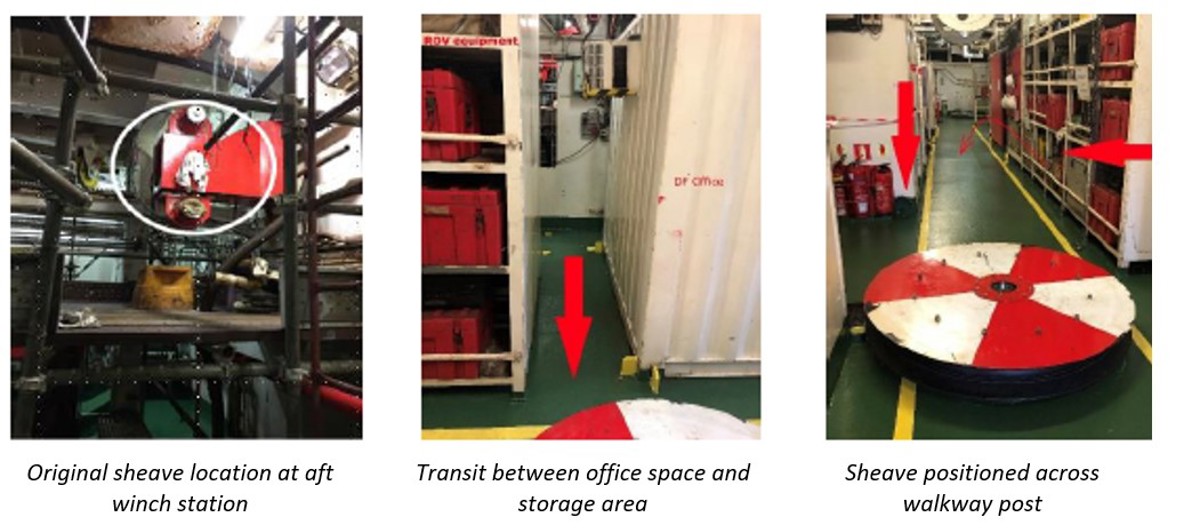
An umbilical winch sheave was being hand-rolled along the deck when it fell over and struck the leg of one of the people handling it. Crew were rolling an umbilical sheave from an umbilical winch along the lower bell hanger to the main deck for onshore refurbishment.
The sheave was big and heavy: 1.7m across and 1.8m wide, and weighing around 580 kg. It had to be moved to a position from which the vessel crane could lift it onto a lorry on the quay for transfer to the workshop.
The work team was made up of a supervisor and two technicians. They had already removed one sheave from its housing and moved it to the back deck for lifting to the quayside. As the team were rolling the second sheave it slipped on the deck, dropped to deck level, and struck one of the team. He suffered leg injuries; he remained conscious and after initial first aid was transferred to hospital for further treatment.
What were the causes? What went wrong?
A Safe System of Work (SSOW) was not effectively integrated and implemented at the worksite.
- There was a failure to adequately plan and supervise the works conducted by their team. The team focused on the winch disassembly without consideration of how to safely move the sheaves across the deck.
- The work started before a detailed risk assessment was carried out to ensure that suitable and sufficient controls were identified and implemented.
- There had been a preparatory Task Risk Assessment (TRA) but the controls identified were not effectively communicated to the work team during the pre-work Toolbox Talk.
- The Permit to Work was issued without confirmation that the work team fully understood the risk assessment or that they were able to comply with its requirements.
- The competency of the team had been reduced as a result of changes to crew allocation and rotation.
- Standard practices for supervising and supporting work teams including subcontractors at the worksite had been impacted by additional controls developed in response to COVID-19.
Actions
- Ensure subcontractor activities are correctly interfaced with company safety management systems.
- Ensure that the requirements for Risk Assessment, Permit to Work and effective Toolbox Talk delivery are clearly understood by all, particularly where subcontractors are involved.
- Permits to Work should only be issued after confirmation that all requirements and precautions for the task have been applied.
- Ensure all aspects of upcoming work is adequately discussed, reviewed, managed and controlled.
- Ensure measures in place to protect from COVID-19 are factored into the planning, supervision and completion of work activities.
Related Safety Flashes
-
IMCA SF 22/20
24 July 2020
-
-
IMCA SF 05/15
2 April 2015
-
IMCA SF 14/11
23 December 2011
IMCA Safety Flashes summarise key safety matters and incidents, allowing lessons to be more easily learnt for the benefit of the entire offshore industry.
The effectiveness of the IMCA Safety Flash system depends on the industry sharing information and so avoiding repeat incidents. Incidents are classified according to IOGP's Life Saving Rules.
All information is anonymised or sanitised, as appropriate, and warnings for graphic content included where possible.
IMCA makes every effort to ensure both the accuracy and reliability of the information shared, but is not be liable for any guidance and/or recommendation and/or statement herein contained.
The information contained in this document does not fulfil or replace any individual's or Member's legal, regulatory or other duties or obligations in respect of their operations. Individuals and Members remain solely responsible for the safe, lawful and proper conduct of their operations.
Share your safety incidents with IMCA online. Sign-up to receive Safety Flashes straight to your email.