High potential: navigation near offshore wind turbines
- Safety Flash
- Published on 12 February 2024
- Generated on 21 October 2026
- IMCA SF 03/24
- 2 minute read
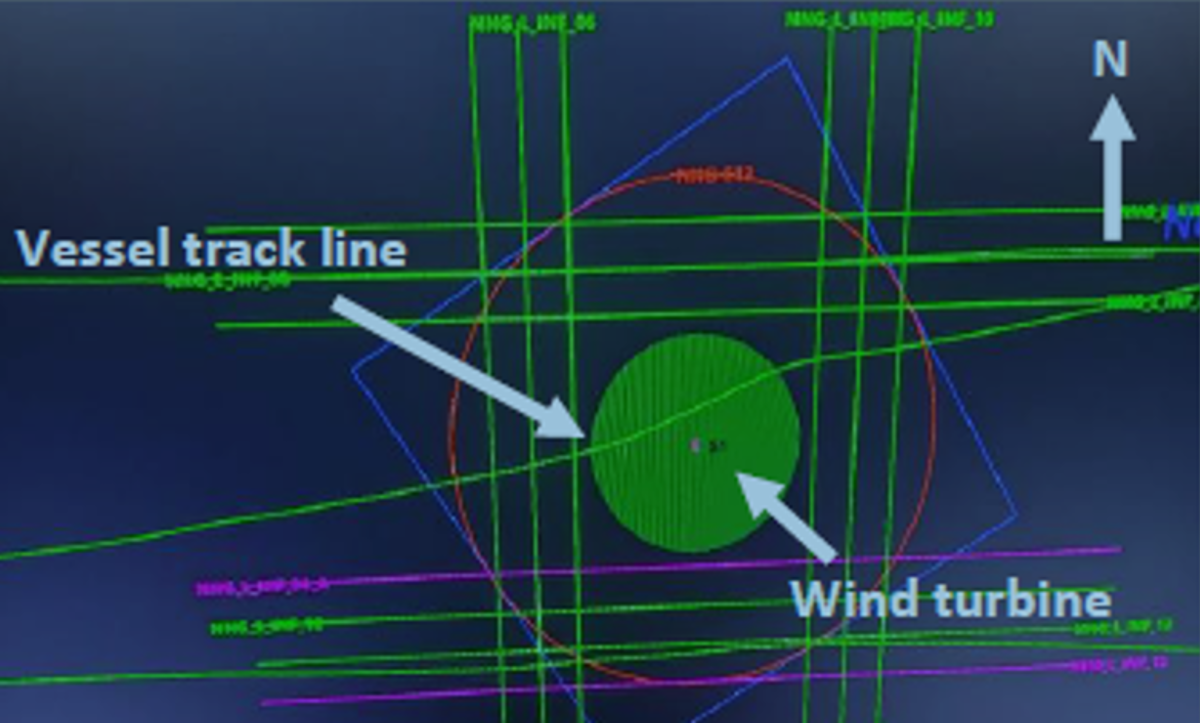
During survey operations, a chartered vessel entered a wind turbine safety zone on two separate occasions whilst attempting to achieve the closest approach line.
What happened?
During survey operations, a chartered vessel entered a wind turbine safety zone on two separate occasions whilst attempting to achieve the closest approach line. On the first occasion, the breach was dealt with onboard the vessel with a safety stand down. On the second occasion, the vessel was immediately stood down and instructed to leave the work site until safe control measures (actions) had been established and agreed with the client.
What went wrong?
The incident investigation established that the Officer on Watch (OOW) lost situational awareness and turned the wrong way – to port instead of to starboard. Given that the tide was running north to south, the OOW should have changed course to starboard for safe clearance of the wind turbine. Misjudgement resulted in a miscalculation of the vessel track, significantly contributing to the near miss incident. Agreed onboard procedures and standing orders were not followed.
What was the cause?
- Officers while experienced, were new to this vessel. Consequently, the bridge team had not been working together long:
- Whilst the OOW was an experienced seafarer / officer, he was new to the vessel. He was not fully familiar with the manoeuvring characteristics of this vessel at slow speed whilst towing equipment.
- The Captain was also new to the vessel.
- The OOW overlooked the need to notify the Captain when control of the vessel was lost.
- The risks associated with close quarter navigation / working in close proximity to an offshore structure was not fully appreciated by the bridge team – who are responsible for the safe navigation of the vessel.
- The bridge toolbox talk was not properly implemented at shift change.
Actions / Recommendations
- Further requirement for enhanced bridge watchkeeping standards and voyage / survey route planning during close quarter navigation.
- Shift change toolbox talk and handover was realigned to include more detail and time to focus on confidence, awareness, communication and contingency scenarios.
- Closer assessment and vetting was required for crew competency, experience and suitability by our member and their vessel charter company during the vessel vetting procedure. This was to be checked and rechecked before starting a project.
Related Safety Flashes
-
IMCA SF 01/24
9 January 2024
-
IMCA SF 25/21
13 September 2021
-
-
IMCA SF 10/21
8 April 2021
IMCA Safety Flashes summarise key safety matters and incidents, allowing lessons to be more easily learnt for the benefit of the entire offshore industry.
The effectiveness of the IMCA Safety Flash system depends on the industry sharing information and so avoiding repeat incidents. Incidents are classified according to IOGP's Life Saving Rules.
All information is anonymised or sanitised, as appropriate, and warnings for graphic content included where possible.
IMCA makes every effort to ensure both the accuracy and reliability of the information shared, but is not be liable for any guidance and/or recommendation and/or statement herein contained.
The information contained in this document does not fulfil or replace any individual's or Member's legal, regulatory or other duties or obligations in respect of their operations. Individuals and Members remain solely responsible for the safe, lawful and proper conduct of their operations.
Share your safety incidents with IMCA online. Sign-up to receive Safety Flashes straight to your email.