What have the alarms ever done for me?
- DP Event
- Published on 18 September 2023
- Generated on 18 September 2026
- DPE 03/23
- 4 minute read
Incident
A DP vessel with a two-way redundant split was in a blow off situation, even though environmental conditions at the time were marginal.
Overview
A DP vessel with a two-way redundant split was engaged in cargo operations alongside a fixed platform, the environmental conditions at the time were marginal however the vessel was in a blow off situation.
The vessel was operating in a split bus configuration, in this case a two-way split, each bus had two generators connected with each generator delivering approx. 40-50% power.
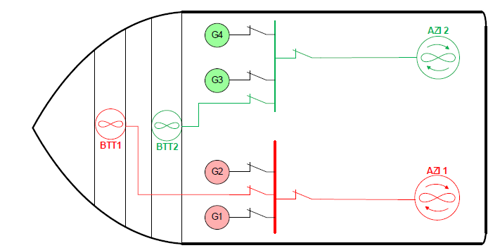
Figure one – Power Configuration Prior to Event
Not long into the operation alarms were activated on the vessels management system indicating that there was a low fuel pressure on the port fuel system, the alarms were accepted and cleared, however they became more frequent. The duty engineer called the bridge and enquired how long the operation would last, they were informed that there were only two lifts left. The decision was made to continue the cargo operation and investigate once the vessel had completed and moved out of the 500m Zone.
The alarms continued, however after a short time further alarms reported low frequency of both Bus sections along with dimming lights, shortly afterward the vessel blacked out.
At the time of the black out the vessel deck crew had just connected the last container to the rig crane, with the vessel in drift off and the marginal weather conditions, the vessel drifted rapidly causing the container to drag across the deck and snagging on the vessel sides before the rig crane operator attempted to lift the container clear. When the crane operator understood the situation, they tried to lift however due to the container snagging, the lifting strop failed.
The vessel was left blacked out and drifting uncomfortably beam onto the swell, it took over 30 minutes for the vessel crew to restore power and propulsion, in that time a lot of damage was inflicted on the vessel due to the uncomfortable motion.
What happened?
The vessel was operating open bus, it wouldn’t be unreasonable for the reader to assume all services were also split to provide independence and redundancy, and this was certainly what the vessel crew also assumed.
However, 24 hours earlier the vessel had a crew change, the off-signing crew failed to inform the on-signing crew that during their trip they had an issue with the starboard fuel system. The issue could not be immediately fixed as a part was required, so the vessels engineering staff cross connected the fuel systems forming a common system.
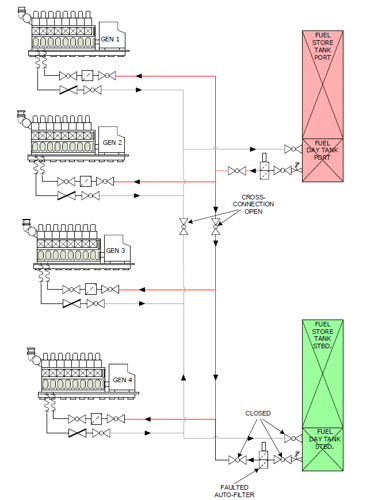
Figure two – Fuel system configuration at time of event
What can be concluded?
A number of conclusions can be drawn:
- No formal documenting of the issues with the fuel system
- No formal handover – the on signing crew unaware of changes, the crew change was literally a handshake due to travel arrangements.
- Field arrival Trials – are they suitable?
- Field arrival check lists – Did not pick up the cross connection.
- ASOG was effectively null void without the knowledge of the changes.
Management of change
There was a significant change of system operation for a major system. Why was this not formally captured and documented? The vessel owners were unaware that the starboard fuel system could not be configured independently, this defeated the redundancy concept of the vessel.
IMCA HSSE001 gives guidance on Management of Change.
Complacency
We must address the use of arrival/DP check lists. In this case the vessel had a comprehensive set of field/pre-DP checklists for both the bridge team and the engine room team. These checklists ask the user pertinent questions to assist in checking the status of the vessels redundancy and ability to survive a single point failure. Unfortunately, due to the repetitive nature of the process complacency can creep in and boxes are ‘ticked’ without a proper check.
Complacency is defined as a condition of being content with oneself or one’s circumstances, particularly when coupled by a lack of awareness of genuine threats or limitations. It can be risky since it causes people to become less cautious and more prone to making mistakes.
It is important to be aware of complacency and to take steps to avoid it. Complacency is a dangerous thing, but it is something that can be avoided. By being aware of complacency and by taking steps to avoid it, you can stay motivated and successful.
Latest DP incidents
-
Know your equipment, or at least where to find the answers
During an update in the Follow Target Mode, the crew noticed an anomaly with joystick control.
DPE 02/26
1 September 2026
Observation
-
New equipment, unexpected consequences
During the operation, a loss of DGNSS correction signals was experienced across multiple vessel DGNSS units.
DPE 02/26
1 September 2026
Incident
-
A chain of small failures leads to a major consequence
While conducting cargo operations on DP a vessel experienced a partial blackout caused by an unexpected shutdown of generator 3
DPE 02/26
1 September 2026
Incident
-
Holding position, losing references
While approaching a turret-moored, weather-vaning offshore installation (FPSO), in preparation for cargo operations, a DP equipment class 2 vessel experienced significant rolling of up to 15–20° due to a long-period swell close to the vessel’s natural roll period, resulting in a resonance effect
DPE 02/26
1 September 2026
Observation
-
DP drill scenario – Loss of seawater cooling pump redundancy
Exercise scenario – Loss of seawater cooling pump redundancy
DPE 02/26
1 September 2026
Drill Scenario
The case studies and observations above have been compiled from information received by IMCA. All vessel, client, and operational data has been removed from the narrative to ensure anonymity. Case studies are not intended as guidance on the safe conduct of operations, but rather to assist vessel managers, DP operators, and technical crew.
IMCA makes every effort to ensure both the accuracy and reliability of the information, but it is not liable for any guidance and/or recommendation and/or statement herein contained.
Any queries should be directed to DP team at IMCA. Share your DP incidents with IMCA online. Sign-up to receive DP event bulletins straight to your email.