High potential dropped object - cradle falls from trailer
- Safety Flash
- Published on 12 January 2026
- Generated on 10 October 2026
- IMCA SF 01/26
- 3 minute read
A large “cradle insert” weighing many tonnes fell off a trailer during a lifting operation.
What happened?
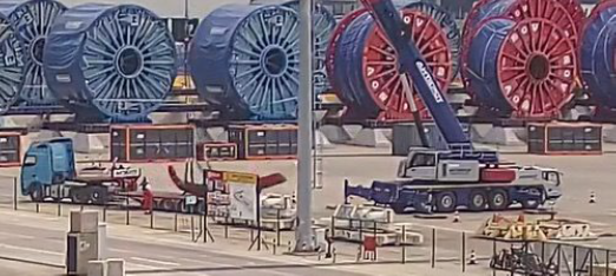
The incident occurred during the offloading of two the cradle inserts from a vessel alongside. The cradle inserts were secured together with cargo straps and rigged with a 4-legged chain bridle. As the crane operator began lifting, the inserts then unexpectedly fell off the right side of the trailer before the rigging was fully tensioned, landing near the crane.
There were no injuries nor equipment damage; however, four personnel were in the immediate area of the dropped cradles. Our member is treating this dropped object near miss incident as having had the potential to have caused serious Injury or fatality.
|
CCTV footage showing the cradle insert falling from trailer |
|
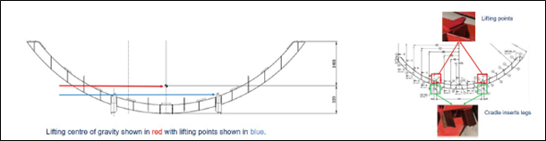
Showing the centre of gravity and associated supports/lifting points |
What went wrong?
- Crew were in the line of fire, because the lift was not planned and managed effectively.
- Clearly understood communications protocols were not established.
- Inadequate communication between the lift banksman and crane operator led to the lift not being stopped in time, resulting in sling interference.
- The banksman was also acting as a rigger rather than keeping an oversight of safety.
- The poor stability/high centre of gravity of the load went unrecognised as a risk; this led to the load being stored vertically with minimal contact on the trailer and made them highly likely to fall.
- Securing straps were removed prematurely, leaving the load unsecured during a critical phase of the lift.
Root causes
- Insufficiently thorough or detailed lift planning, which failed to assess the load’s complexity and stability. The upright storage method wasn’t critically reviewed, and assumptions were made without reassessment.
- Flawed design of the cradle insert, which had minimal support, making it unstable when upright.
- Incomplete and inaccurate lift documentation. Critical data like centre of gravity and rigging details were missing or wrong, causing poor decisions.
Lessons
- Ensure appropriately thorough, specific, and detailed lift planning.
- Take special care when planning the lift for objects that may initially look simple – be aware of hidden complexity;
- At design level, ensure lifting points and Centre of Gravity are clearly marked on drawings.
- At the point of lifting, ensure that the Centre of Gravity and geometry of the lifted object are fully understood by everyone involved in the lifting operation.
- Check – what are your escape routes and safe zones?
- Establish clear communication protocols.
- The banksman should never act as a rigger.
Members may wish to refer to
· HSS 019 Guidelines for lifting operations
Related Safety Flashes
-
IMCA SF 23/21
19 August 2021
-
-
IMCA SF 22/23
12 September 2023
-
-
IMCA SF 28/23
6 December 2023
IMCA Safety Flashes summarise key safety matters and incidents, allowing lessons to be more easily learnt for the benefit of the entire offshore industry.
The effectiveness of the IMCA Safety Flash system depends on the industry sharing information and so avoiding repeat incidents. Incidents are classified according to IOGP's Life Saving Rules.
All information is anonymised or sanitised, as appropriate, and warnings for graphic content included where possible.
IMCA makes every effort to ensure both the accuracy and reliability of the information shared, but is not be liable for any guidance and/or recommendation and/or statement herein contained.
The information contained in this document does not fulfil or replace any individual's or Member's legal, regulatory or other duties or obligations in respect of their operations. Individuals and Members remain solely responsible for the safe, lawful and proper conduct of their operations.
Share your safety incidents with IMCA online. Sign-up to receive Safety Flashes straight to your email.