Explosion and fire on-board the chemical tanker Stolt Groenland
- Safety Flash
- Published on 30 January 2020
- Generated on 25 August 2026
- IMCA SF 03/20
- 2 minute read
The UK Marine Accident Investigation Branch (MAIB) has published its interim report into a serious explosion and fire on-board the chemical tanker Stolt Groenland on 28 September 2019 at Ulsan in South Korea.
What happened?
The incident occurred during ship-to-ship transfer of highly flammable styrene monomer, one of 20 different chemical cargoes the vessel was carrying in 37 of its 39 cargo tanks.
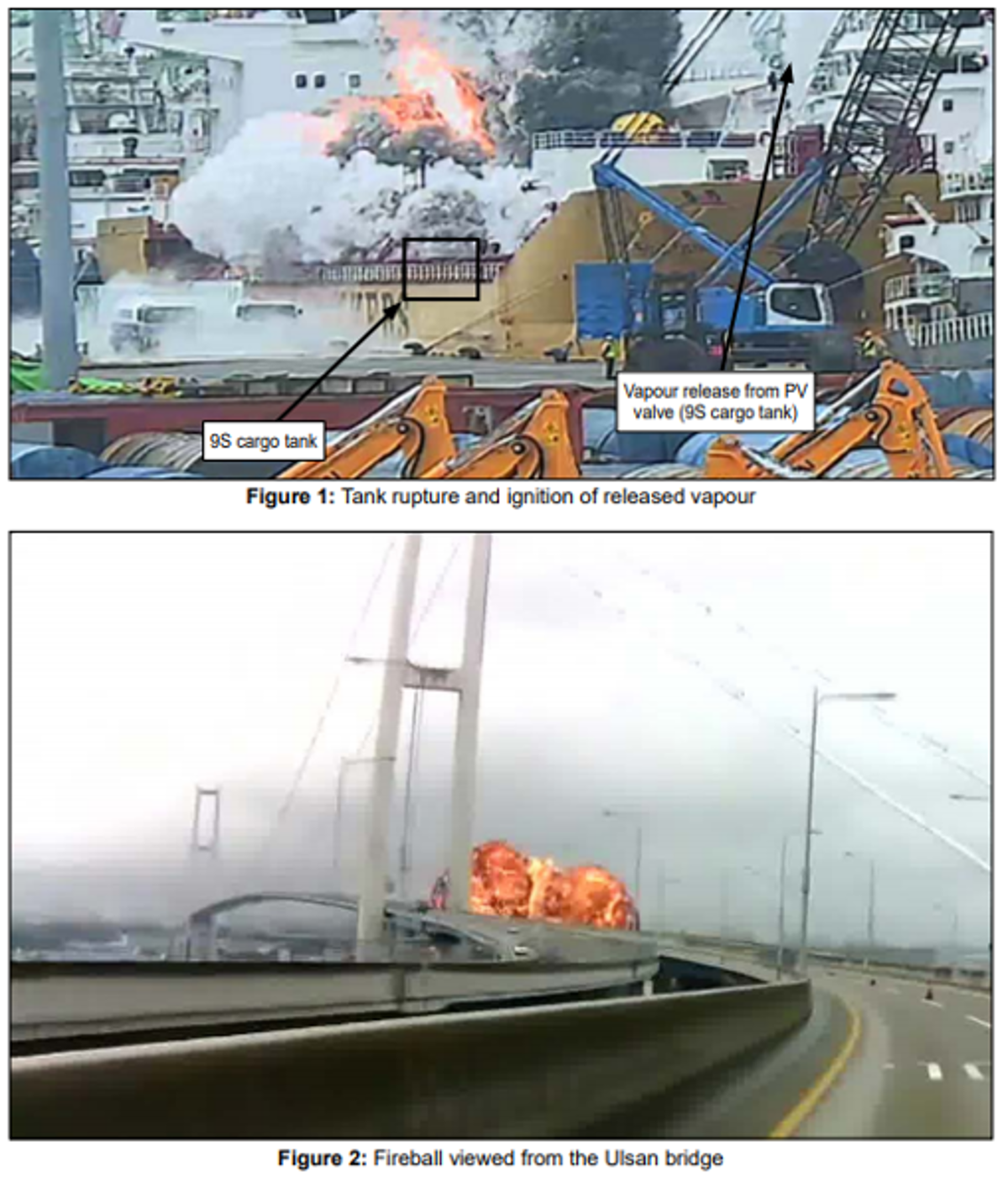
At 1043, vapour started to release from a pressure vacuum valve for the tank which contained styrene monomer. About two minutes later, a high-level alarm indicated that the level in the tank had reached 95%, soon followed by a ‘high-high’ level alarm indicating that the level had increased to 98%. By now, Stolt Groenland‘s on-watch deck officer and chief officer had made their way to the cargo control room.
At 1050, two explosions were seen and heard in rapid succession in way of the tanker’s cargo manifold. The resulting fireball passed very close to a road bridge above the quay.
The fire was fought from the shore and from the water and lasted until the early hours of the following morning. There was extensive damage to the vessel and a number of crew and firefighters were injured.
What went wrong?
The MAIB’s initial findings were that the explosions were probably caused by the rupture of the deck above the cargo tank, followed immediately by the ignition of the styrene monomer vapour that was then released.
The rupture was due to over-pressurisation and the likely sources of the ignition were static electricity, sparks or elevated steel deck plate temperatures resulting from the tank rupture.
The full interim report can be found here.
Related Safety Flashes
-
IMCA SF 23/19
30 September 2019
-
-
IMCA SF 09/12
4 September 2012
IMCA Safety Flashes summarise key safety matters and incidents, allowing lessons to be more easily learnt for the benefit of the entire offshore industry.
The effectiveness of the IMCA Safety Flash system depends on the industry sharing information and so avoiding repeat incidents. Incidents are classified according to IOGP's Life Saving Rules.
All information is anonymised or sanitised, as appropriate, and warnings for graphic content included where possible.
IMCA makes every effort to ensure both the accuracy and reliability of the information shared, but is not be liable for any guidance and/or recommendation and/or statement herein contained.
The information contained in this document does not fulfil or replace any individual's or Member's legal, regulatory or other duties or obligations in respect of their operations. Individuals and Members remain solely responsible for the safe, lawful and proper conduct of their operations.
Share your safety incidents with IMCA online. Sign-up to receive Safety Flashes straight to your email.