Near miss: potential dropped object left on top of cargo
- Safety Flash
- Published on 20 February 2018
- Generated on 27 October 2026
- IMCA SF 04/18
- 2 minute read
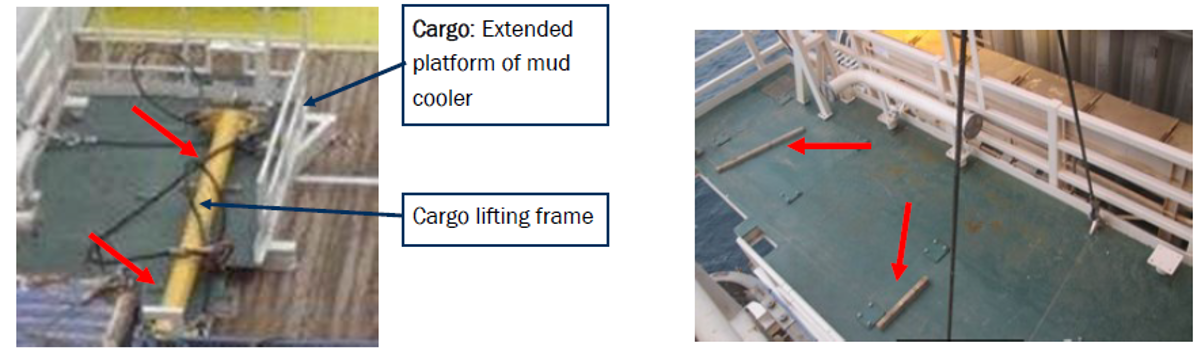
During deck cargo loading operations from a vessel to an offshore platform, two pieces of unsecured timber were inadvertently lifted from the vessel onto the platform, on top of the lifted cargo – a mud cooler module.
What happened?
This was discovered and reported by the deck foreman on the platform, who immediately informed all involved parties. There were no injuries or equipment damage.
What went wrong? What were the causes?
Investigation revealed that the two timbers were initially placed as dunnage under the lifting frame (“spreader bar”) after loading onto the vessel at the quayside. Third party shore-side stevedores originally placed them to prevent damage to the lifting frame and its slings being caused by movement during the voyage.
When the platform hooked the frame, it was anticipated (by the third-party workers) that the crew would go under the suspended load to remove the dunnage. However, the vessel crew correctly declined to do so and left the timbers in situ. However, the vessel crew did not identify the further hazard left by leaving the timbers on the roof of the mud cooler module.
What lessons were learnt?
In this specific case, a possible solution could have been a pre-lift for repositioning the spreader bar, allowing removal of the timbers by using a hands-off approach, using push/pull poles.
What actions were taken?
- Task risk assessments for lifting operations were reviewed to include risk and controls related to potential dropped objects while handling bulky/heavy loads where cargo lifting frames are used;
- Permit to work checklist was reviewed to include a specific requirement to check for potential dropped object (PDO) associated risks;
The incident, investigation and outcome to be shared with the quayside lifting authority, such that future lifting plans take into account the offshore environment.
Dropped objects from cargo are a significant source of incidents reported to IMCA and to other industry organisations including Step Change and the Marine Safety Forum (MSF).
Members may wish to remind their offshore personnel of the following guidance and promotional material:
Related Safety Flashes
-
IMCA SF 26/17
20 October 2017
-
-
IMCA SF 19/14
18 December 2014
IMCA Safety Flashes summarise key safety matters and incidents, allowing lessons to be more easily learnt for the benefit of the entire offshore industry.
The effectiveness of the IMCA Safety Flash system depends on the industry sharing information and so avoiding repeat incidents. Incidents are classified according to IOGP's Life Saving Rules.
All information is anonymised or sanitised, as appropriate, and warnings for graphic content included where possible.
IMCA makes every effort to ensure both the accuracy and reliability of the information shared, but is not be liable for any guidance and/or recommendation and/or statement herein contained.
The information contained in this document does not fulfil or replace any individual's or Member's legal, regulatory or other duties or obligations in respect of their operations. Individuals and Members remain solely responsible for the safe, lawful and proper conduct of their operations.
Share your safety incidents with IMCA online. Sign-up to receive Safety Flashes straight to your email.