Badly sprained ankle resulting in LTI
- Safety Flash
- Published on 8 May 2015
- Generated on 23 October 2026
- IMCA SF 06/15
- 3 minute read
A Member has reported an incident in which a person suffered a badly sprained ankle leading to an LTI.
What happened?
The incident occurred when the person was making his way from the wheelhouse to the galley via the external staircase. When he put his weight on the second step his foot slipped and he fell the remaining distance (approximately 2 metres) to the deck resulting in an ankle injury.
Initial first aid was provided on the vessel until the injured person could be taken to hospital. Subsequent medical assessment diagnosed a badly sprained ankle resulting in being unable to do any work for at least seven days. This was likely to be followed by a period of restricted work.
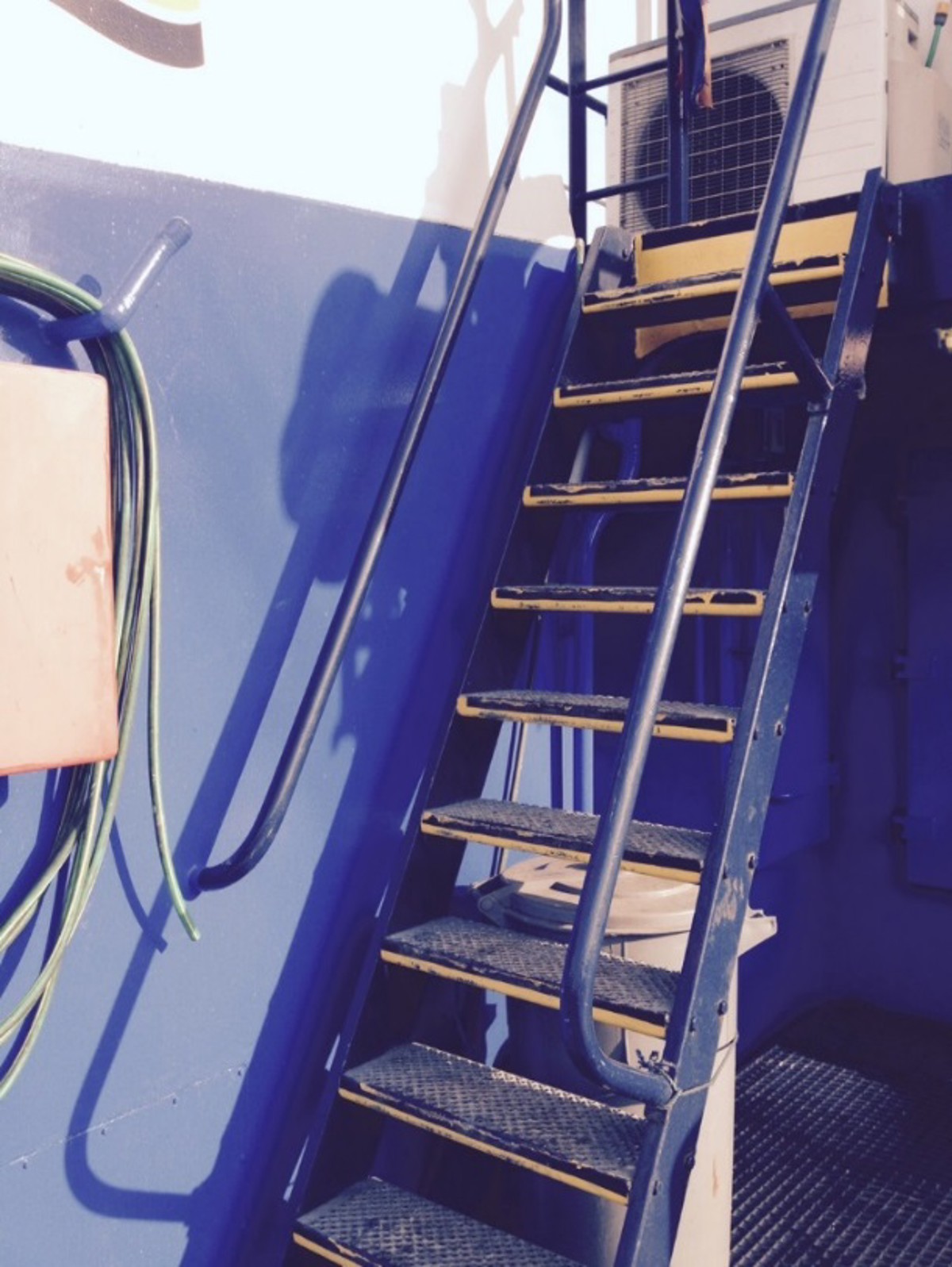
Step staircase outside onboard vessel
Our Member’s investigation noted the following:
- Conditions were wet at the time.
- Other than being wet, the steps were clean.
- The injured person fell without hitting any other steps on way down and took the full impact on his foot when he hit the deck.
- The injured person was descending facing away from steps.
- The design of the stair (approx. 40 degrees from vertical) meant that when descending in this manner, only the person’s heel could be placed on the tread.
- Steep stairs were not identified as a hazard on this vessel.
- The injured person was wearing correctly fitted, laced/zipped work boots with good tread, and was not carrying anything at the time of the fall.
The following lessons were learnt:
- Although risk assessments for the project covered all operational tasks they did not extend to cover descending stairways.
- No warnings signs were in place identifying the steep stairway or the need to use the hand rail.
The support provided by the correctly worn work safety boots may have limited the extent of the ankle injury.
Recommendation and corrective action:
- Individuals should always consider the safest method of descending stairs before doing so.
- Stairways to be kept clean, and where possible, non-slip treads/nosings fitted.
- ‘Caution steep stairway use handrails’ signage fitted.
- The fact that you have not been told how to descend the stairs does not remove the need for you to assess your own safety before descending, and decide how to descend the stairway.
- Ensure hazards not directly linked to operational tasks, are considered and addressed in the workplace, and included in vessel induction for all crew, client personnel and passengers.
- Ensure that work boots and all other PPE is fitted and worn correctly.
Related Safety Flashes
-
IMCA SF 17/14
31 October 2014
IMCA Safety Flashes summarise key safety matters and incidents, allowing lessons to be more easily learnt for the benefit of the entire offshore industry.
The effectiveness of the IMCA Safety Flash system depends on the industry sharing information and so avoiding repeat incidents. Incidents are classified according to IOGP's Life Saving Rules.
All information is anonymised or sanitised, as appropriate, and warnings for graphic content included where possible.
IMCA makes every effort to ensure both the accuracy and reliability of the information shared, but is not be liable for any guidance and/or recommendation and/or statement herein contained.
The information contained in this document does not fulfil or replace any individual's or Member's legal, regulatory or other duties or obligations in respect of their operations. Individuals and Members remain solely responsible for the safe, lawful and proper conduct of their operations.
Share your safety incidents with IMCA online. Sign-up to receive Safety Flashes straight to your email.