Wind farm service vessel in collision with wind turbine foundation
- Safety Flash
- Published on 19 July 2013
- Generated on 27 October 2026
- IMCA SF 12/13
- 2 minute read
A Member has reported an incident in which a wind farm service vessel collided with a turbine foundation, after failure of the vessel jet drive.
What happened?
The incident occurred after the vessel had disembarked passengers at the sub-station and had reversed away to drift, whilst standing by for the next assignment. The jets were disengaged and engines left running, as was common practice. Under the influence of currents, the vessel drifted towards another turbine foundation and when approximately 30m away, the vessel coxswain/skipper attempted to engage the jets. At this moment it was found that neither jet would engage. Several minutes were spent fault finding to no avail, after which the vessel coxswain/skipper assisted the deckhand with fenders. The vessel collided with the foundation, causing a buckled frame and bent plate in the port quarter bulwark, but no damage to the foundation.
Later the same day, the problem re-occurred and the vessel returned to port. Since that time, the problem had not re-appeared. Client and office were only informed after the second failure, when the vessel was returning to port.
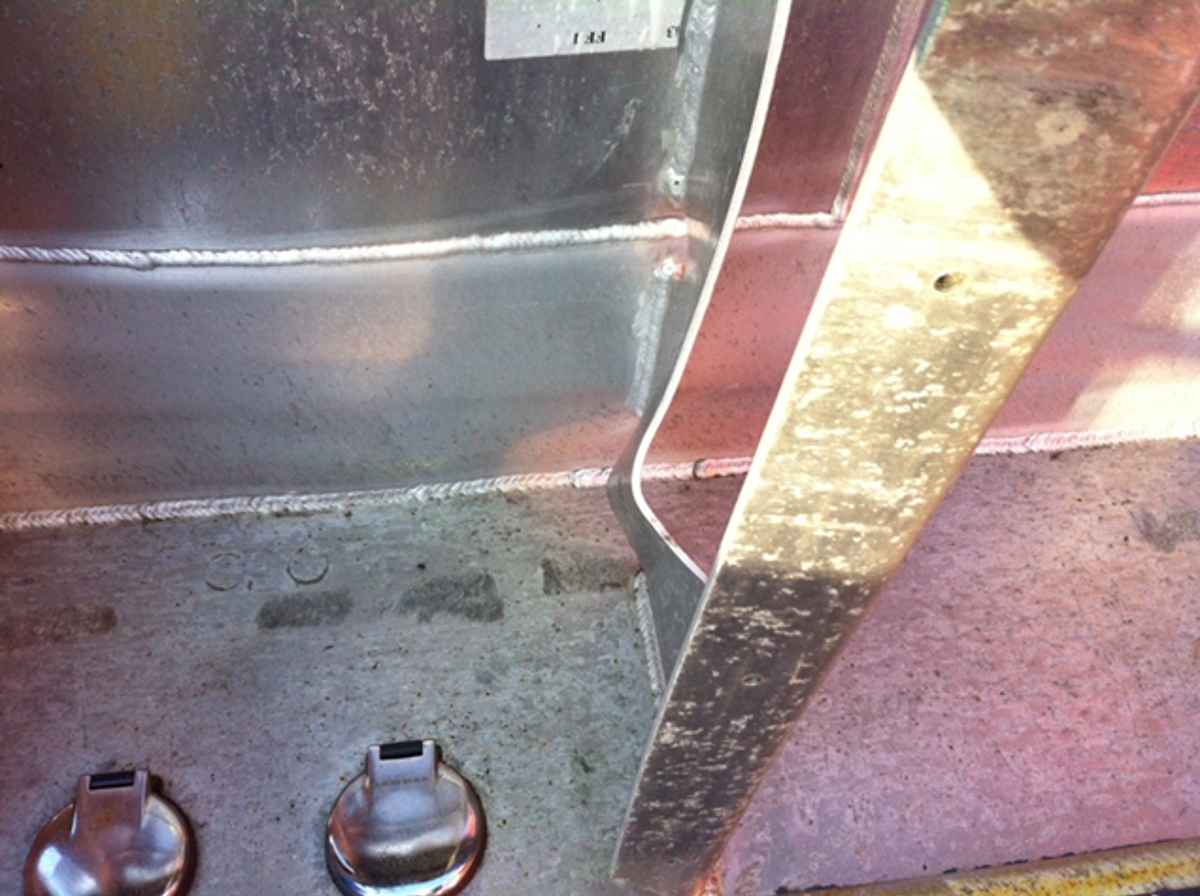
buckled frame and bent plate, as a result of collision between wind farm service vessel and turbine foundation
What were the causes?
During investigation, the following points were noted:
- It was common practice for wind farm vessels to be allowed to drift in field, whilst waiting for work.
- There was no guidance from the wind farm operator (the client) on a minimum distance of approach to offshore structures while drifting.
- At the speed the wind farm vessel was drifting, 30m was not sufficient distance to allow enough time to re-start the jets or to anchor.
- The jet drives re-engaged, once they had been completely shut down and re-started.
Lessons learnt
Our Member drew the following lessons from the incident:
- Following any incident, the company office and client should be informed immediately, if necessary using satellite telephone.
- Jet drives should be engaged when within 100 m of an offshore structure, unless the wind farm service vessel is at anchor or tied off.
- Following this incident, the wind farm client now allows wind farm service vessels to tie off on to foundations when waiting on work.
IMCA Safety Flashes summarise key safety matters and incidents, allowing lessons to be more easily learnt for the benefit of the entire offshore industry.
The effectiveness of the IMCA Safety Flash system depends on the industry sharing information and so avoiding repeat incidents. Incidents are classified according to IOGP's Life Saving Rules.
All information is anonymised or sanitised, as appropriate, and warnings for graphic content included where possible.
IMCA makes every effort to ensure both the accuracy and reliability of the information shared, but is not be liable for any guidance and/or recommendation and/or statement herein contained.
The information contained in this document does not fulfil or replace any individual's or Member's legal, regulatory or other duties or obligations in respect of their operations. Individuals and Members remain solely responsible for the safe, lawful and proper conduct of their operations.
Share your safety incidents with IMCA online. Sign-up to receive Safety Flashes straight to your email.